When you close a flip cover with a magnet inside over a smartphone, the screen turns off by itself. How does the phone know the cover is closed? The secret lies in a phenomenon in which an electric current, near a magnet, crowds to one side and creates a tiny voltage. That phenomenon is the Hall effect.
Put simply, the Hall effect means ‘when a magnetic field is applied at right angles to a conductor carrying a current, a voltage appears sideways, perpendicular to both the current and the field.’ It is named after Edwin Hall, a graduate student at Johns Hopkins University in the United States, who discovered it in 1879 while testing a question posed by his advisor, Henry Rowland.
In this article, we will look in turn at how the Hall effect was discovered, the principle behind the sideways voltage, the Hall sensors hidden all around us, and finally the uses that led to a Nobel Prize and to space thrusters.
A voltage made by a current pushed aside in a magnetic field: everything about the Hall effect
1. A new action found with a single sheet of gold leaf
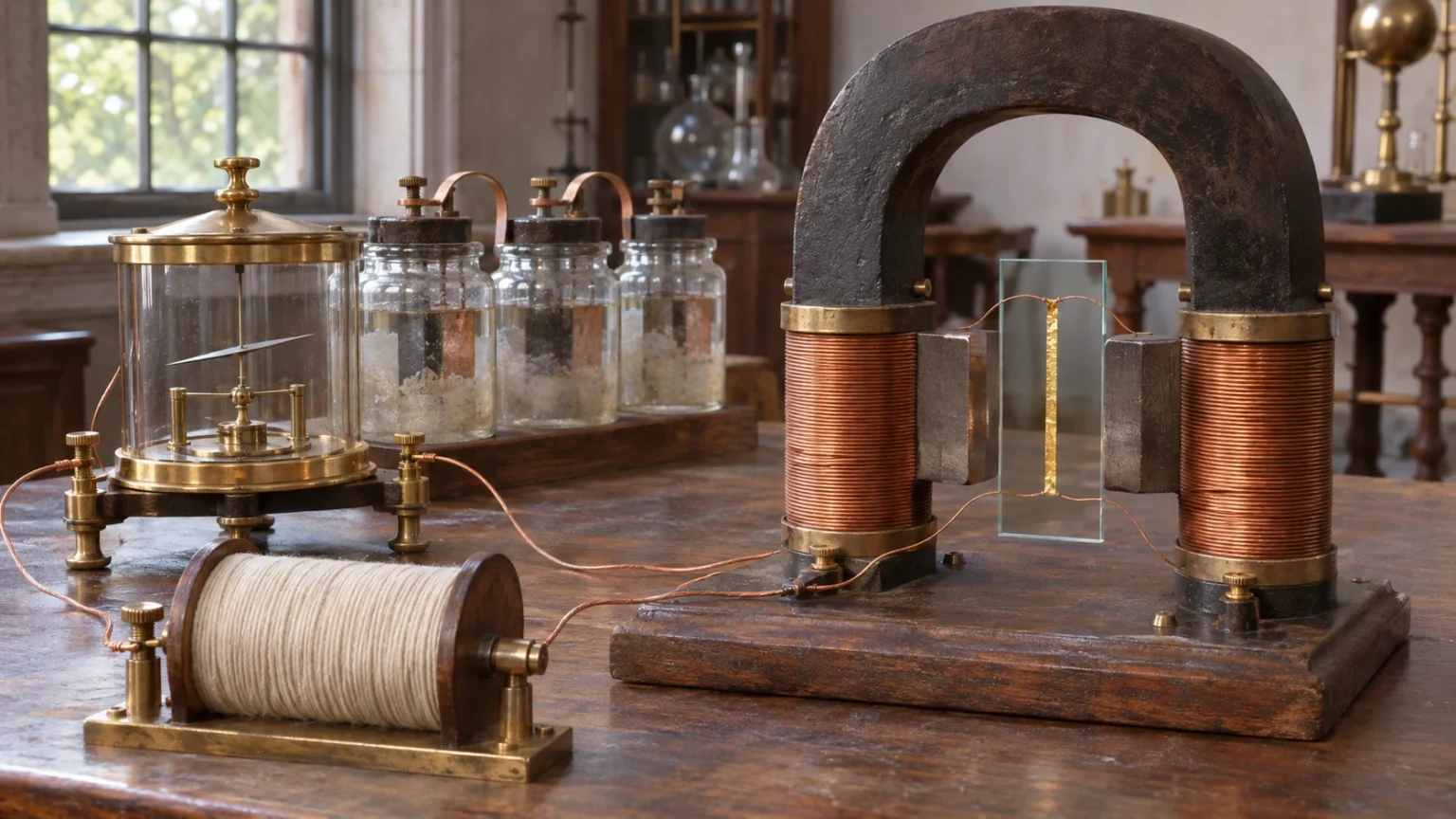
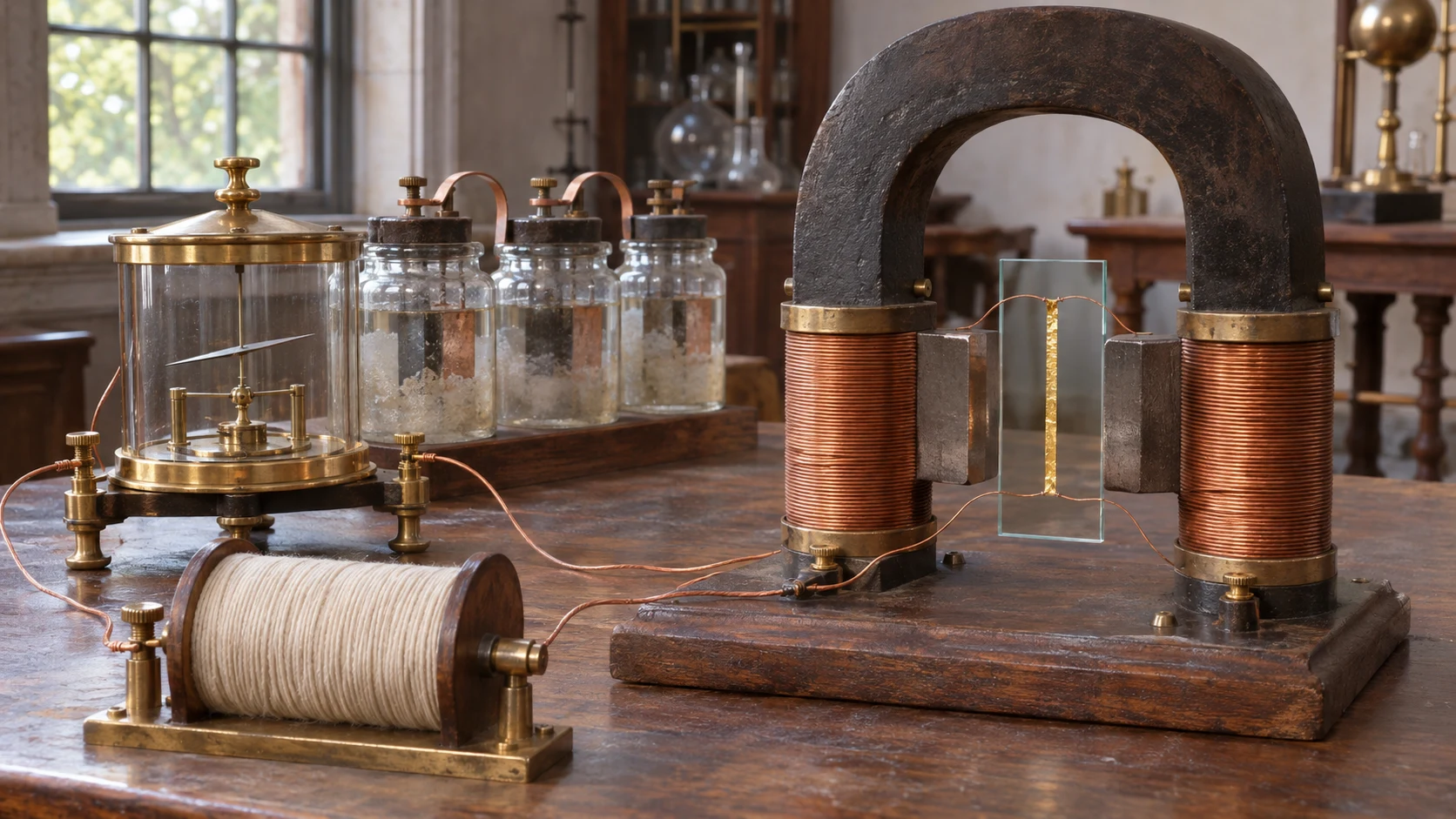
When Hall did his experiment, no one yet knew what an electric current was made of. He wanted to find out whether a magnet acts directly on the current flowing inside a wire, rather than on the wire itself.
(1) Rowland’s question
It was known that a wire in a magnetic field feels a force, but no one had confirmed whether that force pushes the current toward one side of the conductor. Rowland suggested placing a current-carrying metal strip between the poles of an electromagnet and measuring the potential difference across its two sides.
(2) Thin gold leaf instead of a thick plate
The thick metal plate used at first showed no change at all. At Rowland’s suggestion, Hall mounted thin gold leaf on a glass plate, and on October 28, 1879, the galvanometer needle moved distinctly when the electromagnet was switched on; when the magnet was reversed, the needle moved the other way.
(3) A trace found before the electron
That same year, Hall published “On a New Action of the Magnet on Electric Currents” in the American Journal of Mathematics. This was 18 years before the electron was discovered, and catching such a faint signal was a remarkable feat of experimental skill for the time.
2. A voltage created as charges crowd to one side
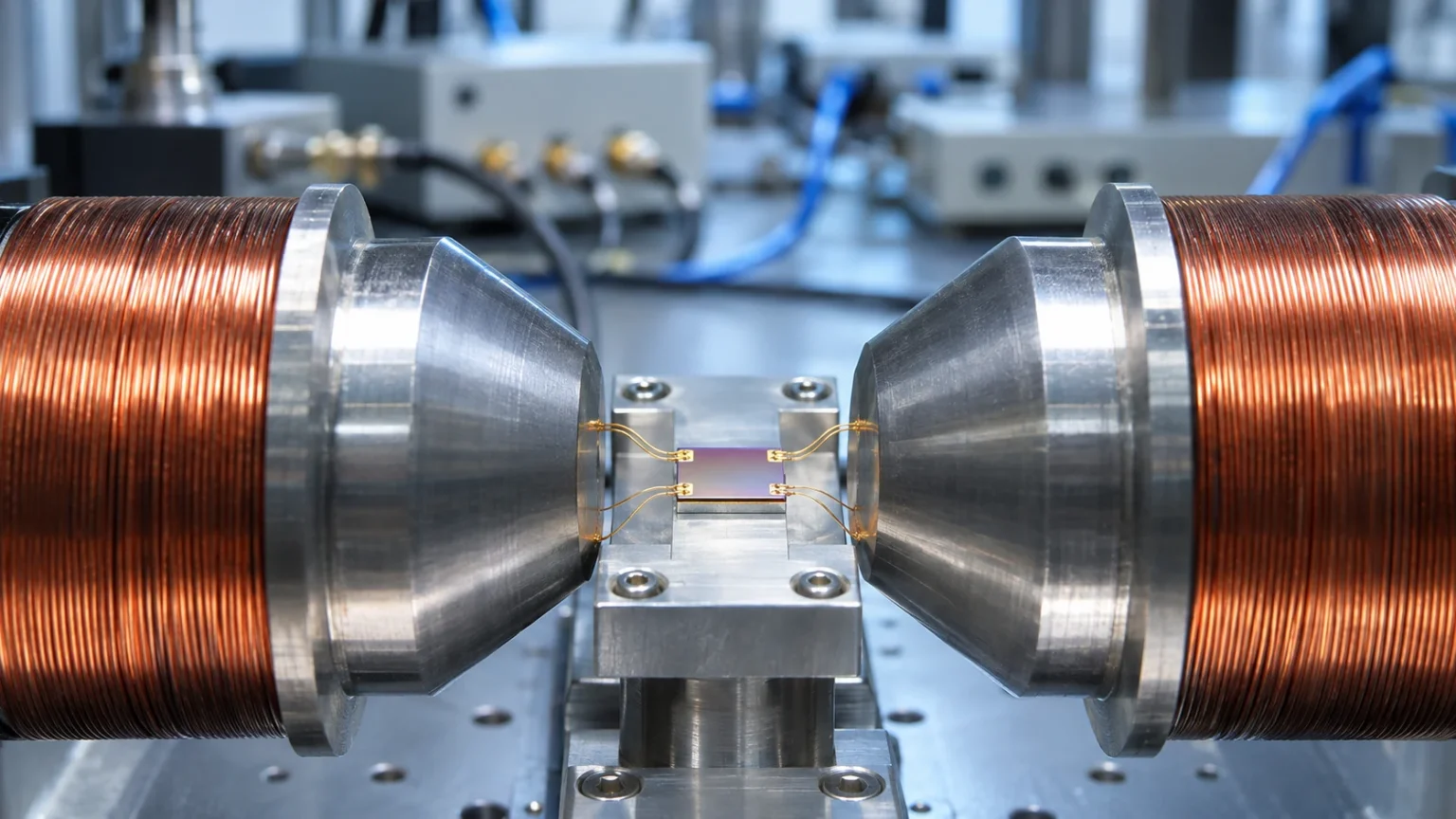
The principle is explained by the force a moving charge feels in a magnetic field. As in the figure below, when a magnetic field is applied at right angles to a thin plate carrying a current, the charges are pushed toward one edge of the plate and a voltage appears between its two sides.
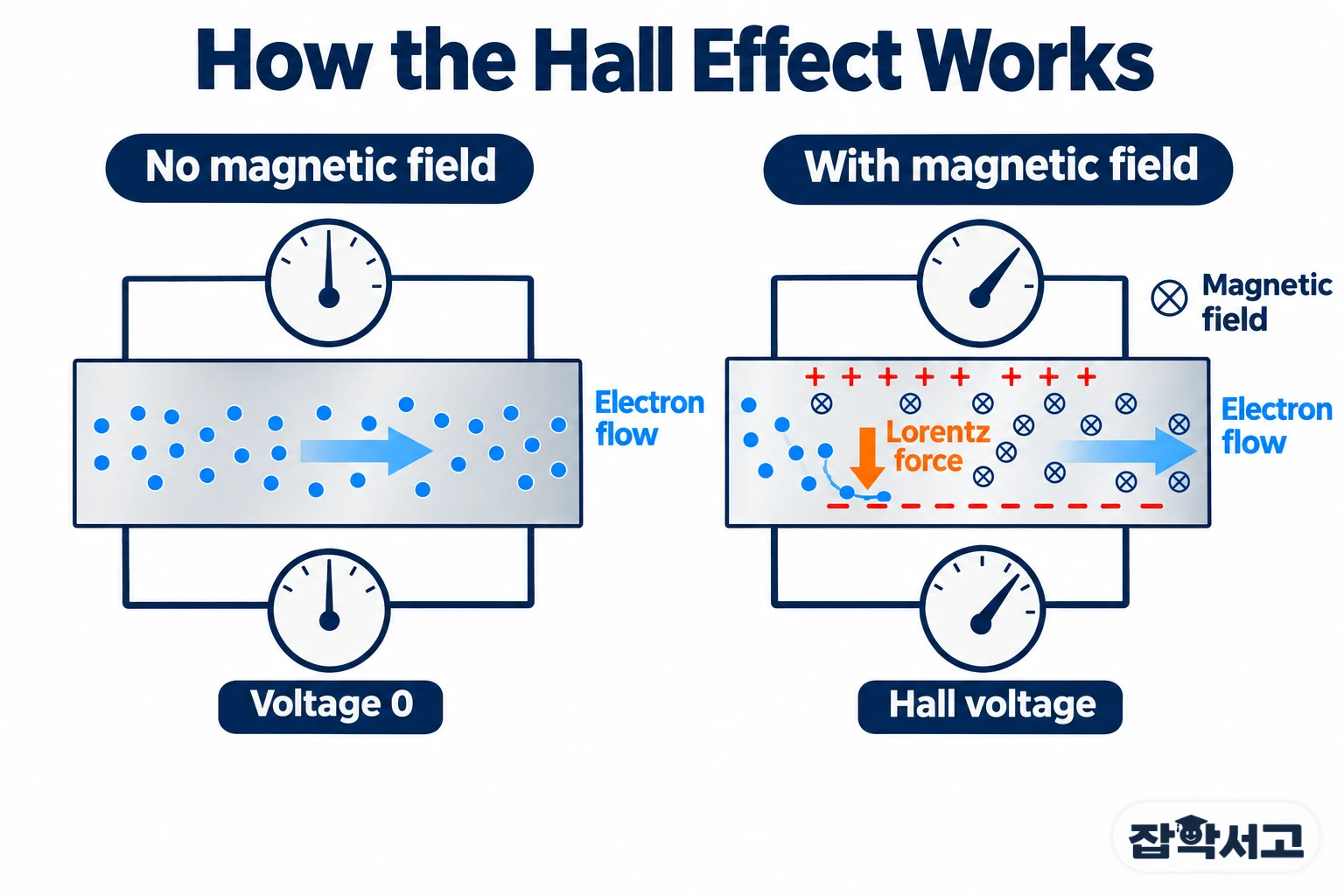
- Lorentz force: the force a charge moving in a magnetic field feels in a direction perpendicular to both its motion and the field.
- Hall voltage: the voltage that appears in the direction perpendicular to both the current and the magnetic field, that is, between the two sides of the conductor.
- Hall coefficient: a value that expresses how strong the Hall effect is in a given material, revealing the density and sign of its charge carriers.
- Charge carrier: the electron or hole that actually moves inside a conductor and carries the current.
- Hole: a vacancy left where an electron has gone missing in a semiconductor, which behaves like a positively charged particle.
(1) Until the forces balance
As charges pile up on one edge, they create an electric field that pushes back. The moment the magnetic force and this electric force become equal, no more charge accumulates, and the steady voltage between the two sides at that point is the Hall voltage.
(2) Thinner, with fewer carriers, means bigger
The Hall voltage grows with a stronger current and magnetic field, and shrinks when the plate is thicker or has more charge carriers. That is why semiconductors, which have few carriers, give a much larger voltage than metals, which have a great many, and sensors are mostly made from semiconductors.
(3) The sign reveals who the carriers are
The direction of the voltage flips depending on whether the charges carrying the current are negative or positive. In most metals the result shows that electrons carry the current, but in some p-type semiconductors the opposite direction appears, revealing holes that move like positive charges.
3. From mobile phones to car wheels: Hall sensors

A component that uses the Hall effect to detect a magnetic field is called a Hall sensor. Because it picks up a signal without touching the magnet, it does not wear out and resists dust, so hundreds of millions are made every year and built into countless devices.
(1) Knowing open, closed and position
A smartphone uses a Hall sensor to detect the small magnet in its cover approaching and turns off the screen. The same principle tells whether a laptop lid is open or shut, where a machine part is, and how far a game controller’s analog stick is tilted.
(2) Counting rotation speed
Attach a magnet to a wheel or shaft, and a signal comes out with every turn, giving the rotation speed. Typical examples are wheel-speed sensing in a car’s anti-lock braking system (ABS) and brushless DC motor control, which switches the current to match the rotor’s position.
(3) Measuring current and direction without contact
By measuring the magnetic field around a wire, you can know how strong the current is without breaking the circuit. A Hall sensor that senses the Earth’s magnetic field can also serve as the electronic compass in a mobile phone.
4. A Hall effect that led to a Nobel Prize and into space

A hundred years after its discovery, the Hall effect showed an entirely new face under extreme conditions, and today its name is even part of the engines of satellites flying through space.
(1) Resistance divided into steps
In 1980, Germany’s Klaus von Klitzing showed that, at very low temperatures and in strong magnetic fields, the Hall resistance of a thin semiconductor layer does not change smoothly but stops at fixed values like the steps of a staircase. For this quantum Hall effect he received the 1985 Nobel Prize in Physics.
(2) A resistance standard that is the same everywhere
The values of these steps are set only by the Planck constant and the electron charge, regardless of the shape or material of the sample. So from 1990 the von Klitzing constant of 25,812.807 ohms served as the international reference value for electrical resistance, and when the 2019 revision of the International System of Units fixed those two constants at exact values, this constant also became a value with no uncertainty.
(3) Hall thrusters that push satellites
Hall thrusters, which shoot ions out at high speed using an electric field created by electrons trapped in a magnetic field, first flew in December 1971 on the Soviet Union’s Meteor satellite. Today Starlink satellites also keep their orbits with Hall thrusters that use krypton or argon.
The simple idea that bringing a magnet close makes a current step aside and leave a voltage behind—that is the first step to understanding the Hall effect.