Turn the ignition knob on a gas stove and, with a “click,” a small spark jumps. With no battery and no wall outlet, the force of a finger pressing a button alone produces the spark. What on earth is happening inside this small device?
The secret lies in a special piece of crystal. In certain solids, electric charge builds up on the surface the moment they are pressed or stretched, and this phenomenon is called the “Piezoelectric Effect.” The key point is that the path from force to electricity and the path from electricity back to force are both contained in a single material.
In this article, we will look in turn at how the piezoelectric effect arises, the meaning contained in its name, the reverse effect in which applying electricity changes the body of the material, and its uses in igniters, clocks, sonar, and ultrasound.
How Crystals Trade Force for Electricity
A Crystal That Builds Up Electricity When Pressed

The piezoelectric effect does not appear noticeably in every material; it stands out in materials whose crystals have a special arrangement of particles.
(1) How charge shifts to one side
Inside a crystal, particles carrying positive and negative charge are lined up in a regular pattern. When the crystal is pressed and its shape is squeezed out of true, the centers of the positive and negative charges slip slightly out of alignment, and as a result opposite charges gather on two opposing faces of the crystal.
(2) The condition of lacking symmetry
If a crystal is perfectly symmetric from top to bottom or side to side, the shift of charge cancels itself out even when the crystal is deformed. For this reason, the piezoelectric effect appears only in crystals that lack a center of symmetry. Quartz is the classic example, and it is known to appear weakly in sugar and in biological materials such as bone as well.
(3) The meaning in the name
The word “piezo” comes from the ancient Greek word meaning “to press” and the word meaning “amber.” Amber is a gemstone that generates static electricity when rubbed, so it was used as a symbol of electricity, and the name “electricity from pressing” was given in 1881 by the German Wilhelm Hankel.
A Road That Runs the Other Way Too
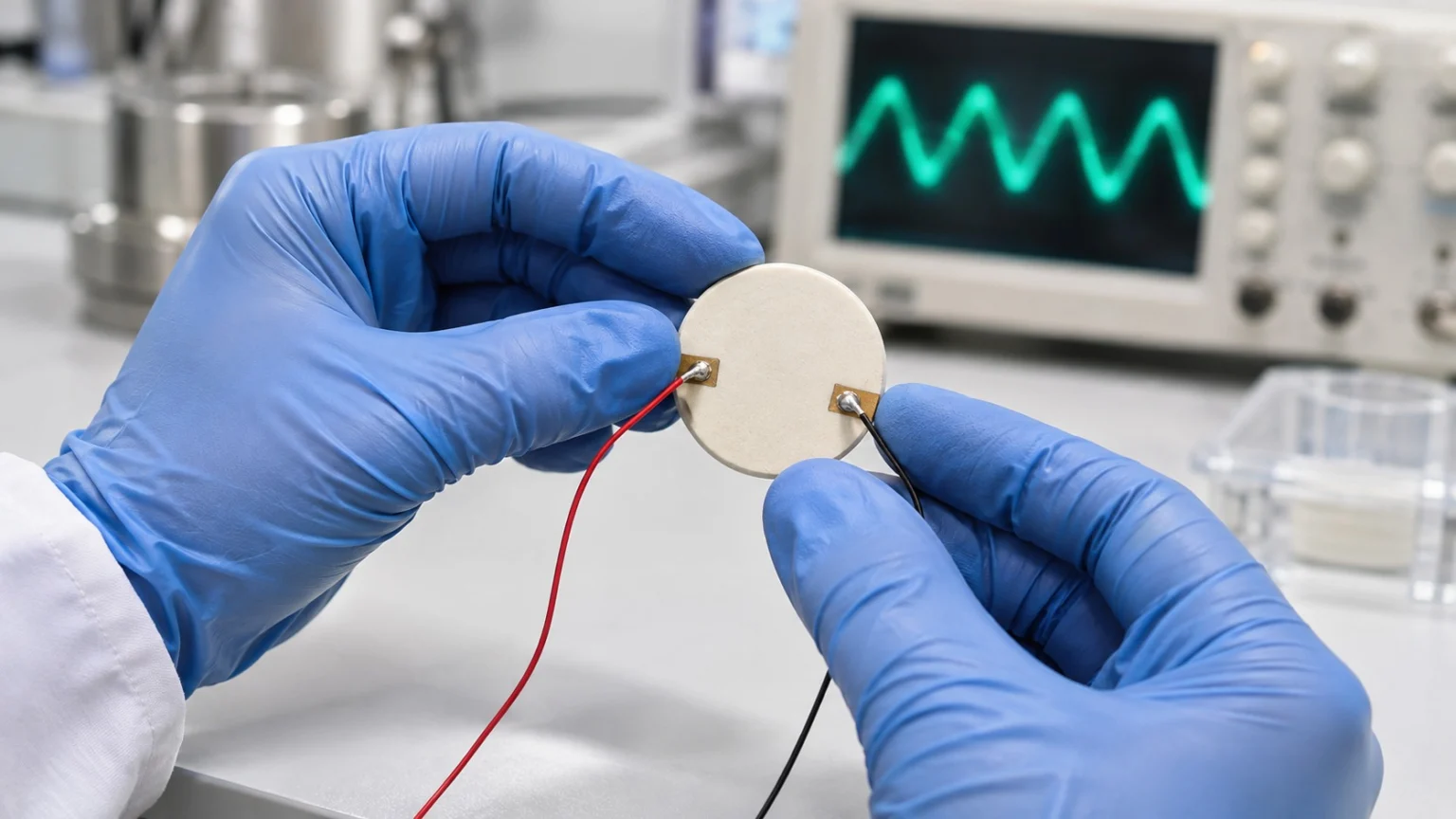
The piezoelectric effect does not occur in only one direction. If there is a path where pressing yields electricity, there is also a path where putting in electricity changes the body.
(1) The direct and the converse piezoelectric effect
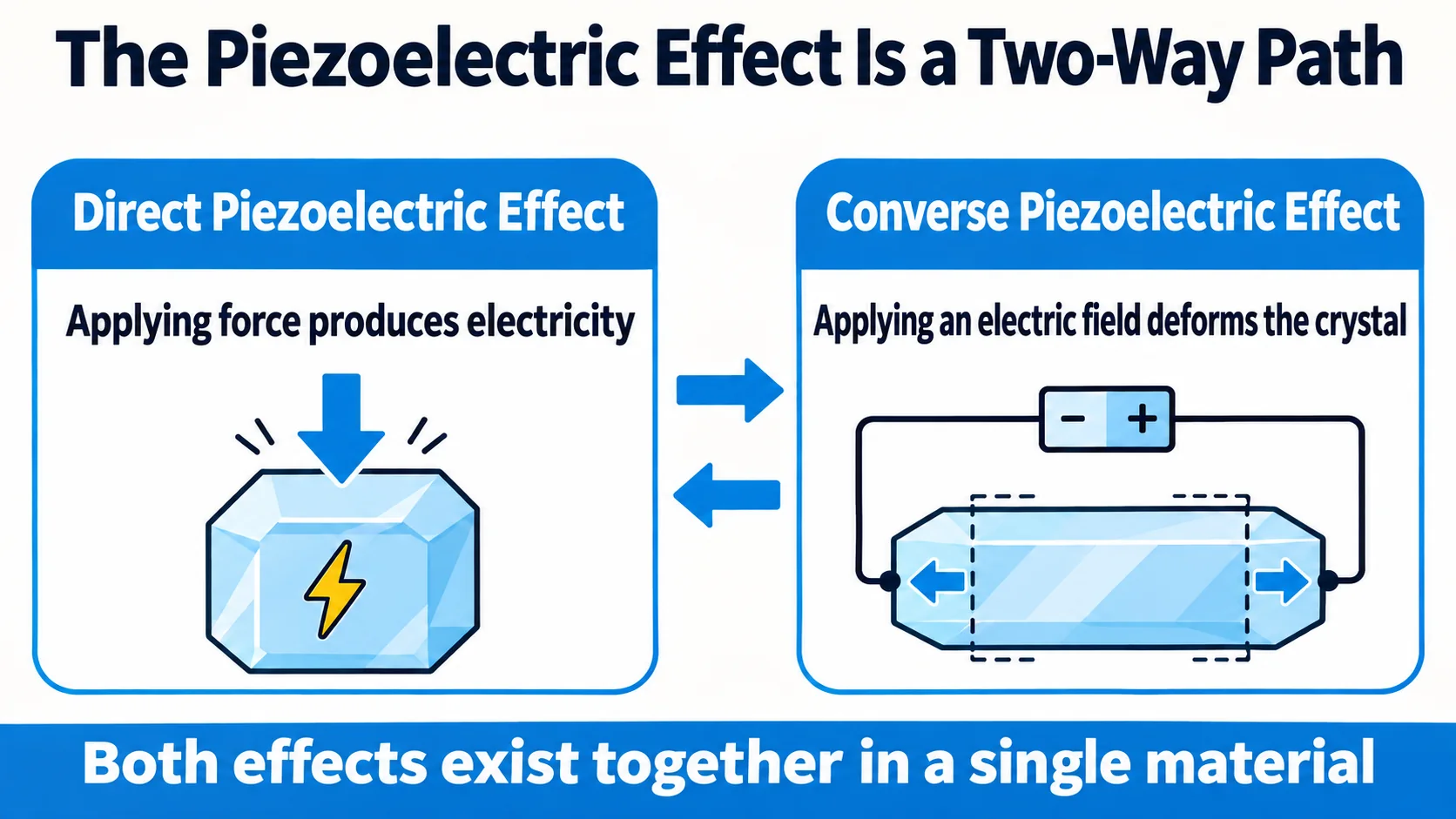
Obtaining electricity by applying force is called the direct piezoelectric effect, and deforming a crystal by applying an electric field is called the converse piezoelectric effect. The two effects are contained together in a single material, and depending on the use, one or the other is chosen.
(2) The discovery by the Curie brothers
In 1880, the French brothers Pierre and Jacques Curie first demonstrated the direct piezoelectric effect in crystals such as tourmaline, quartz, and Rochelle salt. The following year, Gabriel Lippmann pointed out in theory, using the principles of thermodynamics, that an effect in the opposite direction must exist, and the Curie brothers soon confirmed it by experiment.
(3) A very small change
Lead zirconate titanate (PZT), one of the piezoelectric ceramics, produces a measurable amount of electricity even when its size changes very slightly, by less than 0.1 percent. Conversely, when electricity is applied, its size changes by around 0.1 percent at most, which is very small, but that is exactly what makes it possible to handle very fine movements with precision.
Piezoelectric Elements Hidden in Everyday Life

Piezoelectric elements are used closer to home than you might think. It is easy to understand if you divide them into those that turn pressing force into electricity and those that use electricity to create vibration.
- Igniter: When you press the button, a small spring-loaded hammer strikes a piezoelectric crystal, and the high voltage produced in an instant makes a spark jump across a narrow gap and burn the gas.
- Quartz Clock: When voltage is applied to a piece of quartz, it vibrates steadily at a rate set by the shape of the crystal, and this regular vibration becomes the signal for counting time. Wristwatches usually use quartz that vibrates 32,768 times per second.
- Microphone and Pickup: When the vibration of sound presses on a piezoelectric element, an electric signal is produced in proportion to its strength, and this is used in electric guitar pickups and contact microphones.
- Inkjet Printer: Some printers apply electricity to a piezoelectric element and use the force of its deformation to push ink out in very small droplets.
Uses That Widened From Sonar to the Microscope

For a long time the piezoelectric effect was a curious phenomenon confined to the laboratory, but after the first practical product appeared, its range of uses widened quickly.
(1) The first practical use, sonar
In 1917, during the First World War, Paul Langevin of France and his colleagues fired ultrasound with a device made of thin slices of quartz bonded between steel plates and used it to find submarines. Sonar, which measures distance by the time it takes sound to return, was the first practical use of the piezoelectric effect.
(2) The arrival of stronger materials
Around the time of the Second World War, researchers in the United States, the Soviet Union, and Japan discovered synthetic materials called ferroelectrics. Ceramics such as barium titanate and PZT, whose piezoelectric effect is dozens of times larger than that of natural crystals, spread widely afterward, and even today most probes in medical ultrasound diagnostic equipment use piezoelectric elements.
(3) Fingertips that read atoms
The scanning probe microscope, which sees atoms one by one, makes use of the converse piezoelectric effect. By changing the voltage by a tiny amount, it moves the probe with a precision finer than a micrometer.
(4) A challenge still unsolved
There were also attempts to collect electricity from the steps taken while walking, but the U.S. Defense Advanced Research Projects Agency’s research on generating power inside military boots was abandoned because it was too burdensome for the wearer. Research on gathering, from human movement or machine vibration, enough electricity to run small sensors continues even now.
The piezoelectric effect is a phenomenon in which force and electricity pass back and forth within a single crystal. It is fascinating that the spark of an igniter, the steady vibration of a clock, and the ultrasound fired beneath a ship all come from the same principle.
To know that pressing force and electricity create each other: that is the first step toward understanding the piezoelectric effect.