Have you ever tried to push a shopping cart sideways in a big supermarket, only to struggle because the wheels resisted? Ordinary wheels roll only forward and backward, so to move sideways you first have to turn the whole vehicle. Yet there is a wheel that lets a vehicle glide forward, backward, sideways and diagonally without turning, and even spin on the spot. It is the Mecanum wheel.
Put simply, a Mecanum wheel means ‘a wheel fitted with small slanted rollers around its rim, which lets a vehicle move in any direction by combining the rotation direction and speed of its four wheels.’ It was devised by Bengt Erland Ilon, an engineer at the Swedish company Mecanum AB, which is why it is also called the Swedish wheel or the Ilon wheel.
In this article, we will look in turn at the shape and origin of the Mecanum wheel, how its four wheels work together to create motion, its uses from navy ships to robot competitions, and finally its strengths and limitations.
A Wheel That Moves in Any Direction: All About the Mecanum Wheel
1. Slanted Rollers Around the Rim
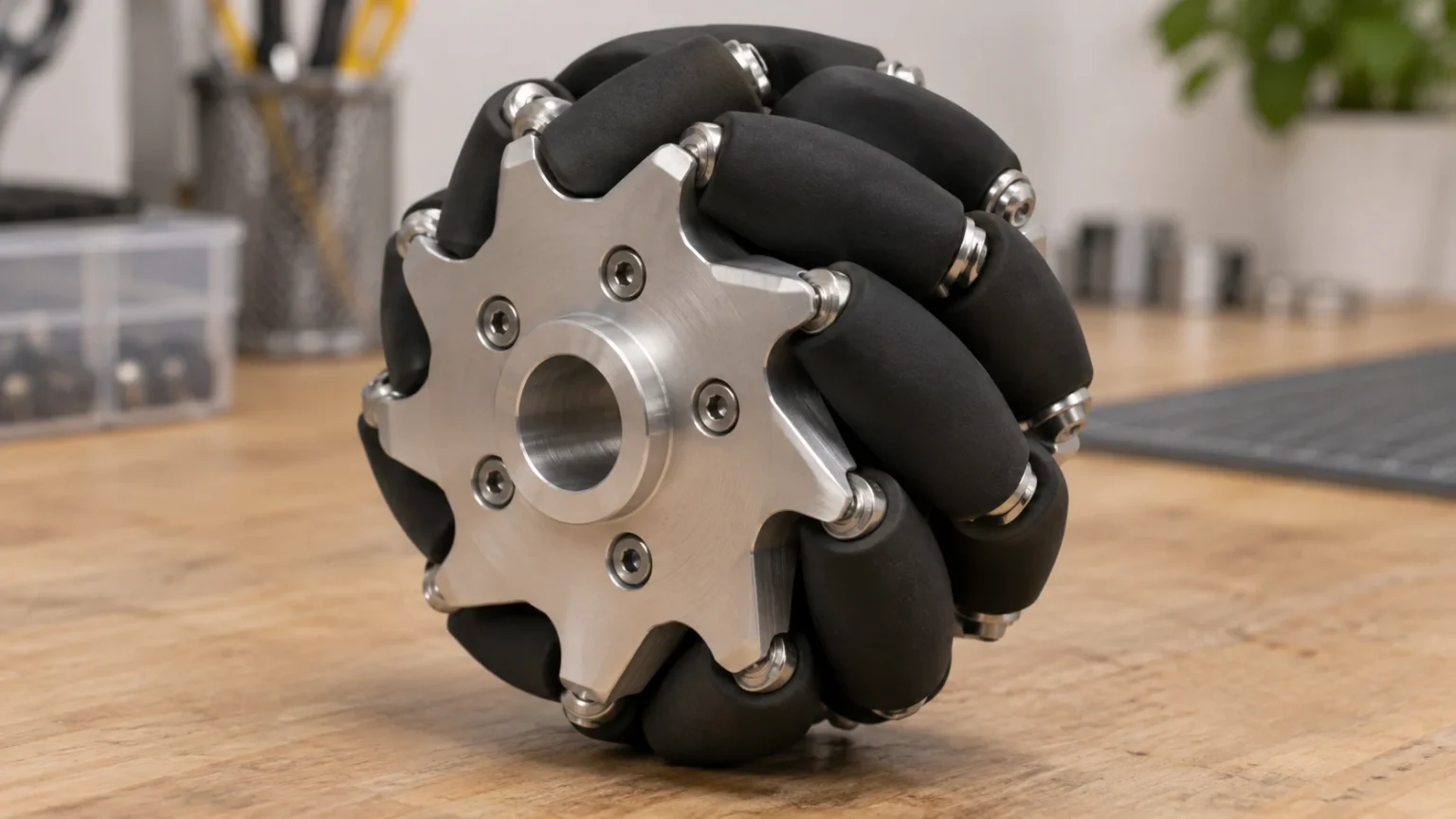
At first glance a Mecanum wheel looks like an ordinary wheel, but its entire rim is lined with many small rubber-coated rollers set at an angle. A motor turns the wheel itself, while the rollers have no power of their own and roll freely as they touch the ground.
(1) Rollers tilted at 45 degrees
The axis of each roller is at 45 degrees to the plane of the wheel and also at 45 degrees to the wheel’s axle. As a result, when the wheel turns, the force it applies to the ground acts not in the direction the wheel faces but in a slanted direction perpendicular to the roller axis, and this force splits into a forward-backward component and a sideways component.
(2) Wheels that never steer
There is no steering mechanism like the front wheels of a car. Each wheel simply has its own motor and turns independently, and where the vehicle goes is decided solely by how the rotation directions and speeds of the four wheels are matched.
(3) An invention born in Sweden
Bengt Ilon (1923–2008) devised the wheel in the early 1970s and applied for a patent, and the U.S. patent (US 3,876,255) was granted in April 1975. The wheel was named after the company he worked for.
2. Motion Created by Four Wheels Together
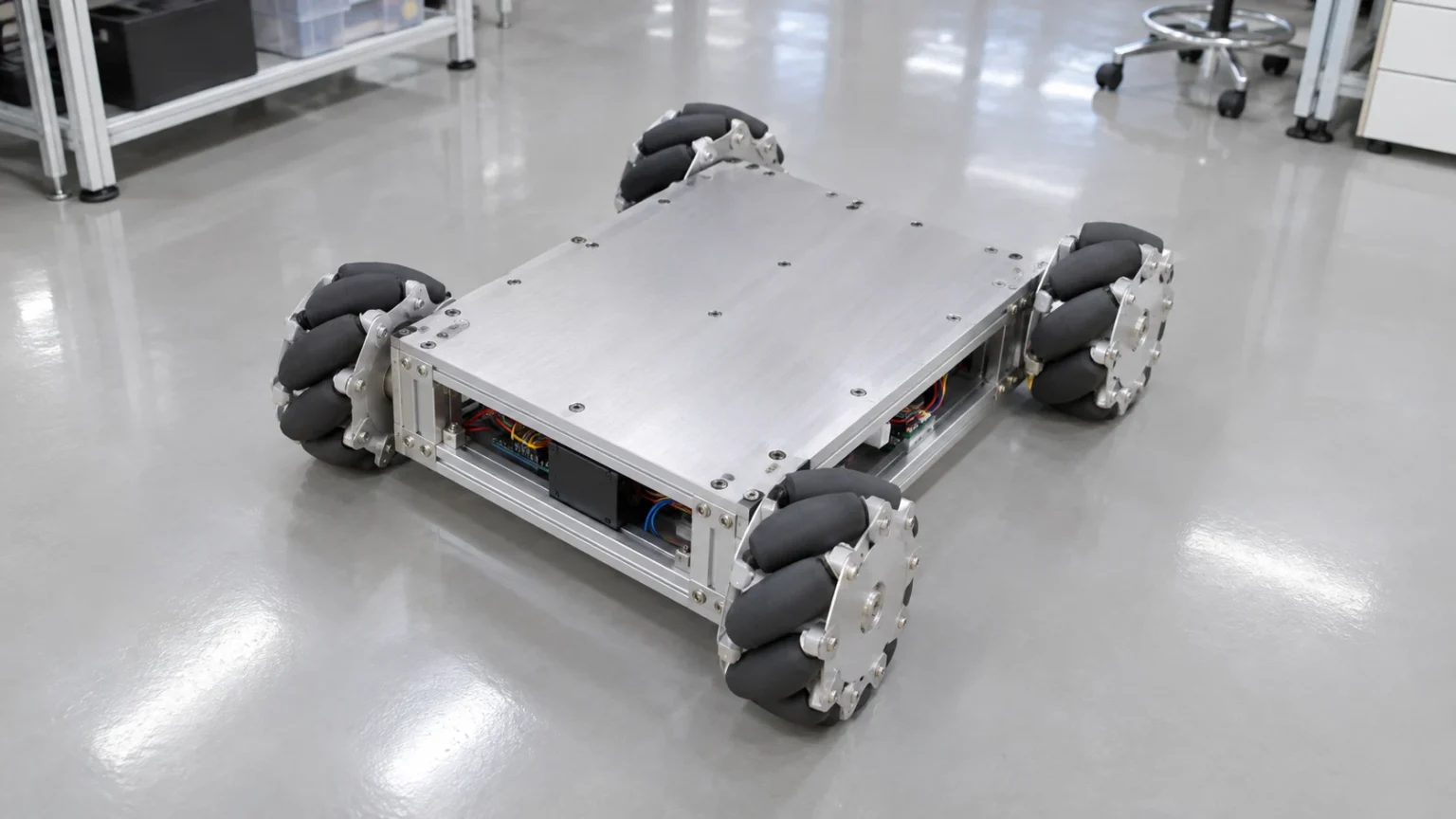
Mecanum wheels are usually used in sets of four. Wheels with rollers slanted to the left and wheels with rollers slanted to the right are mounted alternately so that, seen from above, the rollers of the four wheels point toward the center of the vehicle and form an X. The force from each wheel then runs almost parallel to a diagonal of the vehicle.
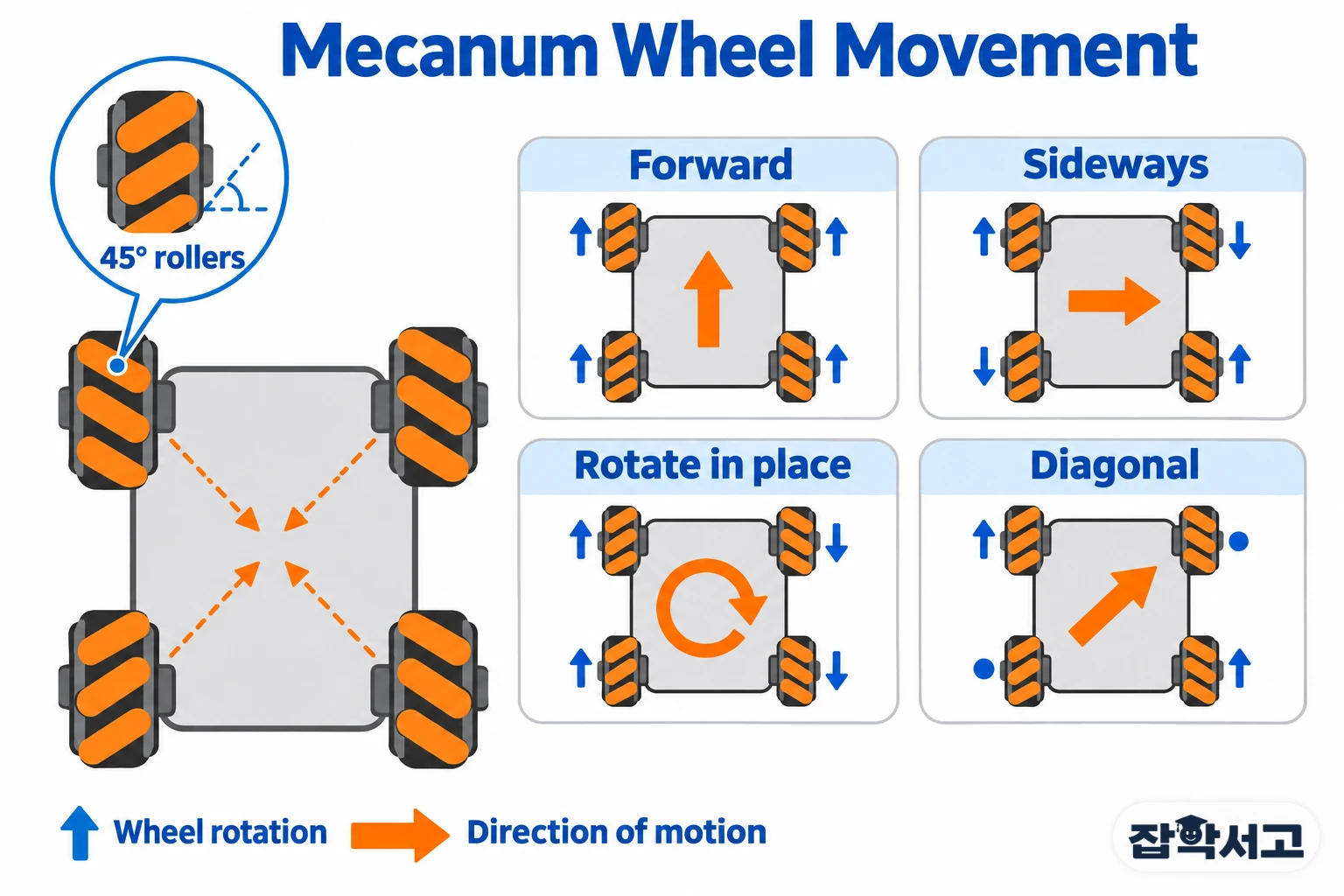
- Forward/Backward: all four wheels turn in the same direction at the same speed.
- Strafing: the wheels facing each other diagonally are paired, and the two pairs turn in opposite directions.
- Rotation: the two wheels on one side turn forward and the two on the other side turn backward at the same speed.
- Diagonal: only one diagonal pair of wheels turns while the other pair stays still.
(1) Adding and cancelling forces
When the vehicle moves sideways, the forward-backward forces produced by the four wheels cancel each other out and only the sideways forces add up. Conversely, when it moves forward, the sideways forces cancel out and only the forward forces remain.
(2) Every direction by mixing speeds
By mixing the speeds and directions of the four wheels in slightly different ways, almost any combination of movement and rotation can be produced. The vehicle can slide diagonally while still facing forward, or turn its body while it moves.
(3) What happens if the layout is wrong
If the wheels are mounted so that the rollers, seen from above, form a diamond instead of an X, the force directions are misaligned and the vehicle does not move as intended. That is why builders always check which way the rollers slant first when assembling.
3. From Navy Ships to Robot Competitions
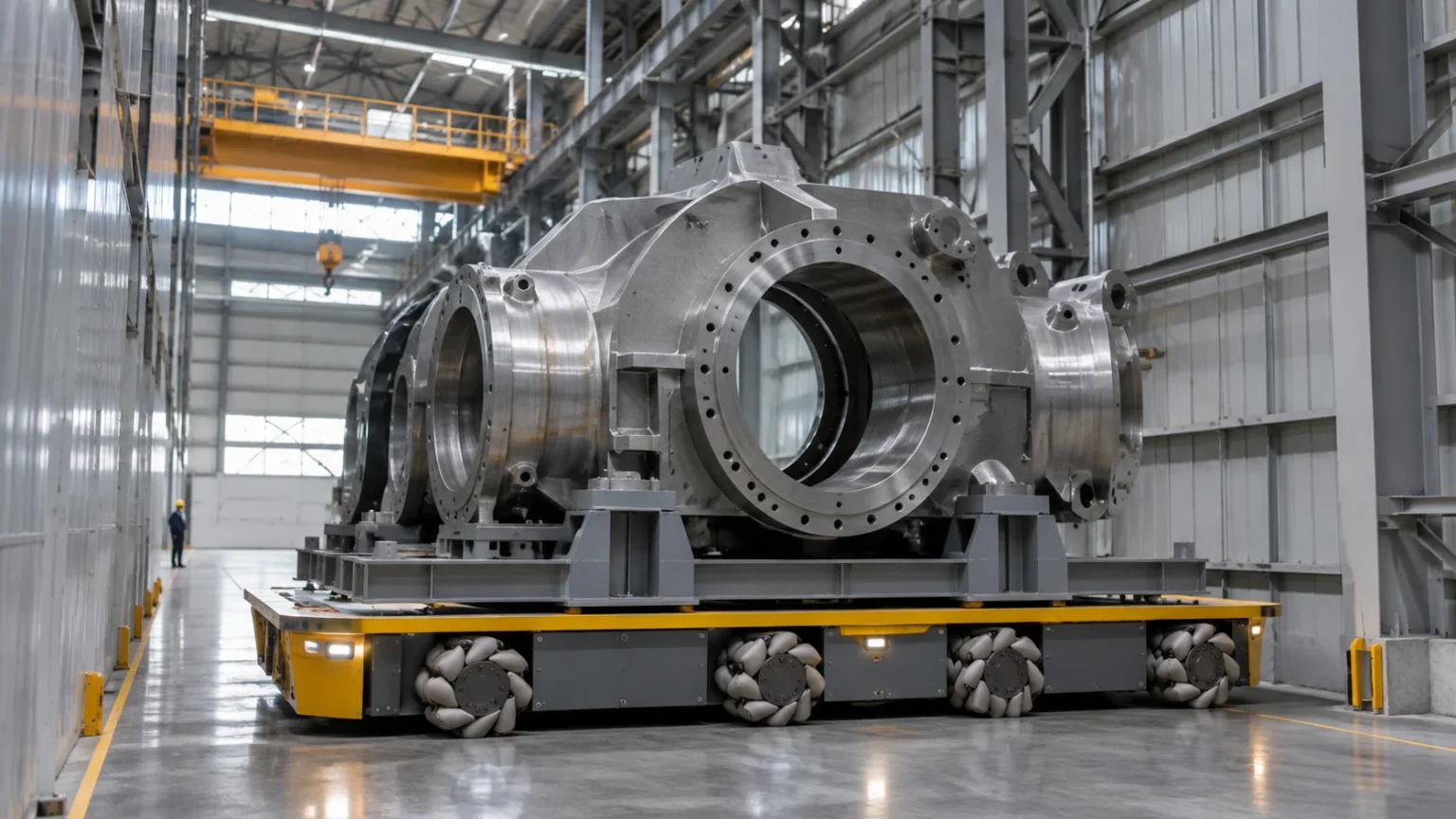
Mecanum wheels are especially useful where there is no room to make wide turns. After their invention, they spread step by step into military, industrial, research and educational fields.
(1) The U.S. Navy and omnidirectional forklifts
The U.S. Navy bought the patent from Ilon and carried out research in Panama City, Florida, in the 1980s, using the wheels to move items around ships. In 1997, Airtrax and several other companies each paid the Navy $2,500 for the rights to the technology and built omnidirectional forklifts for tight spaces such as aircraft carrier decks.
(2) Mobile robots for research
Carnegie Mellon University’s (CMU) URANUS of 1985 is regarded as the first mobile robot with Mecanum wheels, and it was used for navigation research for about 20 years. In 1992, the wheels were also used on Tessellator, a robot designed to service the Space Shuttle’s thermal protection tiles.
(3) Wheelchairs and youth robot competitions
Because they make it easy to change direction in tight indoor spaces, Mecanum wheels have also been applied to wheelchairs, and a Mecanum-wheeled wheelchair was presented at the EVER exhibition in Monaco in 2006. Today they are also a common sight in youth robot competitions such as FIRST Tech Challenge and VEX Robotics.
4. Strengths and Limitations of the Mecanum Wheel
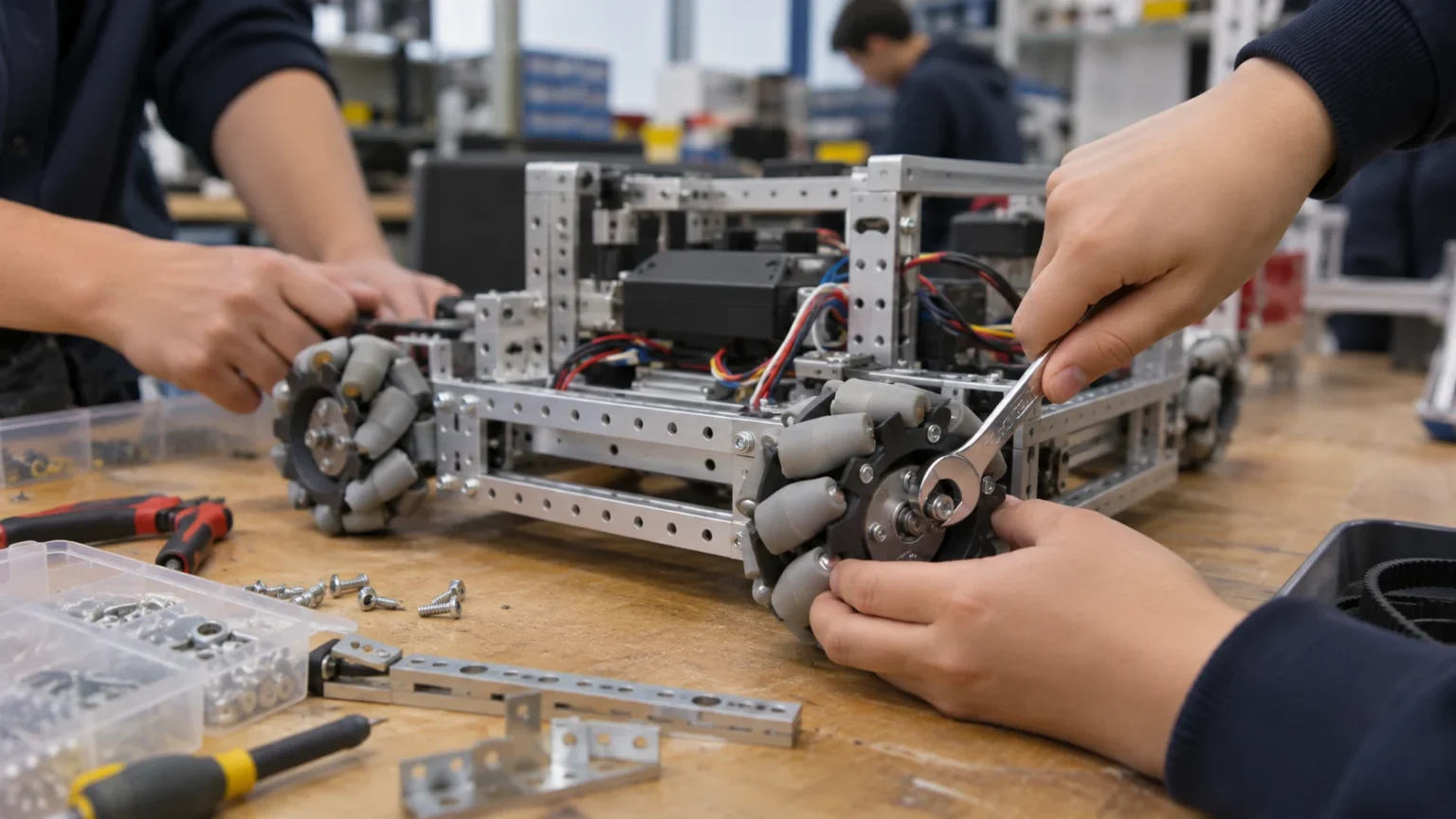
Being able to move in any direction is a clear strength, but it comes at a price. When choosing Mecanum wheels, both sides need to be weighed together.
(1) Freedom in tight spaces
Because the vehicle can move sideways or rotate in place without turning its body, it can position itself even in very tight spaces. Unlike tracked or skid-steer vehicles, it does not drag its wheels across the ground to turn, so it does less damage to soft or fragile floors.
(2) Weak traction and pushing power
The rollers have a lower coefficient of friction than ordinary wheels, so traction is reduced and pushing power is relatively weak. When moving sideways the rollers slip more, so the vehicle cannot travel sideways as fast as it drives forward.
(3) Floors and maintenance
Because the rollers are small, the floor needs to be reasonably smooth for the wheels to perform well, and if dust or debris gets caught in the rollers, the ride becomes bumpy or the wheels drag. Being more expensive than ordinary wheels is also counted as a drawback.
The Mecanum wheel is an invention that broke the assumption that a wheel can only move in the direction it rolls, using nothing more than the tilt of its rollers. The simple idea that a vehicle can go anywhere if you just slightly turn the direction in which its wheels push against the ground is the first step to understanding the Mecanum wheel.