You may have seen a performance in which hundreds of drones rise into the evening sky and draw the Korean flag and letters. On the ground, a colony of ants finds the shortest path to food without a single commander, and termites build mounds of earth far larger than their own bodies together. The field that carries this principle—simple individuals achieving amazing things when they gather—over to robots is ‘Swarm Robotics.’
Put simply, swarm robotics means ‘the field of robotics that designs many robots following simple rules to get work done together using only the signals they exchange with nearby peers, without a central brain giving commands.’ Instead of one outstanding robot, many cheap, small robots join forces.
In this piece, we will look in turn at the meaning and features of swarm robotics, the working principles borrowed from nature, cases in the lab and in the field, and the challenges still to be solved.
Intelligence Built Together by Simple Robots
What Is Swarm Robotics?

Swarm robotics branched off from ‘Swarm Intelligence,’ the study of insect colonies, flocks of birds and schools of fish. Research grew in earnest from the early 2000s, and in the ‘SWARM-BOTS’ project funded by the European Union from 2001 to 2005, up to 20 robots linked their bodies together in experiments to move objects jointly. The follow-up ‘Swarmanoid’ project (2006–2010) grouped flying robots, wall-climbing robots and ground-running robots into one team to find and fetch objects.
(1) A Group Without a Leader
In a robot swarm, there is no robot that looks down on the whole group and gives orders. Each robot senses only its nearby peers and its surroundings, and decides its next action on its own based on that information.
(2) A Structure That Grows Stronger with Numbers
Unlike ordinary robot teams, swarm robotics assumes a very large number of robots. That is why miniaturization—making robots small and cheap—is considered a key challenge.
The Principles That Move a Robot Swarm
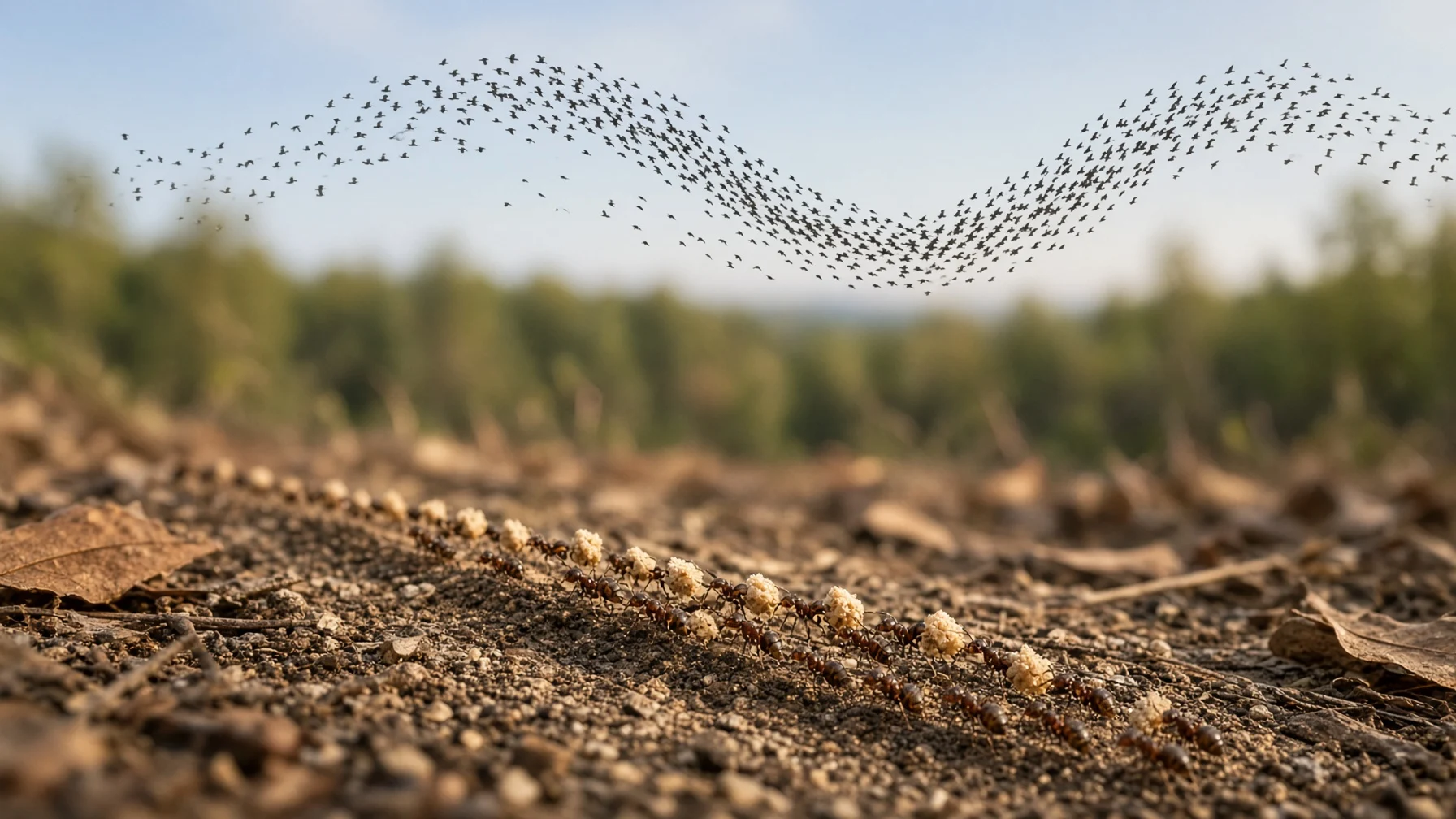
The core of swarm robotics is ‘Emergence,’ in which complex behavior arises on its own when simple rules come together. Researchers borrowed those rules from nature.
- Boids rules (Boids): In 1986, while creating a program that imitates a flock of birds, Craig Reynolds reproduced natural flocking with just three rules: ‘don’t get too close to your neighbors,’ ‘fly in the same direction as your neighbors’ and ‘move toward the center of your neighbors.’ This method was also used for the bat swarm scenes in the 1992 film Batman Returns.
- Stigmergy (Stigmergy): A term coined in 1959 by the French biologist Pierre-Paul Grassé while observing termites, it refers to indirect communication in which a trace one individual leaves in the environment guides another individual’s next action. The pheromone trails left by ants are a classic example.
- Local communication (Local Communication): Robots briefly exchange information only with nearby peers through infrared or radio signals.
Thanks to these principles, a robot swarm can keep working even if a few robots break down, can take in more robots without a major redesign, and can move while switching roles to fit the situation. Researchers call these three strengths robustness, scalability and flexibility.
Robot Swarms in the Lab and in the Field
Robot swarms have already moved beyond the lab into the sky and onto construction sites.
[Case 1] A Thousand Robots: Kilobot
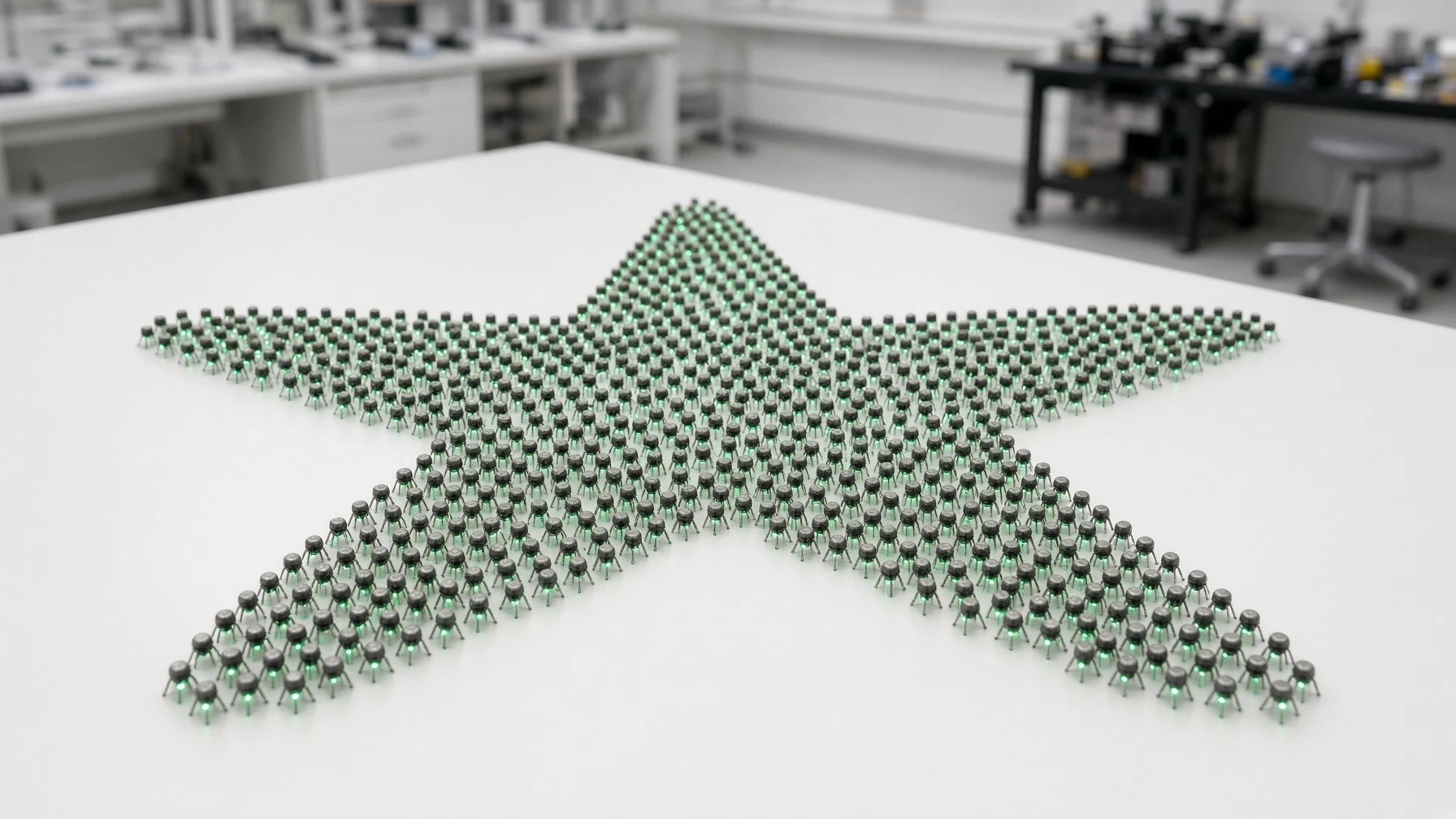
The Kilobot, created by Radhika Nagpal and Michael Rubenstein at Harvard University in the United States, is a small robot 3.3cm tall. It moves with two vibration motors instead of wheels, bringing its parts cost below $15. In 2014, the researchers showed 1,024 Kilobots forming shapes such as the letter K and a starfish on their own, simply by exchanging signals with their neighbors. Another notable feature was that, since no one could handle a thousand robots one by one, the system was designed to send programs to all the robots at once through an overhead infrared device.
[Case 2] Robots That Build Like Termites, and Drone Shows
The same university’s ‘TERMES’ robots imitated the stigmergy of termites, placing the next brick by looking only at the shape of the bricks already stacked, and built structures such as staircases and pyramids. In effect, the robots did not talk to each other directly but used the built result as their signal. In Korea, the Korea Aerospace Research Institute staged a swarm flight of 100 drones flying together to commemorate the 100th anniversary of the March 1st Movement.
Uses of Swarm Robotics and Remaining Challenges
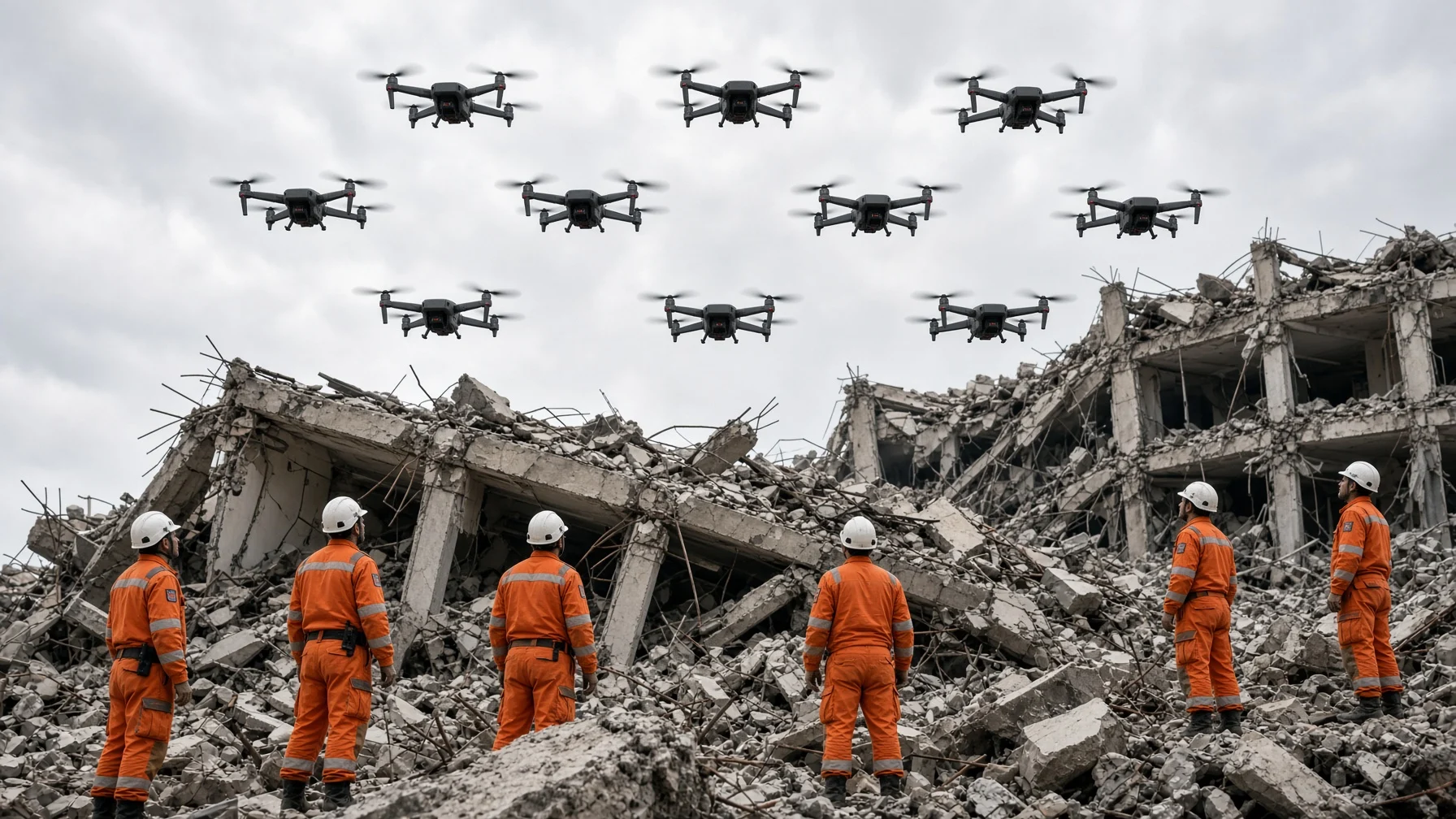
Robot swarms are especially useful for work in places too dangerous for people to enter or in wide areas that must be surveyed quickly.
(1) Promising Uses
They can be used for tasks too much for a single robot, such as searching for survivors in collapsed buildings, monitoring wide farmland and forests, tracking pollutants and exploring space. Researchers are also studying delivery in which several drones share a heavy load, and 3D printing in which many robots print a large structure together. In 2023, researchers from the University of Washington and Microsoft unveiled a swarm of small speaker robots that spread themselves out across a table using only sound signals, with no cameras, to pick up or mute sound from specific zones of a room.
(2) Problems to Solve
Even when the rules are simple, it is hard to predict the overall behavior precisely in advance. Small robots have short battery life and communication range, and one person watching over and handling countless robots carries a heavy burden. Uses such as military drone swarms that even attack on their own are also sparking ethical debate.
Swarm robotics is a technology that starts from the idea that many ordinary robots can go further than one outstanding robot. Even without a leader, when a few small rules for watching one’s neighbors come together, the swarm finds its way, builds homes and draws pictures in the sky.
Each following its own small rules and sharing signals with the peers beside it: that is the first step toward intelligence that works together.