Have you ever listened closely to a lecture, only to find yourself unsure of the right answer when you sat down to solve a problem? Everything seemed clear while you were listening, yet the moment the question was phrased a little differently, your confidence slipped away. Peer Instruction is a teaching method that began in a physics lecture hall at Harvard University in the United States to close exactly this gap.
Simply put, Peer Instruction means ‘a teaching method in which students first answer a concept question on their own, then explain their reasoning to the classmate beside them and answer again.’ Harvard physics professor Eric Mazur first introduced it in his introductory physics course in 1991, and in 1997 he set it out in a book titled Peer Instruction: A User’s Manual, which spread the method widely.
In this article, we will look in turn at how Peer Instruction came about, the sequence of a concept question and two votes that makes up a class, the effects confirmed by research, and finally how to apply it well and what its limits are.
From a Lecture Hall Where Students Only Listened to One Where They Explain to Each Other: The World of Peer Instruction
1. Why Did Peer Instruction Come About?

Professor Mazur believed his lectures were going well because his students rated them highly. Then he came across research showing that students could solve calculation problems without truly understanding the basic concepts underneath, and he decided to give the same concept test to his own students.
(1) Students Who Can Calculate but Whose Concepts Are Shaky
The concept test asked about everyday situations without formulas, yet many students relied on everyday intuition and chose the wrong answer. It revealed that the ability to plug numbers into a formula and the ability to understand a concept can be two different things.
(2) Why Even a Good Explanation May Not Get Through
Mazur reasoned that the more expert a lecturer is, the easier it is to forget where beginners get stuck. The idea that a classmate who has just grasped the concept may be better at pinpointing a friend’s sticking point became the starting point of Peer Instruction.
(3) The Harvard Experiment That Changed the Lecture
From 1991, he divided lecture time into short explanations and concept questions. He had students read the material in the lecture notes beforehand and gave more class time to students thinking and discussing for themselves.
2. How Does a Peer Instruction Class Proceed?
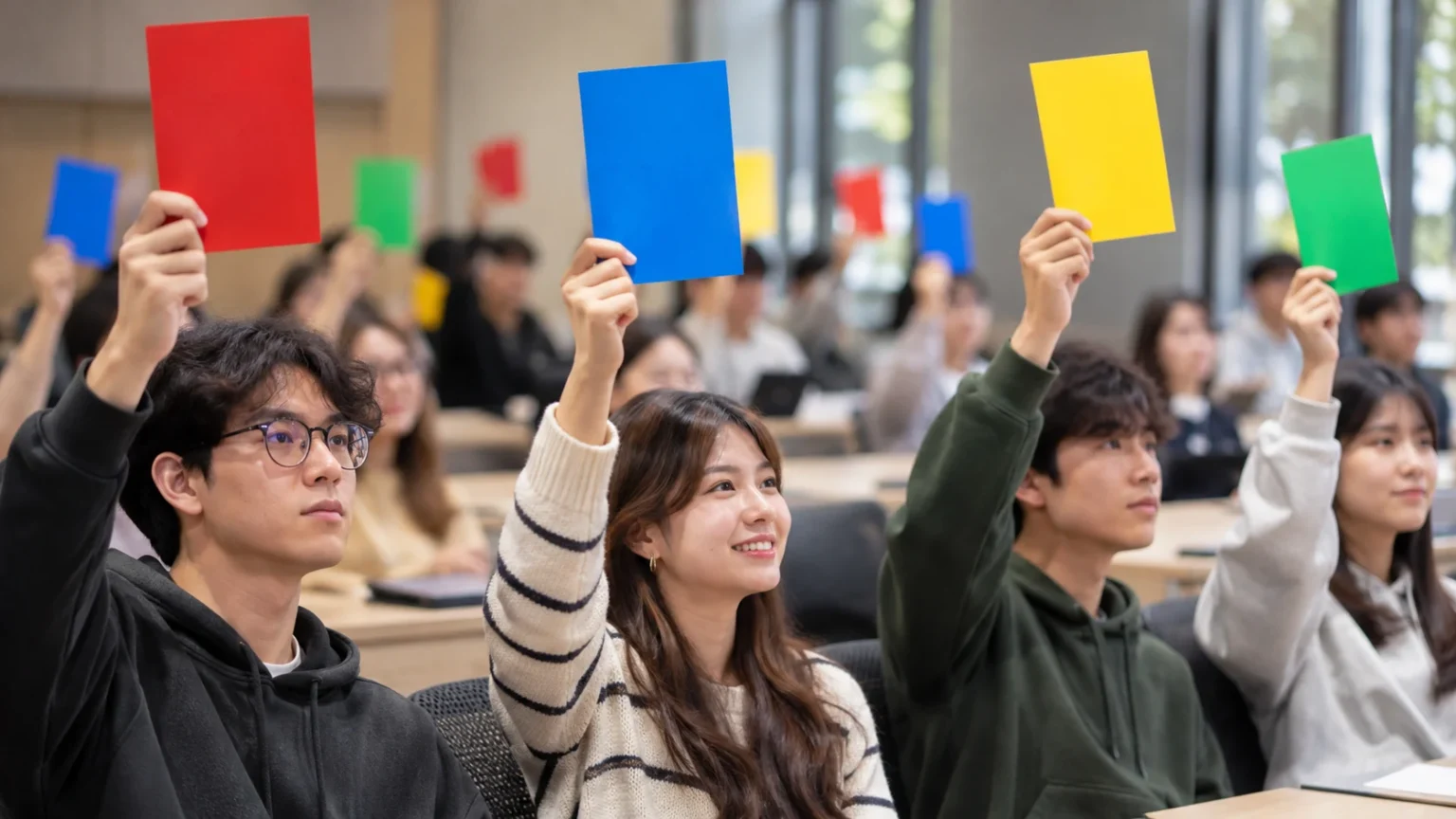
A Peer Instruction class repeats the same sequence for each key concept. After a short explanation, the instructor poses a concept question; students answer on their own, discuss with a neighbor, and then answer again.
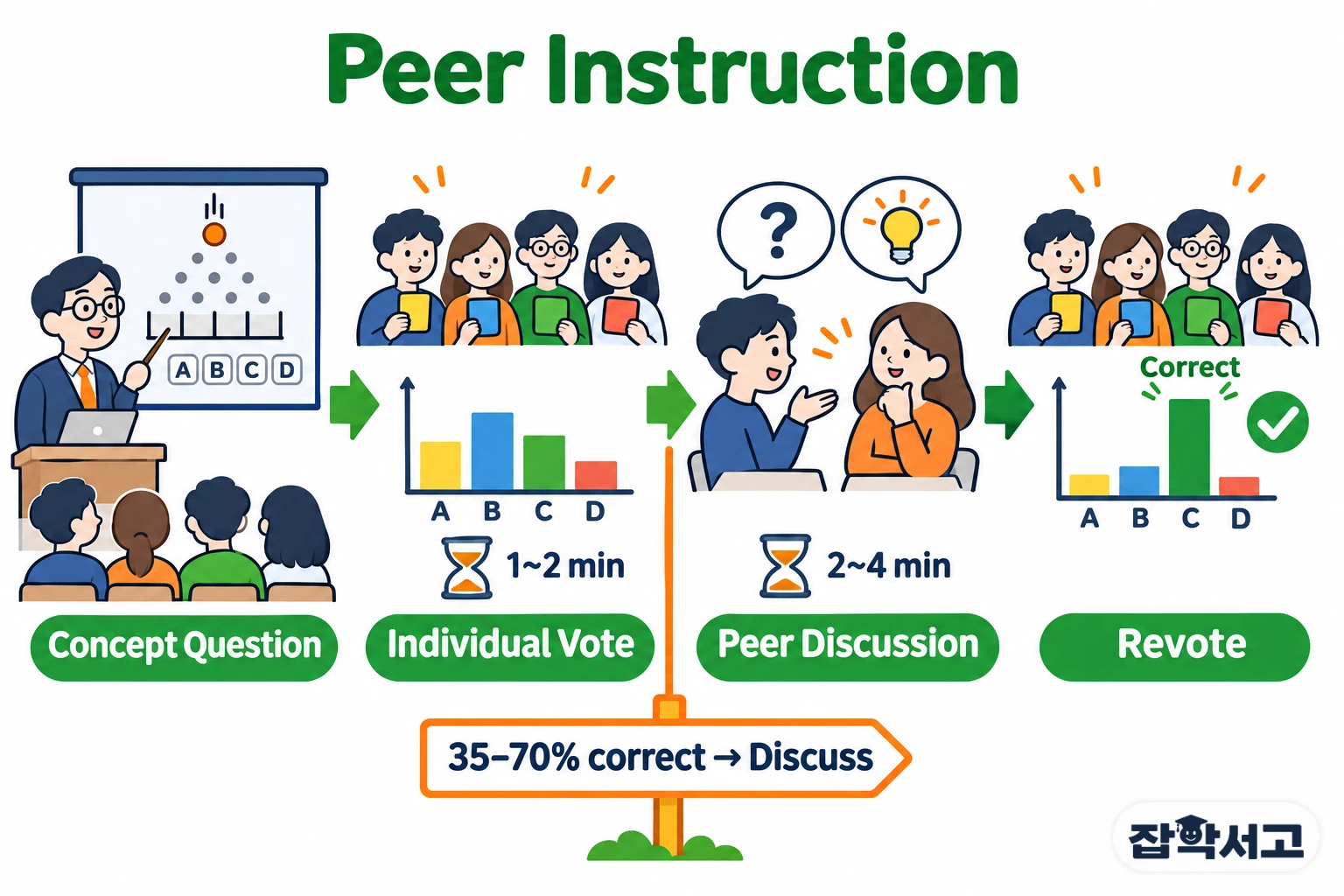
- Concept Question (ConcepTest): A multiple-choice question that checks understanding of a key concept without calculation, with plausible wrong answers included.
- Individual Vote: Students think on their own for 1–2 minutes, then give their answer with hand signals, cards, or response devices.
- Peer Discussion: Students find a neighbor who chose a different answer and spend 2–4 minutes explaining to each other why their answer is right.
- Revote and Explanation: Students answer the same question again, and the instructor sums up the correct answer and the reasoning before moving on to the next concept.
(1) The Criterion for Deciding on Discussion
A 2001 paper by Catherine Crouch and Mazur explains that discussion is most useful when 35–70% of students answer correctly in the first vote. Below that, the question may be ambiguous or the concept may need more explanation; above that, there is little left to discuss.
(2) Explaining the Reason, Not Just the Answer
The purpose of discussion is not to follow the majority answer but to exchange reasons. Students therefore have to explain in words why their chosen answer is right, and in the process they notice for themselves where their understanding falls short.
(3) A Class That Starts with Reading Beforehand
Because most of the lecture time goes to questions and discussion, students need to read the textbook before class. Through short reading assignments, Mazur found out in advance what students had found difficult and adjusted his lectures accordingly.
3. How Effective Is Peer Instruction?

The effect of Peer Instruction has mainly been measured by how much physics concept test scores rose from before to after a course. The measure used here is the normalized gain, which expresses as a ratio how much of the possible improvement students actually achieved.
(1) Ten Years of Records from Harvard Lectures
According to data compiled by Crouch and Mazur, the normalized gain in 1990, when the course was taught as a traditional lecture, was 0.25. It rose to 0.49 in 1991, when Peer Instruction was introduced, and reached 0.74 in 1997.
(2) A Large-Scale Survey Comparing 6,542 Students
In 1998, physicist Richard Hake compared data from 62 introductory physics courses and 6,542 students. The average normalized gain in interactive-engagement courses was 0.48, about twice the 0.23 of traditional lectures.
(3) Answers That Change After Discussion
In the concept questions of Harvard’s fall 1997 course, nearly half of the correct answers came after discussion. Conversely, students switched from a correct answer to a wrong one during discussion only 6% of the time.
4. What Does It Take to Use Peer Instruction Well?
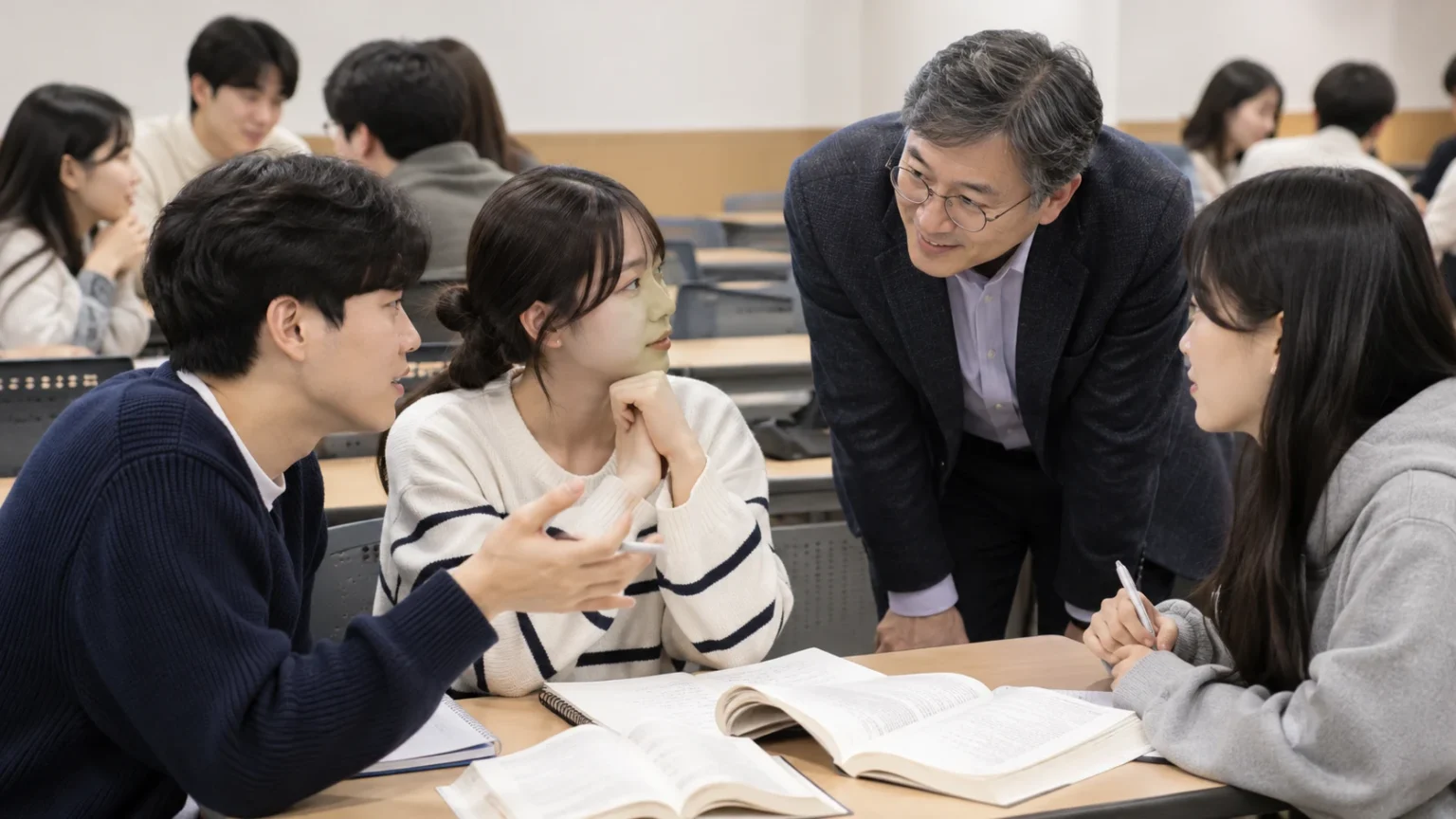
Peer Instruction began in physics, but today it is used in lecture halls across many fields, including biology, chemistry, mathematics, and engineering. However, simply inserting a few questions does not automatically produce results.
(1) Writing Good Concept Questions
If a question is too easy or only requires calculation, no discussion happens. Only when the answer choices include misconceptions students actually hold do different answers emerge, and real discussion begins over those differences.
(2) Discussion Helps Even When No One Knows
In a study of a genetics course at the University of Colorado published in Science in 2009, the correct-answer rate on a similar new question rose after discussion even when no one in the discussion group had known the right answer at first. This means that reasoning together, not just following a friend who knows the answer, helps understanding.
(3) The Burden of Time and Preparation
Because lecture time goes to discussion, the amount of content that can be covered may shrink, and writing good questions takes time too. The instructor has to guide the class carefully so that students do the reading and discussion does not drift into idle chatter.
In the end, Peer Instruction rests on the belief that learning happens not when the instructor talks more, but when students think and speak more. A few short minutes spent explaining an answer you worked out alone to the person next to you can become the time a concept truly becomes your own. The simple idea that real understanding shows itself only when you try to explain what you understand to a friend—that is the first step toward understanding Peer Instruction.