The educational environment in the 21 century is changing rapidly, and the role of educational administration has become more important than ever in keeping pace with these changes.
Educational administration oversees all the activities necessary for the effective operation of educational institutions and plays an essential role in improving students' learning environments and increasing teachers' work efficiency.
In this material, we will explore educational administration in depth, from its basic definition and roles to education policies and laws, school operations and management, and the challenges and future tasks facing educational administration.
We aim to suggest directions for future education based on an understanding of educational administration.
The Definition and Roles of Educational Administration
 What Is Educational Administration?
The Definition of Educational Administration
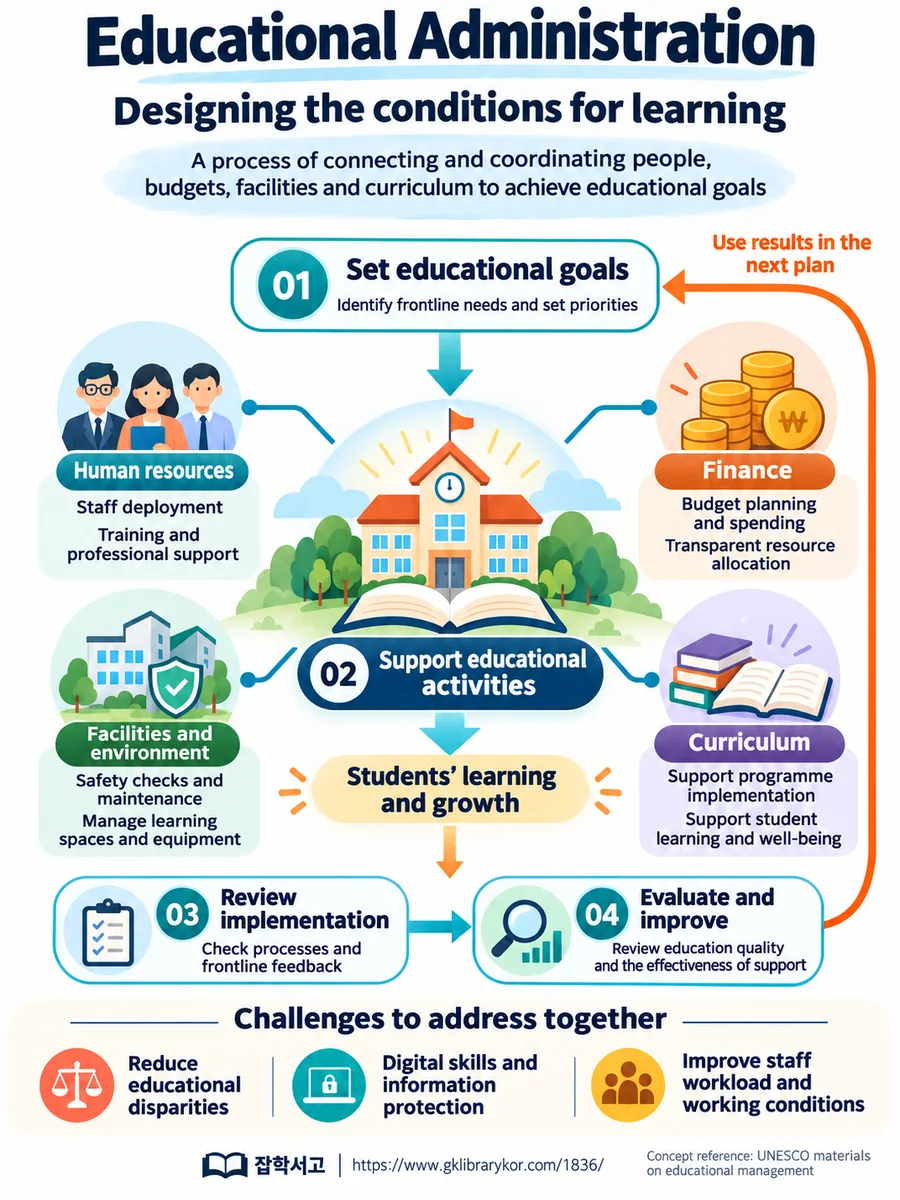
Educational administration is the process of managing and coordinating all the activities necessary to achieve an educational institution's objectives effectively. It encompasses various aspects, including institutional operations, the formulation and implementation of education policies, financial management, and the deployment of human resources.
Educational administration takes place in various educational institutions, including schools, universities, and offices of education, and focuses on improving the quality of education and creating learner-centered environments.
The Roles of Educational Administration
1. Formulating and Implementing Education Policies
Educational administration plays an important role in helping governments and educational institutions formulate and implement education policies. Through this work, it provides direction for education and coordinates efforts to ensure that policies are implemented effectively.
2. Managing School Operations
It manages and supports the daily operations of schools. This includes establishing academic calendars, recruiting and managing teachers and staff, managing facilities, and managing finances. The goal is to improve the quality of education through efficient school operations.
3. Financial Management
It manages the finances of educational institutions and ensures transparent financial operations. It prepares and executes budgets and allocates financial resources effectively to achieve educational objectives.
4. Human Resource Management
It manages human resources efficiently through the recruitment, placement, and training of teachers and staff. This improves the quality of education and strengthens the professional expertise of teachers and staff.
5. Improving Educational Environments
It creates learner-centered educational environments and promotes students' welfare and safety. To this end, it pursues facility improvements, the introduction of educational technology, and the provision of various educational programs.
6. Evaluation and Performance Management
It evaluates the effectiveness of educational programs and policies and develops measures for improvement. Through this work, it pursues continuous development and devises strategies to improve the quality of education.
Educational administration oversees the operations and management of educational institutions and plays an essential role in improving the quality of education. Efficient educational administration increases the satisfaction of students, teachers, and staff and ultimately contributes to the development of society as a whole.
Educational administrators must fulfill these roles, prepare for future education, and lead sustainable development.
Education Policies and Laws
 What Laws and Regulations Relate to Education?
The Concept of Education Policy
Education policy refers to the plans and strategies formulated by governments and relevant institutions to achieve the objectives of the education system. It provides direction and standards for education and is developed to improve students' learning environments and the quality of education. Education policies can be formulated at various levels, from the national level to regional and individual school levels.
The Process of Formulating Education Policy
1. Identifying and Analyzing Problems
The first step in formulating education policy is to identify and analyze problems and needs in educational settings. This clarifies the key issues that the policy must address.
2. Setting Objectives
The objectives of the education policy are established. These may include various goals, such as improving the quality of education, providing equal educational opportunities, and expanding access to education.
3. Policy Development
Specific measures are developed to achieve the established objectives. This involves seeking expert opinions, analyzing various data, and reviewing different alternatives.
4. Policy Implementation and Management
The developed policy is put into practice. During this process, the necessary resources are allocated and implementation is monitored to maximize the policy's effectiveness.
5. Evaluation and Revision
The results of the implemented policy are evaluated, and the policy is revised and supplemented when necessary. This continually increases its effectiveness.
Key Education Laws and Regulations
1. Framework Act on Education
This law sets out the basic principles and direction of education and forms the foundation of all educational activities. It stipulates the purposes of education, the guarantee of the right to education, and the roles of educational institutions.
2. Elementary and Secondary Education Act
This act addresses laws and regulations concerning education in elementary and secondary schools and stipulates curricula, teacher qualifications, and students' rights and duties. Through these provisions, it maintains consistency and quality in elementary and secondary education.
3. Higher Education Act
This law applies to universities and other higher education institutions and stipulates matters such as the objectives of higher education, operating standards, and the awarding of degrees. Through these provisions, it raises the standard of higher education and develops talent that meets society's needs.
4. Special Education Act
This act guarantees education for students with disabilities and stipulates the objectives of special education, methods of provision, and related facilities and support services. Through these provisions, it ensures that all students can enjoy equal educational opportunities.
5. Education Finance Act
This law ensures transparency and efficiency in education finance and stipulates methods for preparing, executing, and managing education budgets. Through these provisions, it ensures that education funds are used appropriately and can contribute to improving the quality of education.
Education policies and laws provide the basic framework for the education system, improve the quality of education, and ensure that all students can enjoy equal educational opportunities. These policies and laws must reflect changes in educational settings and be continually improved.
Through this work, we will be able to create better educational environments and develop the talent that will lead the society of the future.
School Operations and Management
 How Can Schools Be Run Effectively?
The Concept of School Operations and Management
School operations and management refer to the process of efficiently allocating and coordinating a school's organizational capabilities and resources to achieve educational objectives effectively. This plays an important role in supporting the school's daily operations and helping teachers and students learn and grow in an optimal educational environment.
School Organization and Structure
1. Types of School Organization
Schools generally have a hierarchical structure consisting of a principal, vice principal, teachers, administrative staff, and others. This structure promotes efficient operations through a clear division of authority and responsibility.
2. The Importance of Organizational Structure
An effective organizational structure plays an important role in increasing a school's operational efficiency and achieving educational objectives. School organization facilitates interaction between teachers and students and strengthens collaboration and communication.
School Financial Management
1. Budget Preparation
Schools prepare budgets to secure the resources needed for educational programs, facilities, personnel, and other purposes. Budget preparation forms the foundation of school operations and ensures the appropriate allocation of financial resources.
2. Budget Execution
The prepared budget is executed according to plan. This applies to various areas, including educational activities, facility maintenance and repairs, and teacher training. Regular reviews and evaluations are necessary to increase transparency and efficiency in budget execution.
3. Transparency in Financial Management
Transparency in financial management is essential for building trust in school operations. To this end, schools disclose their financial situations and regularly report how their budgets have been used.
Human Resource Management
1. Teacher Recruitment and Placement
It is important to recruit excellent teachers and assign them to suitable positions according to their abilities and characteristics. This makes it possible to make full use of teachers' professional expertise and improve the quality of education.
2. Teacher Training and Development
Various training programs must be provided to support teachers' ongoing professional development. These programs strengthen teachers' capabilities and help them learn about the latest educational trends and technologies.
3. Staff Welfare and Satisfaction
Improving the welfare and satisfaction of teachers and staff is also an important task. To this end, fair evaluations, opportunities for promotion, and welfare benefits must be provided.
Educational Program Operations
1. Curriculum Development and Implementation
Schools develop and implement their own curricula in accordance with the national curriculum. This provides students with various learning opportunities and meets their individual learning needs.
2. Assessing Academic Achievement
Students' academic achievement is assessed, and the curriculum is improved based on the results. Assessment results are an important basis for supporting students' learning progress and determining whether educational objectives have been achieved.
Facility and Resource Management
1. Facility Maintenance and Repairs
Proper maintenance and repair of school facilities are essential for creating a safe and comfortable learning environment. Regular inspections and repairs are necessary to achieve this.
2. Educational Resource Management
Various educational resources, such as teaching materials, books, and educational technology, are managed and used effectively to achieve educational objectives. Introducing and using the latest educational technology is also an important part of this work.
Student Support and Welfare
1. Counseling and Guidance
Counseling services must be provided to help students with psychological and emotional problems. These services help students grow in a healthy way and concentrate on their learning.
2. Student Welfare Programs
Various student welfare programs are operated to improve students' overall well-being. These include school meals, health care, and after-school activities.
School operations and management are core processes for achieving educational objectives. Through efficient operations and management, schools provide students with the best possible learning environments and support teachers and staff in fulfilling their roles to the fullest.
Through continuous improvement and innovation, the quality of school operations must be raised, and all students must be able to enjoy equal educational opportunities.
Challenges and Tasks in Educational Administration
 What Should We Do for the Future of Education?
Key Tasks in Modern Educational Administration
Modern educational administration faces various challenges and tasks in a rapidly changing society and educational environment. These tasks are important issues that educational administrators must address to operate and improve education systems effectively.
1. Digital Transformation and Technology Adoption
- Challenge: The rapid development of digital technology has brought major changes to educational environments. The introduction of online learning, educational platforms, and digital learning materials is essential, but using and managing these technologies effectively remains a challenge.
- Solution: Technology training for teachers and students must be strengthened, digital infrastructure must be expanded, and measures to protect data security and privacy must be developed.
2. Closing Educational Gaps
- Challenge: Educational gaps between regions, schools, and students remain an important issue. These mainly stem from differences in economic and social backgrounds.
- Solution: Efforts to narrow these gaps are needed through the fair distribution of educational resources, the development of tailored educational programs, and support policies for disadvantaged students.
3. Teacher Workforce Management
- Challenge: Improving teachers' professional expertise and working conditions and addressing issues of teacher supply and demand are key tasks in educational administration. High stress levels and low job satisfaction among teachers negatively affect the quality of education.
- Solution: Teacher training programs must be strengthened, fair evaluation systems must be established, working environments must be improved, and welfare benefits must be expanded.
4. Education Finance Management
- Challenge: Managing education finances effectively within a limited budget is very important. In particular, increasing budget transparency and efficiency is a major challenge.
- Solution: Transparency in financial management must be strengthened, regular audits and evaluations must be conducted to improve the efficiency of budget use, and fairness in resource allocation must be ensured.
Future Directions for Educational Administration
1. Tailored Education and Individualized Learning
- Direction: Tailored education and individualized learning that accommodate each student's learning pace and style are becoming increasingly important. This is a direction that can meet students' diverse needs and maximize learning effectiveness.
- Implementation: Systems must be established that use artificial intelligence and big data to analyze students' learning data and provide tailored learning programs.
2. Sustainable Educational Administration
- Direction: It is important to integrate sustainable development goals into the education system. Students must be prepared to fulfill their roles as members of the society of the future through environmental education and education on sustainable lifestyles.
- Implementation: It is necessary to build environmentally friendly schools, introduce energy-saving programs, and develop and implement sustainable curricula.
3. International Cooperation in Education
- Direction: International cooperation in education is becoming more important in the era of globalization. The quality of education can be improved through international exchange programs and studies of educational practices abroad.
- Implementation: International education networks must be established, exchanges among teachers and students must be encouraged, and ways to introduce global educational standards must be explored.
4. Lifelong Education and Vocational Education
- Direction: Lifelong education and vocational education are becoming more important in responding to a rapidly changing employment environment. These must enable students to continue learning after graduation and adapt to a changing society.
- Implementation: Various lifelong education programs must be developed, vocational curricula must be strengthened, and practical education must be provided through cooperation with industry.
Educational administration faces various challenges and tasks, but efforts to address them play an important role in improving the quality of education and making students' futures brighter.
Educational administration can continue to develop by addressing current tasks such as digital transformation, closing educational gaps, teacher workforce management, and education finance management, and by setting future directions such as tailored education, sustainable education, international cooperation, and lifelong education.
These efforts will ultimately help prepare students to live successfully in a changing society.
Educational administration goes beyond simply operating schools and educational institutions and plays an important role in creating better educational environments and improving the quality of education.
Through this material, we have examined various aspects of educational administration, including its definition and roles, policies and laws, school operations and management, and challenges and tasks. Based on this understanding, educational administrators will be able to prepare for the educational environments of the future and lead sustainable development.
In a changing society, the importance of educational administration will grow further, and through it, we will be able to build a more advanced education system.