Some friends score low on math tests yet can sing along to a song they have just heard for the first time. Others struggle with writing but make faster decisions than anyone on the soccer field, and still others open up easily even to strangers. Seeing friends like these makes us wonder whether being “smart” can really be decided by a single test score.
In his 1983 book Frames of Mind, Howard Gardner, a psychologist at Harvard University in the United States, offered a new answer to this question. His idea was that human intelligence is not one lumped-together ability but a bundle of several relatively independent abilities. This is called the “Theory of Multiple Intelligences.”
This article looks in turn at the background of the theory of multiple intelligences, the eight kinds of intelligence, ways to use the theory in the classroom, and the criticism surrounding it.
Smartness Is Not Just One Thing: The World of the Theory of Multiple Intelligences
From a Single Score to Many Intelligences

Since the early 20th century, intelligence has mainly been measured with intelligence tests. The results were expressed as a single number, the intelligence quotient (IQ), and this number was thought to predict school grades and future prospects fairly well. Gardner, however, believed that such tests mostly measured only abilities dealing with language and logic.
Gardner defined intelligence broadly as “the ability to solve problems or create products that are valued within a culture.” He also said that for an ability to be recognized as an intelligence, it had to pass several criteria.
(1) Links to the brain
There should be cases in which damage to a specific part of the brain causes that ability alone to disappear or remain intact.
(2) Exceptional individuals
The existence of prodigies or savants who show remarkable talent in only one field is a clue that the ability exists separately.
(3) A distinctive developmental path
The ability should go through its own stages of growth, from the first steps of learning to an expert level.
(4) A distinctive symbol system
There should be a unique system of symbols for expressing the ability, such as written letters for language or musical notation for music.
Gardner applied these criteria by gathering evidence not only from psychology but from many fields, including neuroscience, anthropology and the arts. His starting point was very different from the existing approach of finding intelligence by statistically analyzing test scores.
The Eight Intelligences

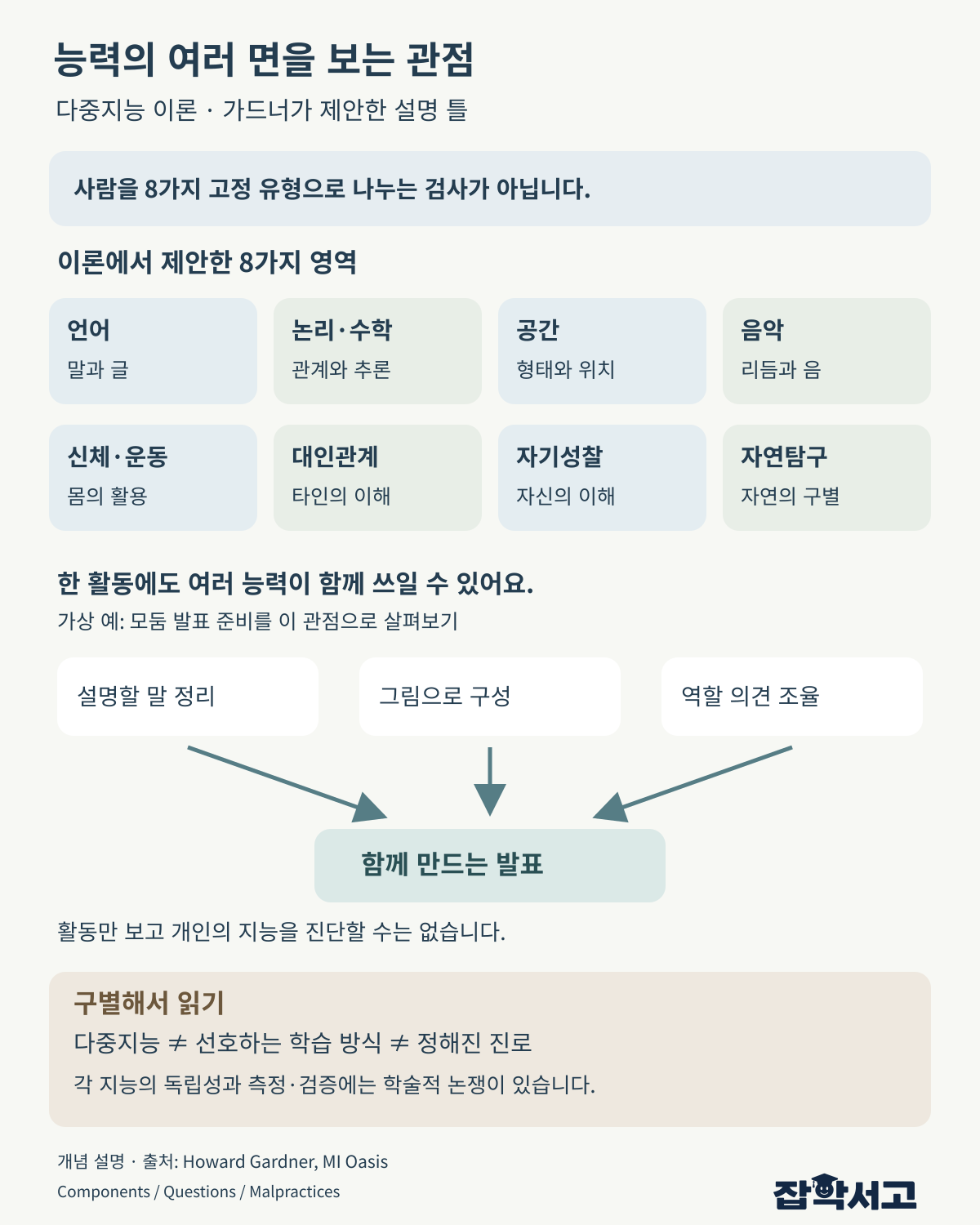
Gardner first proposed seven intelligences, and in 1995 he announced that he would add naturalistic intelligence as the eighth.
- Linguistic Intelligence: the ability to handle the meanings and sounds of spoken and written words well in order to read, write and explain.
- Logical-Mathematical Intelligence: the ability to calculate numbers and solve problems by reasoning about causes and effects.
- Visual-Spatial Intelligence: the ability to picture shapes and positions in the mind and to work with space.
- Musical Intelligence: the ability to sense and express pitch, rhythm and timbre.
- Bodily-Kinesthetic Intelligence: the ability to control body movements and handle objects skillfully with the hands.
- Interpersonal Intelligence: the ability to recognize other people’s moods and intentions and to work with them.
- Intrapersonal Intelligence: the ability to accurately know one’s own emotions, strengths and weaknesses and to manage oneself.
- Naturalistic Intelligence: the ability to recognize and classify plants, animals and the many features of nature.
Every person has a little of all these intelligences; people simply differ in their combination of strengths and weaknesses. In many cases, several intelligences work together to accomplish a single task.
Using the Theory of Multiple Intelligences in the Classroom

The theory of multiple intelligences became more popular among teachers than among psychologists. Gardner recommended the following directions for education.
(1) Fit the student
Because each student has different strengths, teach each person in a way that suits them as much as possible.
(2) Teach in multiple ways
Present important content through several routes, such as stories, pictures, experiments, discussions and hands-on physical activities. This lets more students reach the content and helps them understand one topic from several angles.
(3) Avoid labeling
Do not confine students to a single intelligence, as in “you are the musical-intelligence type.” Gardner stressed that the theory should broaden students’ possibilities, not narrow them.
Gardner also repeatedly warned against confusing multiple intelligences with Learning Styles. Learning styles refer to preferences such as seeing or listening, whereas multiple intelligences are abilities whose level can be assessed.
Criticism of the Theory of Multiple Intelligences

The theory of multiple intelligences has had a great influence on education, but it has also drawn much criticism in psychology.
- Conflict with General Intelligence: across many intelligence tests, scores for different abilities often tend to be high or low together, which critics say does not fit the claim that the intelligences are independent of one another.
- Lack of Empirical Evidence: critics say there are no validated tests that measure each of the eight intelligences separately and few studies that have rigorously tested the theory.
- Definition Problem: critics argue that the theory stretches the word intelligence to cover things like music or sports that could simply be called talents or aptitudes.
Gardner himself acknowledged that the theory has not yet undergone strong experimental testing. Even so, by encouraging people not to see intelligence as a single number, it left meaningful questions for education.
The theory of multiple intelligences reminds us that not every student needs to be smart in the same way. Looking beyond test scores for the strengths each person has is the first step of learning that broadens a person’s possibilities.