Have you ever watched a problem that stalled when tackled alone start to open up with a short hint from the classmate next to you or a single question from the teacher? Tasks that are already familiar feel boring, and tasks that are too far ahead leave only frustration. The stretch in between—‘a bit hard, yet doable with help’—that is the ‘zone of proximal development (Zone of Proximal Development).’
Put simply, the zone of proximal development means ‘the distance between the actual developmental level at which a learner can solve problems alone and the potential developmental level at which they can solve them with an adult’s guidance or in cooperation with more capable peers.’ Soviet psychologist Lev Vygotsky (Lev Vygotsky, 1896–1934) proposed it within sociocultural learning theory, and in the English-speaking world the definition published in Mind in Society (1978) is widely cited. He held that tests measuring only what someone can do alone miss the possibility of growth.
In this piece we will look, in order, at what the zone of proximal development means and its three-layer structure, the role of the More Knowledgeable Other, forms often seen in classrooms, and how it differs from scaffolding.
A stretch that grows when you cannot do it alone but can together
What is the zone of proximal development?

Vygotsky divided the actual developmental level into ‘the level ascertained by independent problem solving’ and the potential developmental level into ‘the level ascertained under adult guidance or in cooperation with more capable peers.’ The space between them is the zone of proximal development. It is close to saying: do not only count the fruit already ripe—look also at the shoots just beginning to grow.
(1) Learning is social
He saw higher mental functions as appearing first in interaction among people and then being internalized into the individual. Dialogue and joint problem solving are not mere mood-setting; they are pathways of development.
(2) Teaching leads development
Rather than only waiting until a child or student is ‘ready,’ he held that tasks one step ahead and appropriate guidance push development forward. The famous line that what is done in cooperation today becomes tomorrow’s independent performance briefly shows this view.
(3) The width differs by person
Even when solo problem-solving levels look the same, how far people rise with help can differ. So the same grade or the same score alone is not enough to design the next lesson.
Reading the place of learning in three layers

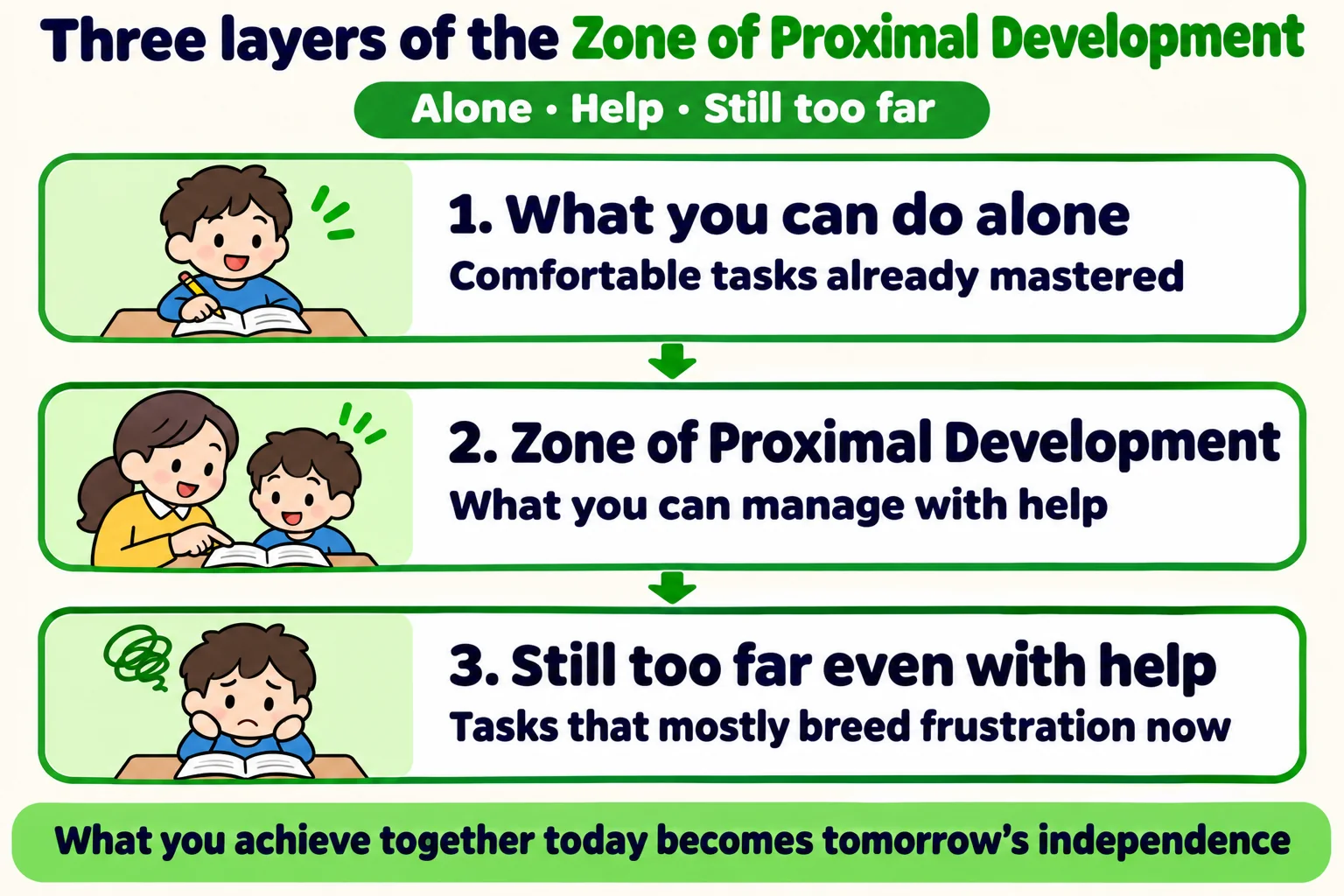
In classrooms and teacher training, the zone of proximal development is often drawn as three layers. Rather than a strict experimental diagram, it is used as a reading frame for judging where to place a task.
(1) The layer you can do alone
These are tasks already mastered. They serve for practice and repetition, but leave little room for new growth. This is the so-called comfort zone.
(2) The layer you can do with help
This is the zone of proximal development itself. Tasks doable with hints, modeling, questions, and cooperation gather here. It is often called the ‘sweet spot’ of a lesson.
(3) The layer still far even with help
This is a stretch that for now easily breeds only frustration. It is better to break the task into smaller pieces or build prior learning so that this layer later comes down into the zone of proximal development.
- Actual Developmental Level (Actual Developmental Level): The level of solving problems independently.
- Potential Developmental Level (Potential Developmental Level): The level that shows under guidance and cooperation.
- More Knowledgeable Other (More Knowledgeable Other): A person or tool more skilled than the learner on that task.
These three layers are not fixed. When a skill learned with help moves into the layer you can do alone, a new task becomes the next zone of proximal development.
The More Knowledgeable Other and what classrooms show

The More Knowledgeable Other (MKO) need not be an older adult. They only need to be more skilled on that task. A teacher, parent, senior student, peer, or even a well-designed tutoring program can fill that role.
(1) Teacher guidance
They model, ask questions that pinpoint the core, and break complex tasks into steps. Rather than giving the answer outright, the approach often discussed is to support the learner in finding the next move themselves.
(2) Peer collaboration
When students with different strengths solve a task together, one may become a guide within another’s zone of proximal development. The one who explains also reorganizes their own thinking.
(3) Language and internalization
Performance that at first leans on outer speech and hints shifts into self-regulation as it becomes private speech and inner speech. Classroom dialogue later becomes a tool of individual thought—that is the reading.
Scenes often used in the field are simple: solving math problems together, unpacking a hard sentence with a partner in reading, or demonstrating an experiment procedure and then handing over steps one by one. The key is placing the task where it is ‘still hard alone, yet possible with appropriate social support.’
How to read it apart from scaffolding

The zone of proximal development and scaffolding are often named in one breath, but they are not the same term. This library already has a piece on scaffolding; here we only briefly separate their places. Scaffolding is a metaphor proposed by Wood, Bruner & Ross (Wood, Bruner & Ross) in 1976 for instructional support that temporarily props up a task a novice cannot yet do alone and is withdrawn as they grow skilled. Vygotsky’s own texts did not use this term.
(1) Zone and method
The zone of proximal development is a developmental–learning concept pointing to ‘where to place the task.’ Scaffolding is closer to a support strategy used inside that zone, or interlocking with it.
(2) What is lost if they are treated as the same
If one gathers only techniques for giving support, the broader discussion Vygotsky raised—social development and measuring potential—can thin out. Conversely, speaking only of the zone and leaving out the regulation of support leaves classroom practice vague.
(3) Use them together, but do not mix the names
In lessons the two are often linked. But substituting ‘zone of proximal development = scaffolding’ blurs both one concept’s breadth and the other’s procedures. It is safer to read the zone first, then decide what support to give and how much to fade.
Between what is still far alone and what is already finished, discerning the place that grows when done together—that is the first step in understanding the zone of proximal development.