The educational environment of the 21st century is changing rapidly, and curriculum design and innovation are essential to keep pace with these changes.
To meet the complex and diverse demands of modern society, we must move beyond traditional educational approaches and develop creative, flexible curricula.
This material explores strategic approaches to future education through four main themes: curriculum design and development, evaluation and improvement, innovation and change, and teacher professional development.
Each theme provides practical insights by combining theoretical background with real-world examples. Through this approach, this material aims to help educators, policymakers, and learners alike prepare for future education.
Curriculum Design and Development
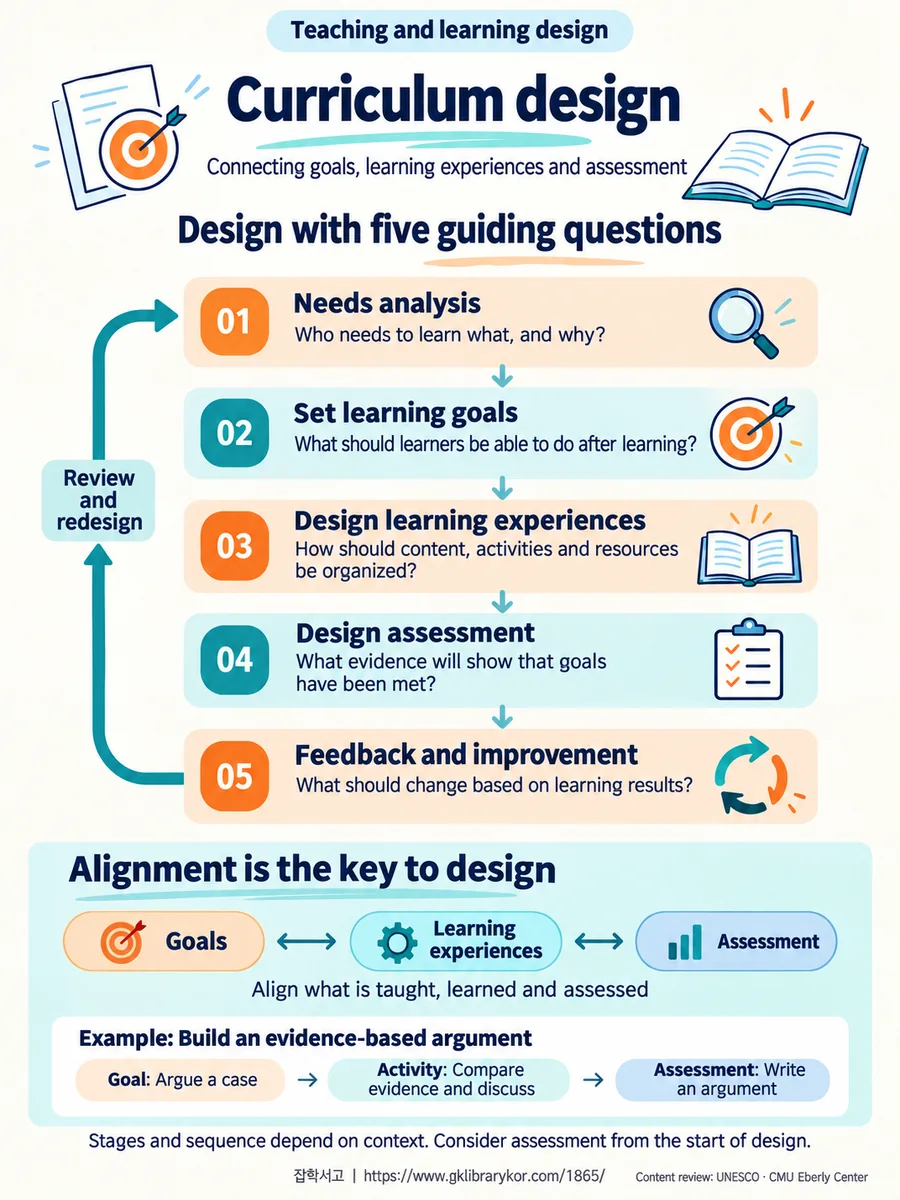
 How should a curriculum be designed?
Curriculum design and development are core elements of education, involving the systematic planning and structuring of what students should learn and how it should be delivered. This process consists of the following main stages.
1. Setting Objectives
The first stage of curriculum design is to set educational objectives. This includes clearly defining what students should attain through the learning process, such as knowledge, skills, and attitudes. The process of setting objectives must reflect factors such as national education policies, the school's educational philosophy, and students' needs.
2. Selecting Content
This stage involves selecting the learning content needed to achieve the established objectives. This process includes various subjects, topics, and learning materials. The selected content must suit students' developmental stages and learning abilities, while taking into account academic rigor and applicability to real life.
3. Organizing Learning Experiences
This stage involves organizing learning experiences so that learning content can be delivered effectively. These experiences include teaching and learning strategies, educational methods, and learning activities. Various teaching approaches, such as student-centered learning, collaborative learning, and project-based learning, can be used in this process.
4. Establishing Assessment Methods
This stage involves establishing methods to assess the extent to which learning objectives have been achieved. Assessment methods can be divided into formative and summative assessment, and various assessment tools, such as tests, assignments, projects, and portfolios, can be used. Assessment is an important tool for monitoring students' learning progress and providing feedback.
5. Feedback and Revision
Curriculum design and development are not completed in a single attempt but are improved through ongoing feedback and revision. The curriculum is periodically reviewed and revised based on students' learning outcomes and teachers' feedback to build a more effective curriculum.
Curriculum design and development are important processes that optimize students' learning experiences and help them acquire the competencies required in future society. Through these processes, educators can provide more systematic and effective education, and students can experience more meaningful learning.
Curriculum Evaluation and Improvement
 What is needed to evaluate and improve a curriculum?
Curriculum evaluation and improvement are important processes that examine a curriculum's effectiveness and use the findings to improve it continuously. This process consists of the following main elements.
1. Establishing the Purpose of Evaluation
The first stage of curriculum evaluation is to clearly establish the purpose of the evaluation. Its purpose is to identify the curriculum's strengths and weaknesses, measure students' learning outcomes, and determine whether the curriculum's objectives are being successfully achieved. The ultimate goal is also to identify ways to improve the curriculum through the evaluation results.
2. Developing Evaluation Tools
Appropriate evaluation tools are needed to objectively evaluate the effects of a curriculum. Various evaluation methods, such as tests, questionnaires, observations, interviews, and portfolios, can be used in this process. Evaluation tools must be reliable and valid, and must accurately reflect students' diverse learning outcomes.
3. Data Collection and Analysis
Evaluation tools are used to collect data on the results of curriculum implementation. The collected data are used to evaluate the curriculum's effectiveness through qualitative and quantitative analysis. This process comprehensively analyzes factors such as students' academic achievement, participation, and satisfaction to identify the curriculum's strengths and weaknesses.
4. Providing Feedback
This stage involves providing feedback to students and teachers based on the evaluation results. Feedback plays an important role in improving learning outcomes and implementing the curriculum more effectively. Students are informed of their strengths and areas for improvement in the learning process, while teachers receive advice on improving the effectiveness of their teaching methods and curriculum implementation.
5. Developing a Curriculum Improvement Plan
A specific plan for improving the curriculum is developed based on the evaluation results and feedback. This process may include resetting educational objectives, adjusting learning content, improving teaching and learning methods, and revising evaluation tools. The curriculum improvement plan must be carried out continuously and systematically, with evaluation and improvement repeated in each cycle.
6. Implementation and Reevaluation
The improvement plan is implemented, and its results are evaluated again to promote the curriculum's continuous development. This process verifies the effects of curriculum improvement and, when necessary, makes further adjustments and revisions to implement an optimal curriculum.
Curriculum evaluation and improvement are essential processes for enhancing the quality of education and maximizing students' learning outcomes. Through these processes, the curriculum develops continuously and becomes better able to respond to the changing educational environment and students' needs.
Curriculum Innovation and Change
 How can the curriculum be innovated, and what are some real-world examples?
Curriculum innovation and change involve improving students' learning experiences by restructuring educational content and innovating educational methods to reflect the rapid changes in modern society. They play an important role in enhancing the quality of education and helping students acquire the competencies they will need in future society. The discussion will focus on examples of innovation and change in South Korea.
1. Integrating Digital Technology
An important element of curriculum innovation in South Korea is the integration of digital technology. This involves enriching learning experiences beyond the traditional classroom environment by using various digital tools and platforms, including online learning, blended learning, and learning that uses virtual reality (VR) and augmented reality (AR).
- Example: The Seoul Metropolitan Office of Education's "Future Classroom" project is an example of creating a learning environment using digital technology. Students can learn various subjects using tablet PCs, smart boards, and VR devices, and interact with teachers in real time through online platforms.
2. Student-Centered Learning
Curriculum innovation includes a shift toward student-centered learning. This involves providing personalized learning experiences tailored to students' interests and needs and encouraging students to participate actively in the learning process.
- Example: Gyeonggi Innovation School is a representative example of implementing student-centered learning. At this school, students set their own learning objectives and learn independently through collaborative learning and project-based learning. Teachers support learning by considering students' individual needs.
3. Project-Based Learning (PBL)
Project-based learning is an approach in which students learn through projects that address real-world problems. It is effective in developing abilities such as collaboration, critical thinking, and problem-solving.
- Example: Haeundae High School in Haeundae District, Busan, is actively adopting project-based learning. Students integrate their learning across various subjects through projects that address local community problems and deepen their learning by presenting their work and receiving feedback.
4. Global Citizenship Education
Global citizenship education is an element of curriculum innovation that helps students develop the competencies needed in a global society. It includes multicultural understanding, sustainability, human rights, and peace education.
- Example: Seoul Global High School emphasizes global citizenship education, offering opportunities to study various international issues and collaborate with students from other countries through international exchange programs. Through these experiences, students can develop a global mindset and grow as members of the international community.
5. Social and Emotional Learning (SEL)
Social and emotional learning aims to help students develop abilities such as emotional management, interpersonal relationships, and responsible decision-making. As part of holistic education, it is important for improving students' overall quality of life as well as their academic achievement.
- Example: The Chungcheongnam-do Office of Education is improving students' social and emotional abilities through SEL programs. The "Creating Happy Schools" project includes various activities that help students understand their emotions and form positive relationships with others.
Curriculum innovation and change go beyond simply introducing new technologies or methods, involving a reconsideration and restructuring of the essence of education so that students can develop the diverse competencies needed in future society. These innovations enhance the quality of education and help students grow through better learning experiences.
Curriculum and Teacher Professional Development
 What is needed to further develop teachers' professional expertise?
Curriculum and teacher professional development are important processes that help teachers design and implement effective curricula. Teacher professional development supports teachers in learning about the latest educational research and methodologies and applying them in educational settings. This process consists of the following main elements.
1. Teacher Training Programs
Systematic training programs are provided to enhance teachers' professional expertise. These programs cover various topics, including curriculum design, the latest teaching methods, assessment methods, and the use of digital tools.
- Example: The Seoul Metropolitan Office of Education's "Seoul Teacher Academy" offers training programs to enhance teachers' professional expertise. The academy conducts various lectures and workshops on curriculum design and development, student-centered learning methods, and the use of digital educational tools.
2. Professional Learning Community (PLC)
Professional learning communities are promoted so that teachers can share their experiences and knowledge and collaborate to solve problems. This creates an environment in which teachers can continue to learn and grow.
- Example: The Gyeonggi-do Office of Education's "Teacher Research Groups" program provides opportunities for teachers to gather voluntarily to research and discuss curricula and teaching methods. Through these community activities, teachers share their experiences and explore effective educational methods together.
3. Mentoring and Coaching
Mentoring and coaching programs are offered so that new teachers can receive guidance and support from experienced teachers. This helps teachers implement curricula effectively and solve various problems they encounter in educational settings.
- Example: The Daejeon Metropolitan Office of Education's "New Teacher Mentoring Program" supports new teachers in quickly adapting to teaching and enhancing their professional expertise under the guidance of mentor teachers. Mentor teachers meet regularly with new teachers to provide advice on curriculum implementation, classroom management, student counseling, and related topics.
4. Teacher Evaluation and Feedback
Teachers' educational activities are evaluated, and feedback is provided based on the results to enhance their professional expertise. Evaluation comprehensively considers factors such as students' learning outcomes, the effectiveness of teaching methods, and teachers' professional expertise.
- Example: The Busan Metropolitan City Office of Education systematically evaluates teachers' educational activities through its "Teacher Competency Evaluation System" and provides tailored training programs and feedback based on the results. Through this process, teachers can identify their strengths and weaknesses and further enhance their professional expertise.
5. Strengthening Digital Literacy
Digital literacy education is strengthened so that teachers can use digital tools and resources effectively. This enables curriculum implementation suited to the digital age.
- Example: The Incheon Metropolitan City Office of Education's "Digital Teacher Training Program" supports teachers in implementing curricula using the latest digital educational tools and platforms. Through this program, teachers learn how to create and use various digital learning materials and apply these methods in educational settings.
Curriculum and teacher professional development are important elements that help teachers design and implement curricula effectively. Through these elements, teachers can continue to grow and provide students with better education. Teacher professional development ultimately makes a significant contribution to improving students' learning experiences and achievement.
Curriculum design and innovation strategies for future education go beyond simply adding new content and involve reconsidering and innovating the essence of education.
By considering curriculum design and development, evaluation and improvement, innovation and change, and teacher professional development in an integrated manner, we can create a better educational environment and help students develop the ability to adapt successfully to future society.
Responding proactively to the changing educational environment requires ongoing research and collaboration, as well as continuous efforts to improve.
We hope this material provides useful information and inspiration to educators, policymakers, and learners alike, contributing to the advancement of future education.