Have you ever watched a film scene in which the face of the person in front, the conversation partner deep inside the room and even a child playing outside the window were all clearly visible? Usually in photos and videos only the subject in focus is sharp and the rest tends to blur, but in such a scene the entire frame stays sharp and alive. In film and media studies, this way of shooting is called ‘deep focus’.
Simply put, deep focus means ‘a shooting technique that keeps the foreground, middle ground and background of the frame all sharp, from the area closest to the camera to the farthest’. It became widely known when cinematographer Gregg Toland used it extensively in director Orson Welles’s 1941 film Citizen Kane.
In this article, we will look in turn at the meaning and origins of deep focus, the principles behind creating it, a representative example seen in Citizen Kane, and how deep focus is used today.
A Shooting Technique That Keeps the Whole Frame Sharp
The Meaning and Origins of Deep Focus
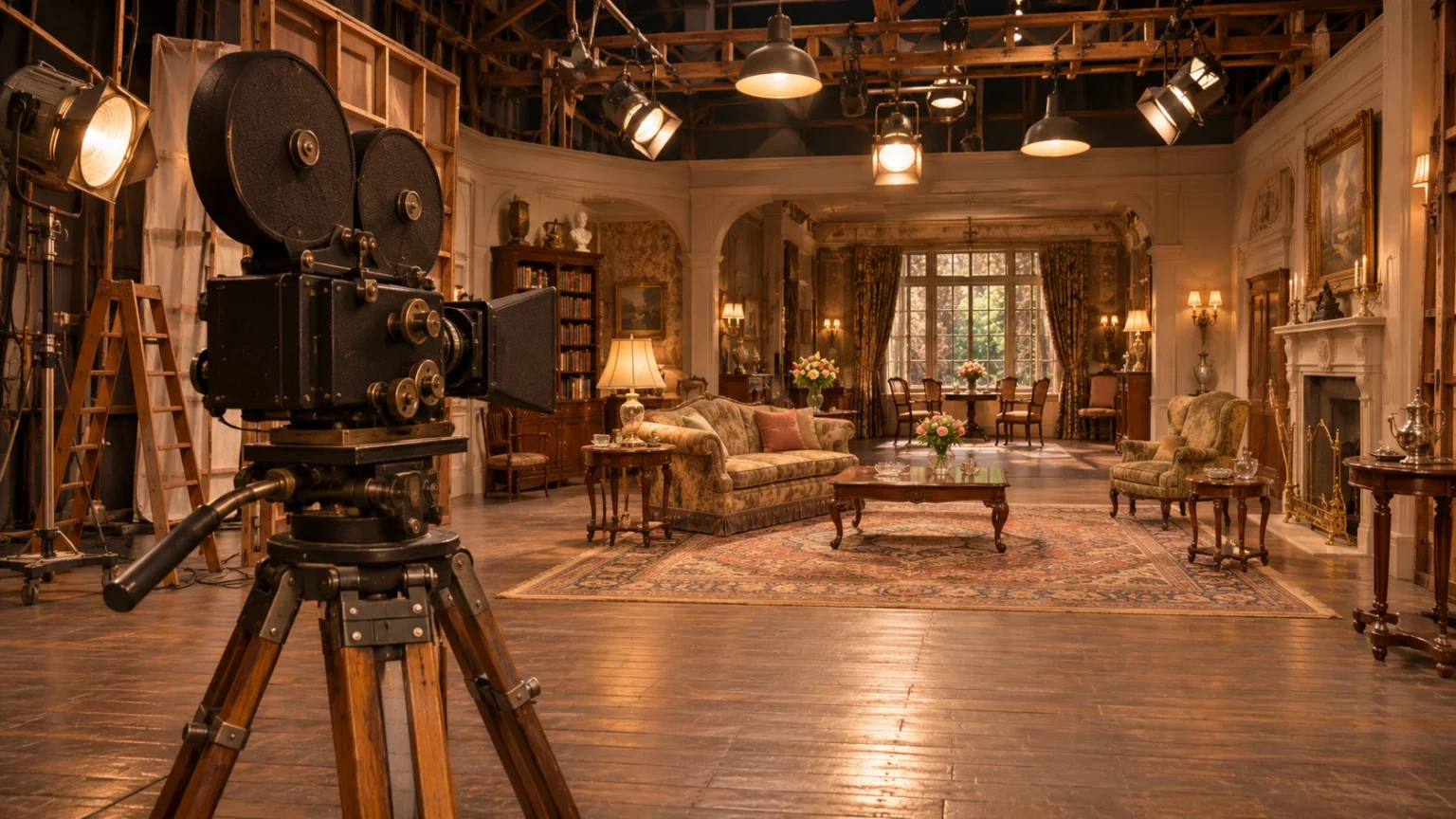
A camera lens can bring only one distance into exact focus. The range in front of and behind it that looks ‘acceptably sharp’ is called the depth of field, and deep focus is a way of widening this range as much as possible so that the image stays sharp deep into the frame.
(1) The difference from shallow focus
A frame in which only the main character is sharp and the background is blurred is called shallow focus. If shallow focus gathers the audience’s gaze on one spot, deep focus shows several subjects at once in a single frame.
(2) Sharp images in early cinema
Early silent films were often shot in bright sunlight with wide angles of view, so their images were relatively sharp in depth. In the 1920s and 1930s, however, factors such as a cinematographic taste for soft images came together, and shallow focus became common.
(3) Its return in the 1930s and 1940s
Staging that layered characters in the front and back of the frame continued, as in Jean Renoir’s The Rules of the Game (La Règle du jeu, 1939), and when Citizen Kane showed it dramatically in 1941, deep focus became established as a style of cinematography.
The Principles Behind Deep Focus
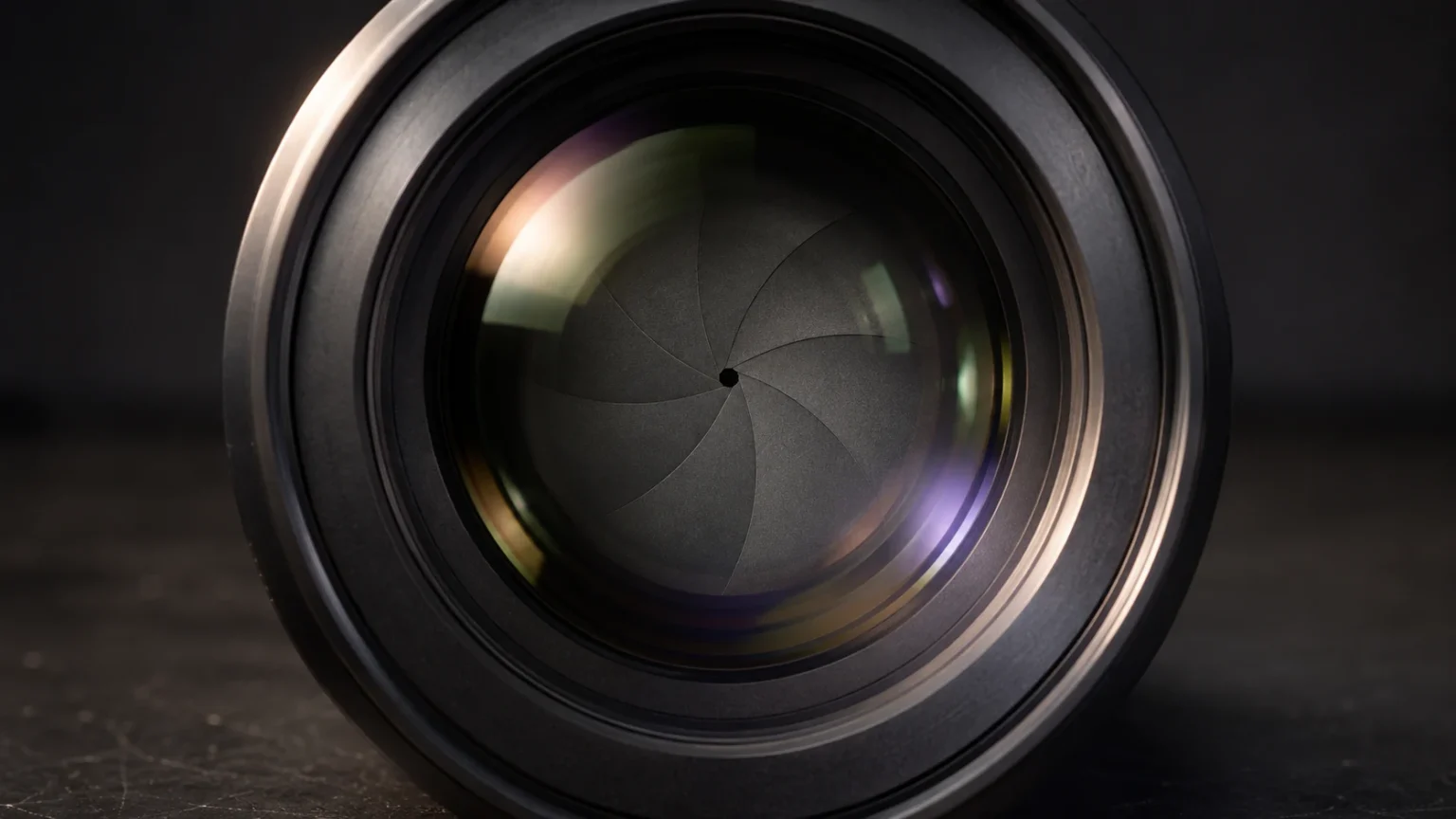
Depth of field changes with the size of the aperture, the focal length of the lens and the distance to the subject. Deep focus is created by setting these conditions so that the whole frame becomes sharp.
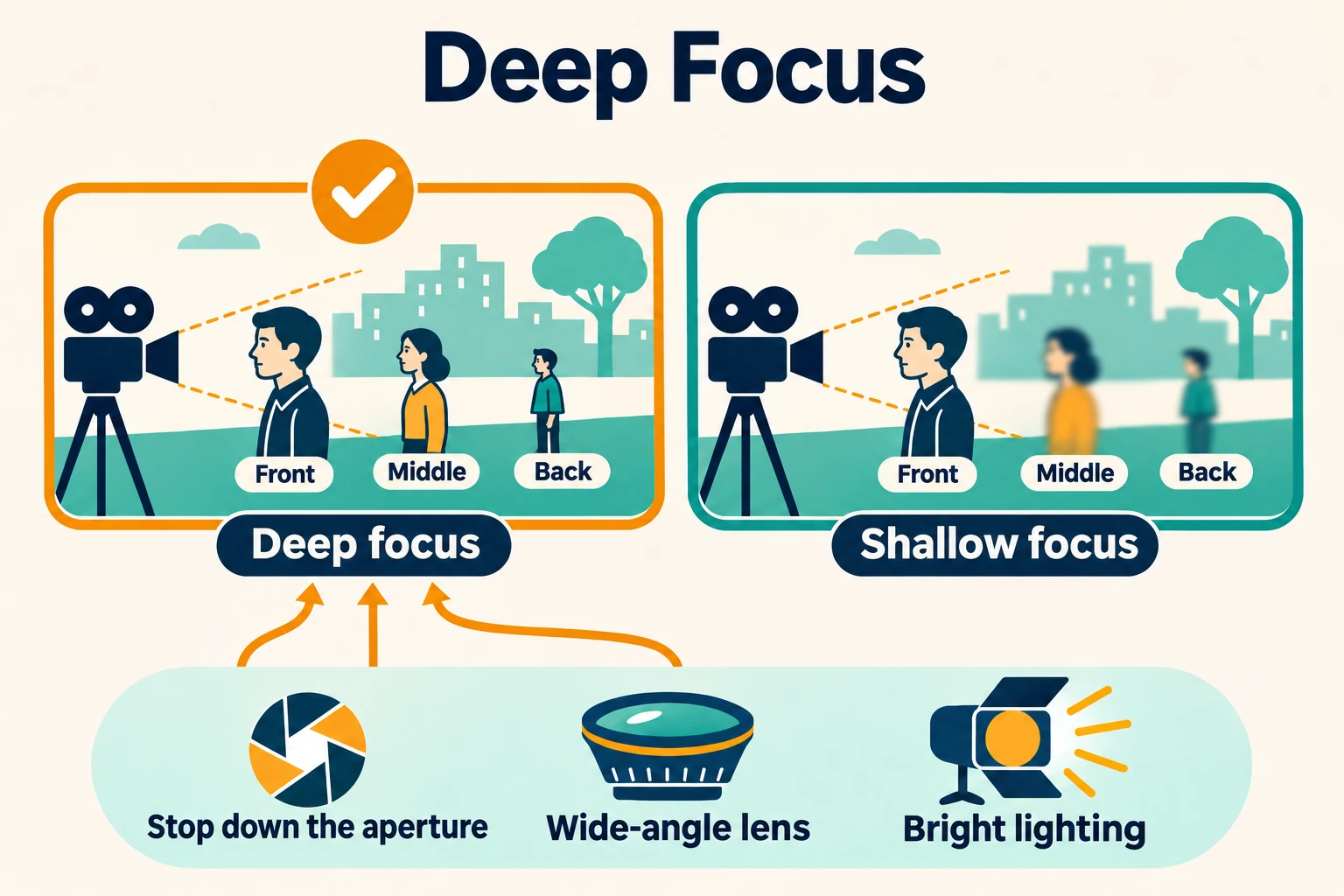
- Depth of Field: the range in front of and behind the focused distance that looks sharp.
- Aperture: the opening that controls how much light enters the lens; the smaller it is stopped down, the deeper the depth of field.
- Wide-Angle Lens: a lens with a short focal length, which shows a deeper depth of field than a telephoto lens under the same conditions.
- Hyperfocal Distance: the reference distance at which, if you focus there, everything from half that distance to infinity falls within the sharp range.
(1) Why stop down the aperture
The smaller the aperture opening, the smaller the blur of light that forms where the image is out of focus, so a wider range looks sharp. In return, less light comes in, so more lighting is needed to keep the image bright.
(2) The effect of lens and distance
Using a wide-angle lens or shooting from a little farther away from the subject widens the sharp range. Conversely, the closer you shoot with a telephoto lens, the more easily the background blurs.
(3) Support from film and lighting
Because stopping down the aperture reduces the light, high-sensitivity film or sensors and sufficient lighting are needed together to use deep focus reliably.
A Representative Example: Citizen Kane

In Citizen Kane, Gregg Toland combined high-sensitivity film, strong lighting and wide-angle lenses to capture both the front and the back of indoor scenes sharply at the same time. The film is still the first work mentioned when deep focus is explained.
(1) Young Kane outside the window
In an indoor scene where his mother signs papers entrusting her son’s future to others, young Kane, playing with his sled in the snow outside the window, remains clearly visible in the frame. The audience sees the adults’ decision and the child’s fate together in a single frame.
(2) Help from special techniques
Not every shot was made with the lens alone. Some shots achieved their deep image through special effects such as multiple exposure, in which the front and back were filmed separately and combined in one frame.
(3) André Bazin’s assessment
The French critic André Bazin held that instead of directing the gaze through cuts, deep focus lets the audience choose for themselves where to look within the frame, and he praised it highly as a technique that respects the ambiguity of reality.
How Deep Focus Is Used Today
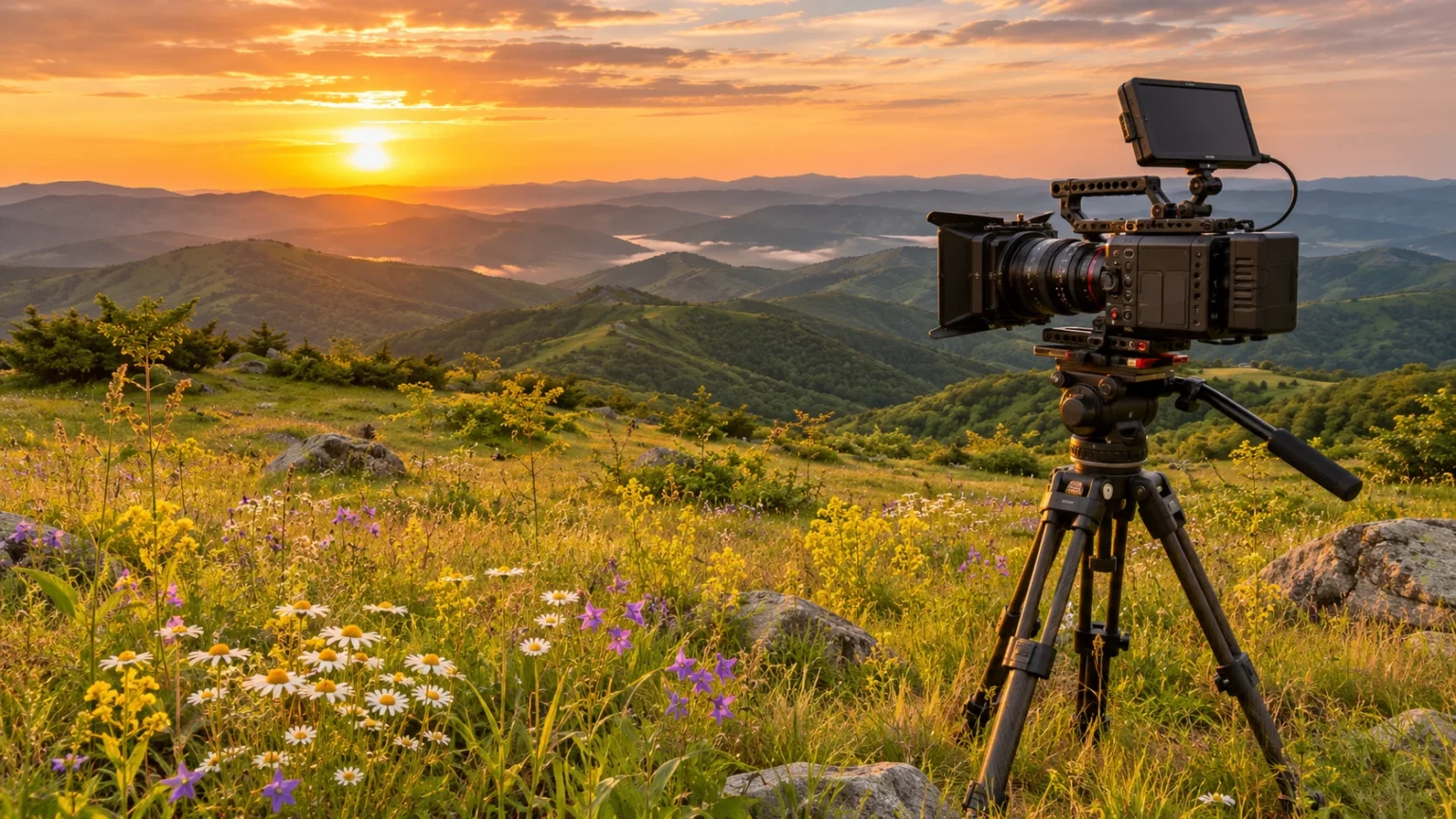
Even in the digital age, deep focus is used when filmmakers want to capture the relationship between space and characters in a single frame. However, the ways of creating it have changed somewhat depending on equipment and modes of expression.
(1) Sensor size and depth
Cameras with large sensors blur the background easily, while cameras with small sensors, like smartphones, have a deeper depth of field at the same angle of view, so the front and back are easily captured sharp together.
(2) Using a split diopter
With a split diopter, an auxiliary lens attached over only half of the front of the lens, you can focus at the same time on a near subject on one side of the frame and a far subject on the other. It is known as a technique often used by director Brian De Palma.
(3) Choosing to suit the scene
Shallow focus is effective when concentrating on a character’s emotions, and deep focus when showing the relationship between characters and space. Cinematographers choose between the two depending on what the scene is meant to convey.
The simple idea that when both the front and back of the frame are sharp, it is the audience who chooses where to look: that is the first step to understanding deep focus.