When we picture a huge warehouse, we often think only of seemingly endless floor space. Yet the real innovation in modern logistics begins with the use of vertical space reaching toward the sky, rather than the floor.
Racking (Rack) is the key to using this vertical space and plays a pivotal role in provisioning the vast puzzle that is a warehouse. Racks are more than shelves for stacking goods. The types of racks selected and how they are arranged can multiply a warehouse's storage capacity and dramatically improve dispatch speeds, ultimately making them a key factor in a company's logistics costs.
However, when it comes time to introduce racks, the sheer variety of types and uses can easily become confusing. From pallet racks to drive-in racks and cutting-edge automated racks. Today, GK Library will take an in-depth, easy-to-understand look at the types of racks and their uses, which can dramatically improve the efficiency of complex warehouses. Let's explore which racks suit our warehouse and where the racks of tomorrow's logistics are heading.
Storage Fundamentals: Pallet Racking (Pallet Rack) - The Starting Point for Every Warehouse
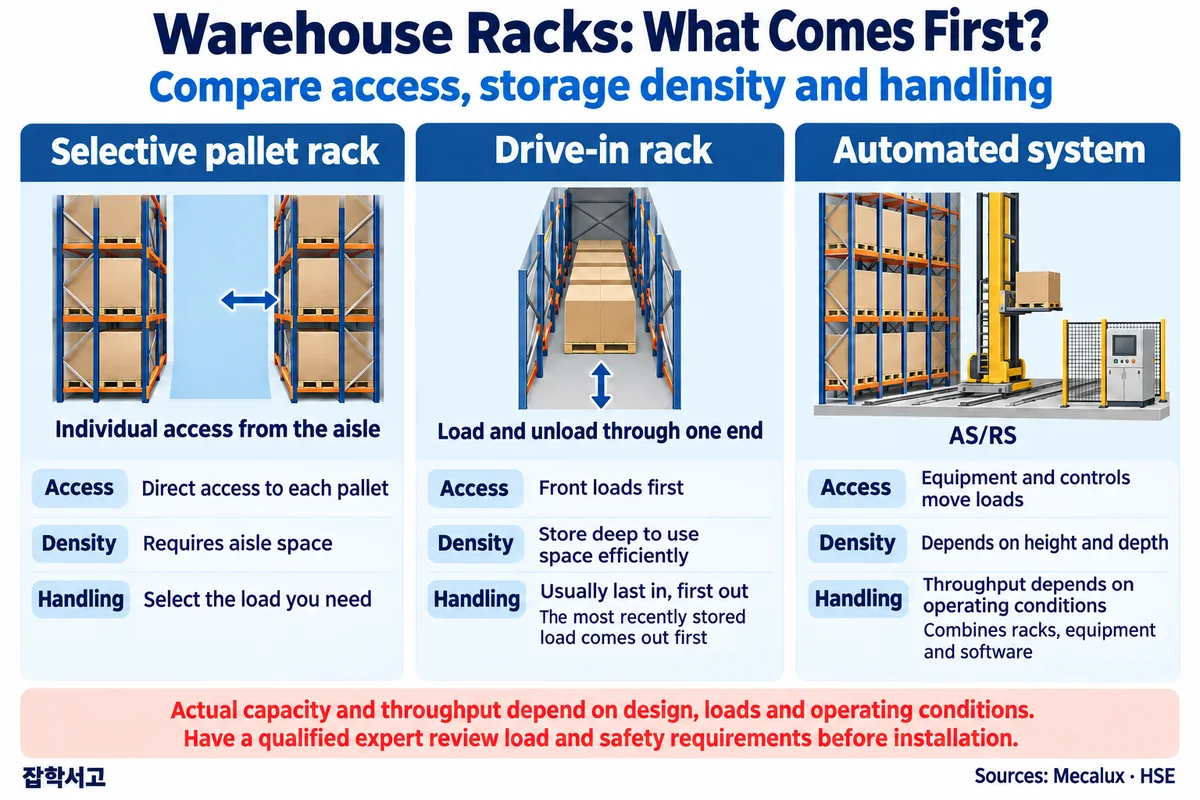

The first type we will introduce is pallet racking (Pallet Rack), the most common type found in logistics operations. If you have visited a warehouse, you have probably seen wooden pallets stacked in layers between steel uprights; that is pallet racking.
Uses and Features
As its name suggests, pallet racking is optimized for storing standardized loads in pallet units. Its greatest advantages are flexibility and accessibility. The height and width of the racks are easy to adjust, and above all, a forklift can immediately access any pallet directly to put it away or retrieve it.
An Illustrative Example
Imagine the warehouse of a large supermarket. Dozens of different kinds of snacks, drinks, and daily necessities arrive and leave on pallets every day. When a pallet of cola or a pallet of snacks needs to be dispatched urgently, pallet racking allows a forklift to retrieve just the goods needed. This makes it the most fundamental yet efficient type of racking for storing small quantities of many different products or large quantities of standardized loads.
Maximizing Space Utilization: Drive-In Racking (Drive-In Rack) - Eliminating Aisles

While pallet racking emphasizes accessibility, drive-in racking (Drive-In Rack) takes space utilization to its limit. Pallet racking requires aisles for forklifts to travel through, but drive-in racking turns even those aisles into storage space.
Uses and Features
Drive-in racking is designed so that a forklift drives directly into the rack to store or retrieve loads. In other words, goods are packed closely together, leaving only the minimum entrance space needed for a forklift to enter. As a result, it can store far more goods than pallet racking within the same area.
This approach is closer to last-in, first-out (LIFO, Last-In-First-Out) than first-in, first-out (FIFO, First-In-First-Out). This is because goods at the front must be removed first to retrieve those farther inside. It is therefore particularly suitable for storing large quantities of identical goods with low turnover or no expiration date.
An Illustrative Example
Shall we take a frozen-storage warehouse or a rice-storage warehouse as an example? Rice has a very long shelf life, and it is all of the same type. There is no need to retrieve the sacks of rice in the corner first. In such a warehouse, eliminating aisles and filling drive-in racks to store as much rice as possible is cost-effective.
The Core of Future Logistics: Automated Rack Systems (AS/RS) - Achieving Speed and Accuracy

The final type we will introduce is the pride of modern logistics: the automated rack system (Automated Storage and Retrieval System, AS/RS). It goes beyond a simple steel structure to offer a cutting-edge solution integrating robots, computer systems, and racks into a single system.
Uses and Features
In an automated rack system, people do not drive forklifts. Instead, a stacker crane (Stacker Crane) or shuttle robot (Shuttle Robot) travels between racks under computer instructions to store and retrieve goods. These machines move up and down racks tens of meters high in an instant, locating and transporting goods without the slightest error.
Advantages
- Maximum Use of Vertical Space: Since people do not perform the work, racks can extend all the way to the warehouse ceiling. (30 m or higher is possible)
- Ultrafast Storage and Retrieval: The speed of robots is beyond comparison with that of people. They can process large volumes of orders at dramatically faster speeds.
- Accuracy: Since the computer system manages all inventory perfectly, the mispicking rate (dispatching the wrong goods) is close to 0%.
- 24-Hour Operation: Robots do not rest.
An Illustrative Example
Think of an e-commerce company's fulfillment center. Tens of thousands of different orders arrive every day. A pair of sneakers, a lipstick, and a book must be quickly located and packed. People cannot keep up by walking around such a vast warehouse to find them. This is where an automated rack system enables robots to locate ordered goods in an instant and bring them to the packing workstation. This is the secret behind receiving the goods we order today by tomorrow morning.
The Right Racks for Our Warehouse Are a Competitive Advantage
We have explored the three key rack systems that determine a warehouse's space efficiency: pallet racking, drive-in racking, and automated rack systems (AS/RS).
Each type has distinct advantages, disadvantages, and ideal uses.
Pallet racking, with its excellent flexibility and accessibility, is suited to general warehouses handling a variety of goods,
Drive-in racking, which maximizes space utilization, is suited to frozen or refrigerated warehouses and long-term storage warehouses holding large quantities of identical goods,
Automated rack systems are suited to e-commerce and advanced manufacturing logistics that require speed, accuracy, and maximum space utilization.
Ultimately, there is no such thing as the best rack. What matters is choosing the most suitable rack system by considering our warehouse's characteristics, the types of goods, turnover rates, and budget together. This is the path to reducing logistics costs, providing faster service to customers, and securing a strong competitive advantage for the company.