Did you know that a parcel sent from Seoul to Busan often stops somewhere in Gyeonggi Province overnight before heading south? At first glance it looks like a long detour, but gathering parcels from across the country in one place and then sorting them by destination is actually faster and cheaper. The logistics design behind this approach is the ‘Hub-and-Spoke Model.’
Put simply, hub-and-spoke means ‘a transport network structure in which cargo from many origins is gathered at a central base (the hub), sorted by destination, and sent back out to each region (the spokes).’ The hub is the center of a bicycle wheel and the spokes are the rods running from it to the rim; the name comes from the fact that a drawing of the network resembles a wheel.
In this piece we will look in turn at the basic principle of hub-and-spoke, FedEx’s pioneering success, its strengths and limits, and how it works today in parcel delivery and aviation.
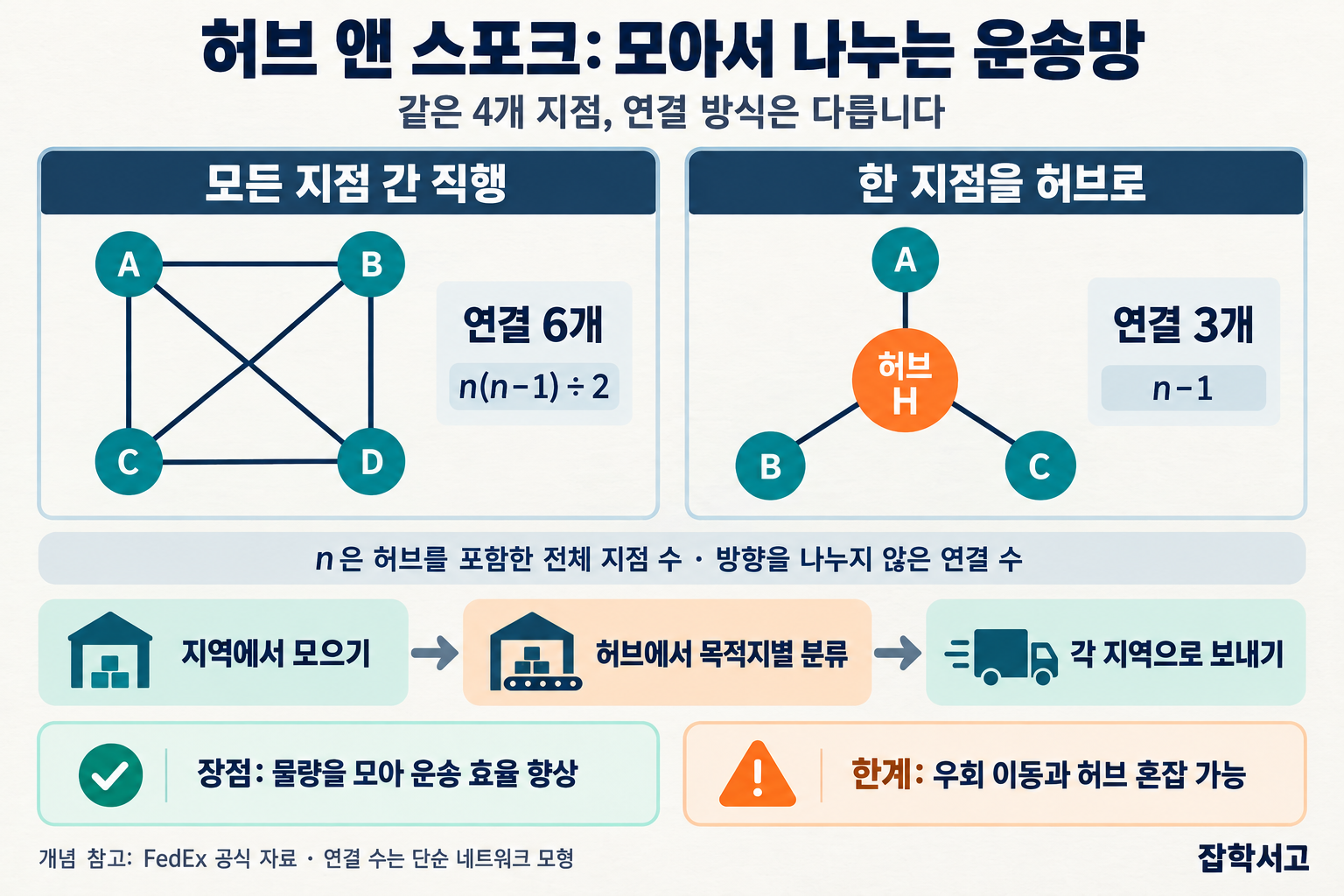
The Principle of a Network That Gathers in One Place and Redistributes
What Is Hub-and-Spoke?

There are two broad ways to design a transport network: connecting every point directly to every other, or connecting them through a central base.
(1) Point-to-Point
This is a direct method that goes straight from origin to destination. With no transfers or reloading it is fast, but the number of routes to be connected grows quickly as points are added. With n points, connecting every pair requires n × (n - 1) ÷ 2 routes.
(2) Hub-and-Spoke
This method connects every point only to a single hub. With n points, n - 1 routes are enough. Take four cities as an example: the direct method needs 6 routes linking them to one another, but if one city becomes the hub, 3 routes to the other three cities do the job. To connect 100 points, the direct method would need 4,950 routes, whereas the hub method lets traffic move between every point with 99.
Fewer routes mean fewer trucks, planes, and workers. In exchange, most cargo has to pass through the hub once, so how quickly and accurately the hub sorts decides the success of the whole network. That is why hubs are run with tightly matched schedules for inbound and outbound vehicles, so cargo does not linger but moves straight on to its next route.
Overnight Delivery, as Proven by FedEx
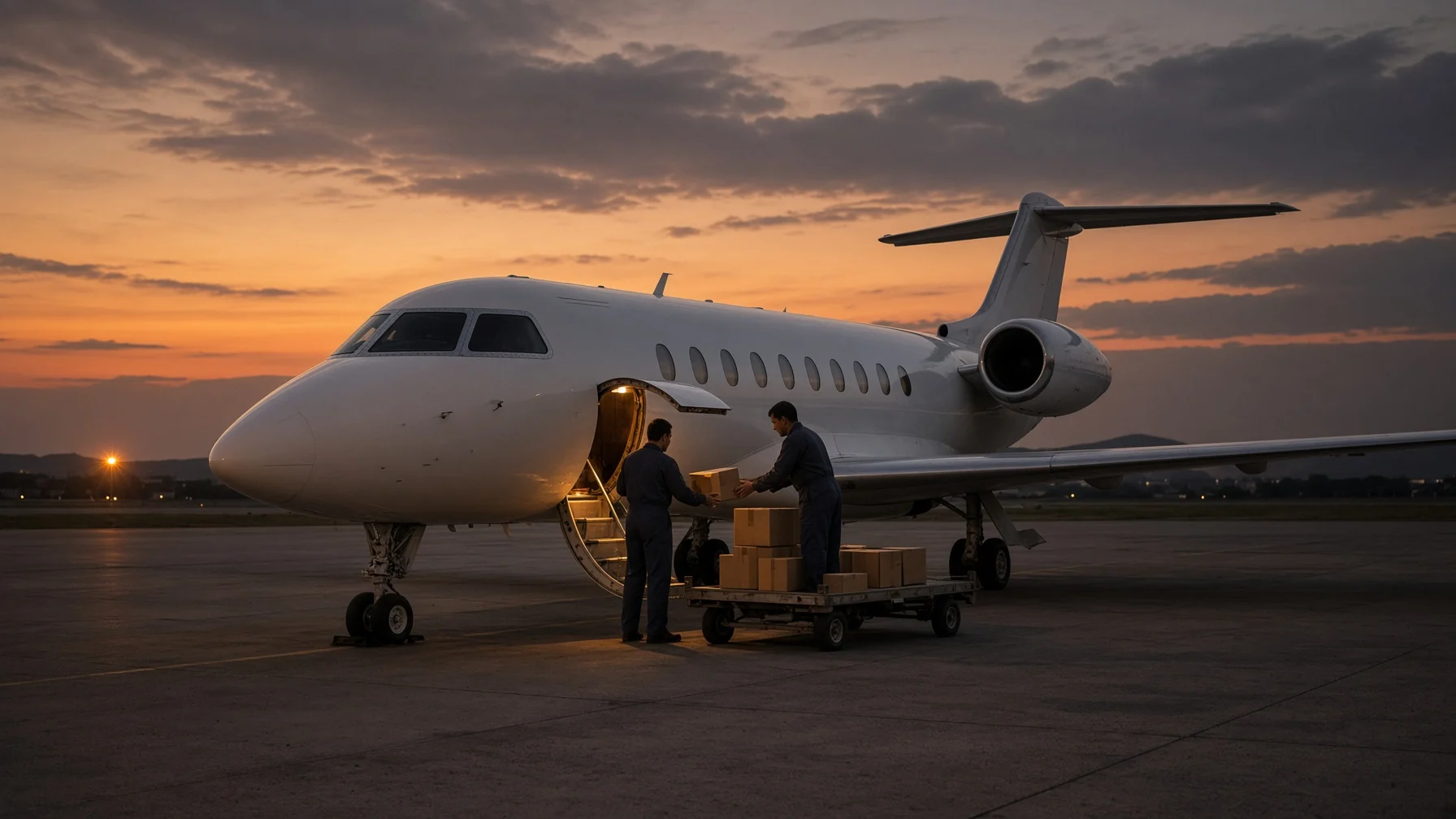
The company that showed the world the power of hub-and-spoke was FedEx (Federal Express) of the United States. Its founder, Frederick W. Smith, is said to have sketched the outline of the company in a paper he wrote as a Yale undergraduate analyzing the inefficiency of air freight.
On April 17, 1973, FedEx began operations with Memphis, Tennessee, as its hub. That night 389 employees and 14 small jets delivered 186 packages to 25 U.S. cities. The system flew packages collected in each city to Memphis overnight, sorted them all at once, and then flew them out to their destination cities before dawn for delivery in the morning. The first few years brought losses, but in July 1975 the company turned its first profit, opening up a new market for overnight delivery.
- Central Location: Memphis lies close to the middle of the United States, so flight distances to any city were evenly short.
- Weather Reliability: Memphis airport rarely closed due to bad weather, which made it easy to keep to a fixed schedule every night.
Strengths and Limits of Hub-and-Spoke
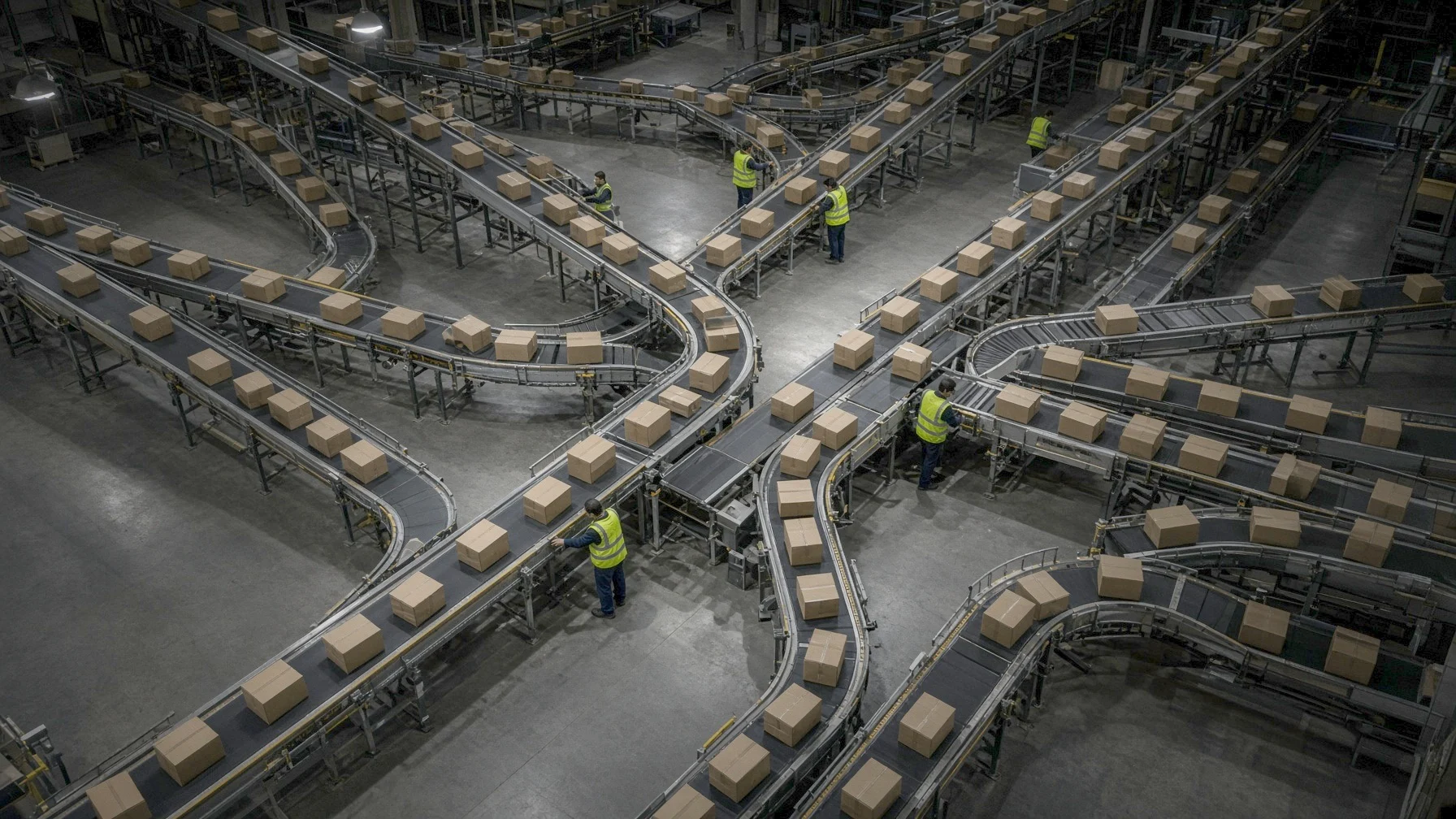
Hub-and-spoke became something of a standard after U.S. airline deregulation in 1978, when major airlines rushed to adopt it. It has clear strengths, but it also carries weaknesses that are hard to avoid.
(1) Strengths of Hub-and-Spoke
Pooling small volumes from many regions at the hub lets large trucks and planes leave fully loaded, lowering the transport cost per item. The routes are also simple, so adding a new region only takes one new link to the hub.
(2) Limits of Hub-and-Spoke
Even cargo moving between two nearby points has to detour through the hub, which adds distance and time. Because every flow converges on one place, if the hub gets crowded or stops due to heavy snow, a power outage, or a breakdown, the whole network stops with it. That is why direct routes are mixed in on high-demand segments, or several hubs are set up to spread the risk.
Hubs in Today’s Parcel Delivery and Aviation
Most parcel delivery in Korea also runs on this structure. Boxes that a driver collects in the neighborhood pass through a nearby sub-terminal and gather at a hub terminal overnight; once sorted by region, they go through the destination sub-terminal and arrive at the door.
- Mega Hub: The Gonjiam Mega Hub Terminal, opened by CJ Logistics in 2018 in Gwangju, Gyeonggi Province, has a total floor area of about 300,000 square meters and sorting conveyors about 43 kilometers long, and is said to be able to handle around 1.75 million boxes a day.
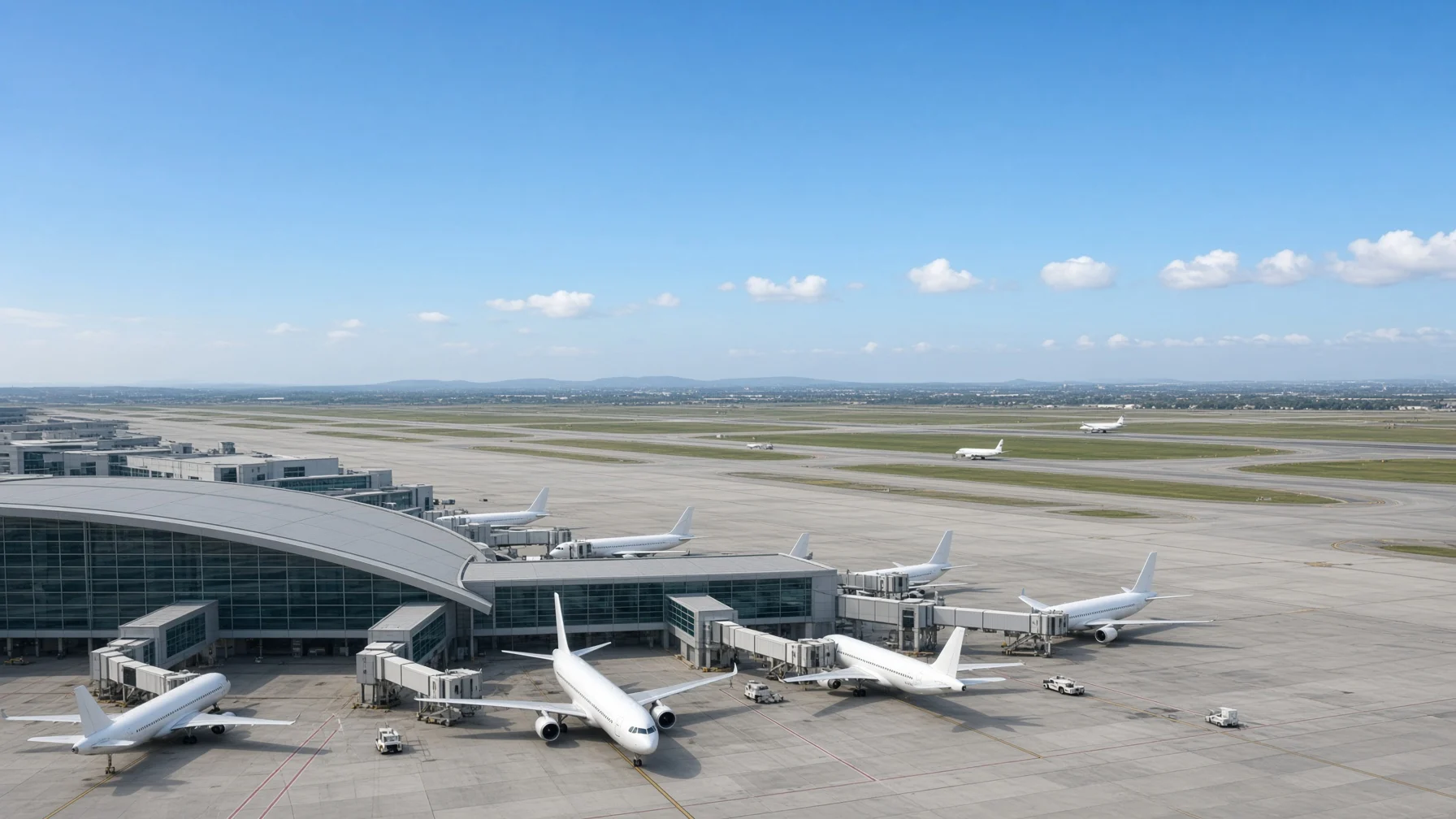
- Hub Airport: Major airlines use airports such as Incheon, Dubai, and Frankfurt as hubs, gathering passengers from many cities and having them transfer there.
- Transshipment Port: Large ports such as Busan act as hubs of the sea, unloading containers from many countries and reloading them onto other ships.
- Point-to-Point Strategy: Some low-cost carriers, such as Southwest Airlines in the United States, have succeeded by flying mainly direct routes that skip the hub.
Hub-and-spoke is a transport network structure that gathers scattered cargo in one place, sorts it, and sends it back out; it greatly reduces routes and costs but places a heavy burden on a single hub. Born from FedEx’s overnight delivery, this design is at work every day in parcel boxes and airline transfers.
Finding the path where things gather best before the shortest path—that is the first step in designing an efficient transport network.