Picture a doctor in a hospital telling a patient who is about to have surgery, “Nine out of ten people who have this operation go home alive,” and then picture the doctor saying instead, “One out of ten people who have this operation dies.” The two sentences point to the same fact, yet the listener’s mind moves in completely different directions. The decisions we make are swayed not only by what is said but also by the shape of the words that carry it.
This phenomenon is the “Framing Effect.” It is a cognitive bias in which people’s choices change depending on whether logically identical options are presented in terms of gains or in terms of losses. It is one of the best-known findings in behavioral economics and psychology.
In this article, we will look in turn at the study that first revealed the framing effect and the prospect theory behind it, three ways frames are used, examples from everyday life, and how to avoid being swayed.
How the Same Fact Produces Different Choices
The Twist Revealed by the Asian Disease Problem

The people who brought the framing effect to the world were the psychologists Amos Tversky and Daniel Kahneman. In 1981, the two published a paper in the journal Science titled “The Framing of Decisions and the Psychology of Choice.”
(1) The experimental setup
Participants were told that a deadly disease was spreading and that 600 people were expected to die, and they were asked to choose one of two programs.
(2) When presented in terms of gains
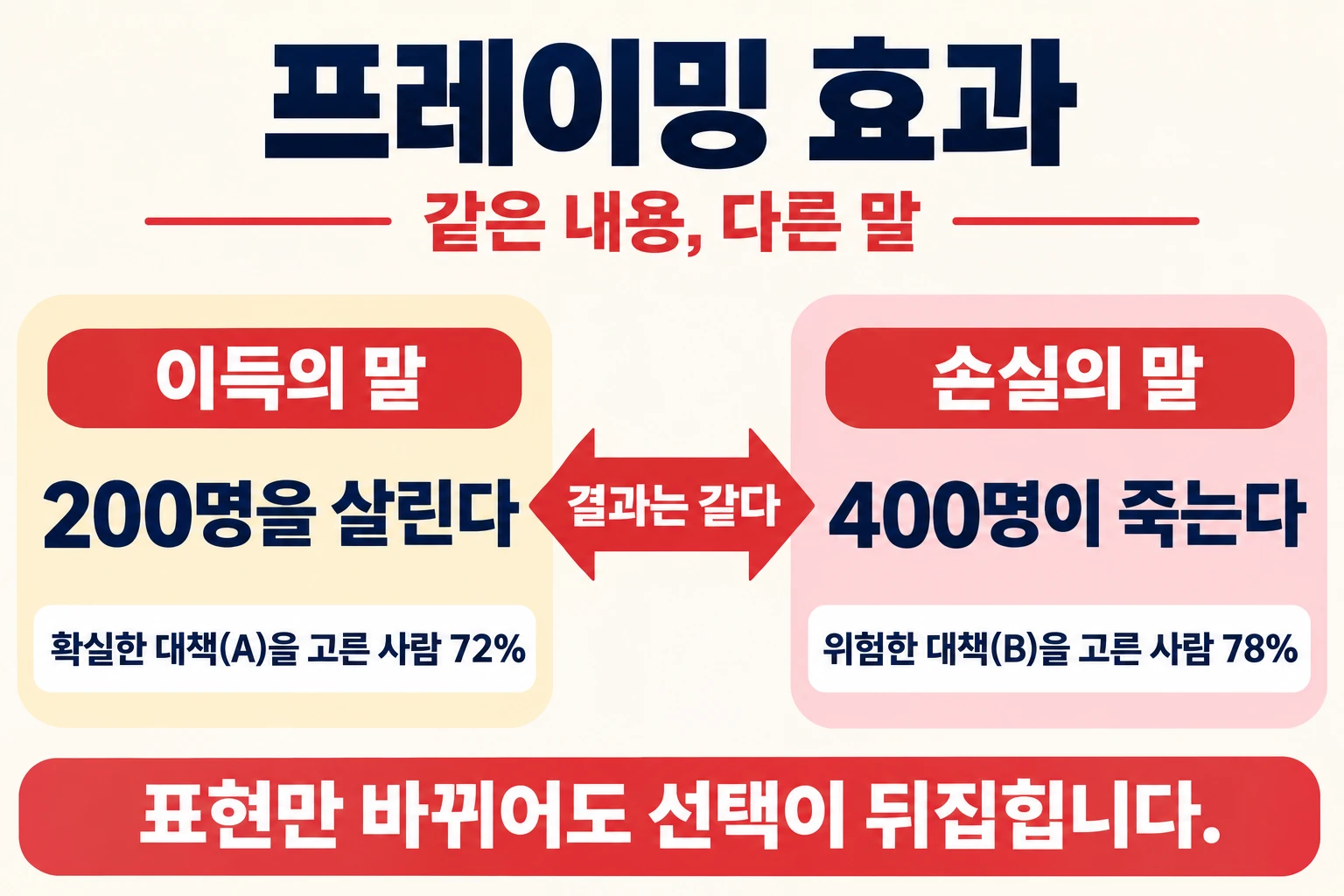
Program A would save 200 people for certain, while Program B had a one-in-three chance of saving all 600 and a two-in-three chance of saving no one. In this version, 72 percent chose the certain Program A.
(3) When presented in terms of losses
Under Program A, 400 people would die for certain, while under Program B there was a one-in-three chance that no one would die and a two-in-three chance that all 600 would die. This time, 78 percent chose Program B, which is closer to a gamble.
(4) The hidden twist
The outcomes in the two questions are numerically identical. The only thing that changed was the wording, “save” versus “die,” and yet the majority’s choice flipped to the opposite.
The Explanation Called Prospect Theory

Tversky and Kahneman explained this result with Prospect Theory. The idea is that people judge not by the absolute size of their final wealth or outcome, but by how much they have gained or lost relative to some reference point.
- Gain Domain: In situations where gains are at stake, people tend to prefer a certain small gain over an uncertain larger one.
- Loss Domain: In situations where losses are at stake, people tend to take a risk and bet on the uncertain option rather than accept a certain loss.
- Loss Aversion: This is the tendency for a loss to feel larger than a gain of the same size.
A frame moves exactly this reference point. The same event is recorded as a gain if you look at it as “people saved” and as a loss if you look at it as “people lost,” and the choice changes accordingly.
Three Ways Frames Are Used

Researchers later sorted the framing effect into three broad branches.
(1) Risky choice framing
This is the case where the choice between a certain outcome and a risky outcome changes, as in the Asian disease problem.
(2) Attribute framing
This is the case where the evaluation of an object changes depending on whether one of its characteristics is described positively or negatively. A typical example is that the same meat is rated tastier when labeled “75 percent lean” than when labeled “25 percent fat.”
(3) Goal framing
This is the case where the willingness to act changes depending on whether the message stresses the benefit gained by acting or the harm suffered by not acting.
It is not hard to find examples in daily life. In one experiment, 93 percent of doctoral students registered early when they were told a fine would be charged after the registration deadline, but only 67 percent did so when they were told early registration would earn a discount. In a savings app, when the same amount was shown as 5 dollars a day, about 30 percent signed up for regular deposits, but when it was shown as 150 dollars a month, only about 7 percent did.
Politics and policy are no exception. There is research showing that the same economic policy wins more support when it is explained with the employment rate up front than with the unemployment rate. There are also differences by age: young children tend to look at the numbers in the options, but as they grow older, the tendency to choose the certain option when facing gains and the risky option when facing losses becomes stronger.
How to See Without Being Boxed In

The framing effect is counted among the very strong biases, but it cannot be avoided entirely. Research has found a few clues.
(1) Rereading with the opposite frame
Deliberately flip the sentence you received. Change “nine out of ten survive” to “one out of ten is lost,” and check whether you still feel the same.
(2) Spelling it out in numbers
Calculating percentages, ratios, and reference points yourself lets you focus on the content rather than the surface. Studies show the framing effect shrinks when people are encouraged to reason analytically.
(3) Adding reliable information
It is known that the effect shrinks or disappears when sufficient and trustworthy information is given.
(4) Thinking from a step back
There is also research showing that bias is reduced when a problem is read in a foreign language. This is interpreted to be because less emotion gets involved and people reason more slowly than in their native language.
(5) Calling up slow thinking
In his book Thinking, Fast and Slow, Kahneman explained that fast, intuitive thinking is more easily swayed by appearances. The more important the decision, the more it helps to slow down and take a beat.
The framing effect tells us that the shape of words can change the direction of the mind. It leaves speakers with the task of expressing themselves responsibly, and listeners with the task of stripping away the wrapping to see the content.
The next time you feel pulled toward one choice, try rereading the same content in the opposite words once. That is the first step to understanding the framing effect.