If losing a job when a company runs into trouble meant finding a new one soon, with living costs and training covered in the meantime, switching workplaces would not feel so frightening. Conversely, a job that is hard to leave once you are in it is stable, but companies grow reluctant to take on new people, and the threshold for getting a job rises. There is an attempt to resolve both worries at once.
Its name is “Flexicurity.” It is a blend of the English words “flexibility” and “security,” and it is an approach that keeps together a flexible labour market, in which companies can hire and let people go with ease, and thick social protection that safeguards the living of those who have lost their jobs. The term is said to have been coined in the 1990s by Poul Nyrup Rasmussen, the Social Democratic prime minister of Denmark.
In this article, we will look in turn at what Flexicurity is meant to protect, the “golden triangle” structure of Denmark, its roots and costs, and then how it spread to the European Union and the criticism it has met.
A System That Holds Flexibility and Security Together
The Idea of Protecting People, Not Jobs

The heart of Flexicurity lies in changing what is being kept secure. Instead of guarding one position at one company for a lifetime, it supports the lives of working people so that they stay steady in whatever job they hold.
(1) Two faces of flexibility
Flexibility does not mean only “numerical flexibility,” in which companies easily increase or cut their workforce. It also includes “functional flexibility,” which lets people learn new skills and take on different work.
(2) A new meaning of security
Security is not about staying at one workplace; it is closer to the confidence that income will not be cut off even if work is lost and that you can cross over to the next job without strain. That is why unemployment benefits and vocational training sit at the center of security.
(3) Two values that do not oppose each other
People often think of flexibility as the employer's interest and security as the worker's, but Flexicurity treats the two values as complementing each other. The logic is that when changing jobs becomes easier, companies hire more readily, and when the safety net is solid, workers fear change less.
Denmark's Golden Triangle

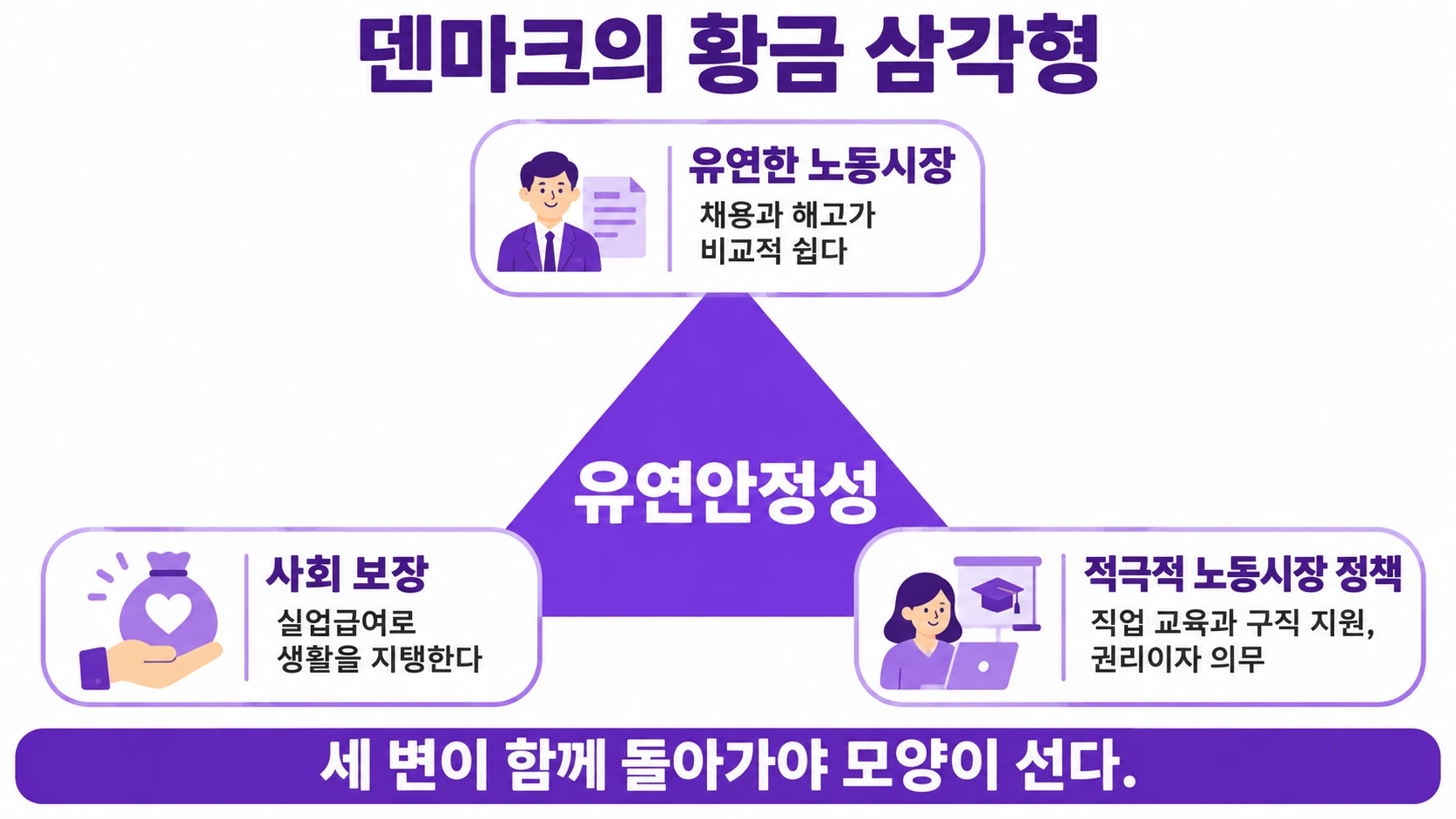
The Danish government describes its approach with the phrase “golden triangle.” Just as a triangle holds its shape only when its three sides support one another, the three elements below must run together.
- Flexible Labour Market: Employers can hire and dismiss people relatively easily as needed, so jobs come and go quickly.
- Social Security: People who lose a job receive a considerable level of unemployment benefit, which sustains their living.
- Active Labour Market Policy: The unemployed are offered vocational training and job-search support, and in return are also expected to make an effort to find work.
What deserves attention in the third side is the pairing of “rights and duties.” In Denmark, activation, meaning guiding the unemployed back toward work, is regarded as both a right and a duty of the unemployed. The feature of this model is that it is welfare that leads people back to the workplace, not welfare that only hands out money.
Long-Standing Agreement and a High Price

Flexicurity is not a system that appeared out of the blue one day. It was built when the reforms of the 1990s were layered on top of a tradition that labour and management had negotiated over many years.
(1) The labour-management agreement of the late 19th century
Denmark's roots go back to the “September Compromise” that employers' organizations and trade unions struck in 1899. This agreement, often called the constitution of the labour market, was revised into the Basic Agreement in 1960, and alongside the unions' freedom of association it recognized the employer's right to hire and dismiss people when needed.
(2) The reforms of the 1990s
In the early 1990s, Denmark adjusted its fiscal policy to reduce high unemployment, and through the labour market reforms of 1994 and 1996 it paired flexibility with generous welfare and active activation policies. This combination later came to be called Flexicurity.
(3) The price to be paid
Unemployment benefits and job training cost a great deal of money. Denmark is a country with high tax rates, and that burden falls more heavily on people with higher incomes. The fact that this concept developed in countries with high wages and clearly progressive taxation is also a reason it is hard to transplant as is to other countries.
A Model Spread Across Europe, and the Criticism That Follows
Denmark's experience spread to neighbouring countries and the European Union. The Netherlands also revised its labour law and introduced a system heading in a similar direction, but it was judged to have tilted the balance between security and flexibility toward one side.
(1) The EU's four components
The European Commission describes Flexicurity as a comprehensive strategy in which four elements interlock: flexible and reliable contractual arrangements, broad lifelong learning, effective active labour market policies, and modern social security that supports income while people move between jobs.
(2) Different paths for each country
In December 2007, the EU's Employment and Social Affairs Council adopted common principles of Flexicurity. These principles stated firmly that there is no single model that fits every country, and recommended tailored pathways suited to each country's circumstances.
(3) Narrowing the gap between inside and outside
This approach also drew attention as a means of narrowing the gap between people holding stable jobs and the unemployed or precarious workers, in other words the segmentation of the labour market. The idea is to lay stepping stones across for people who are easily left on the outside, such as young people and migrants.
(4) The criticism that it is a combination in words only
On the other hand, some criticize Flexicurity as merely tying together opposite words in speech, so that the label could be attached to any mix of policies. That policies with the same name but entirely different content can be blended under one banner is something to keep in mind whenever you encounter this concept.
Flexicurity is the idea of treating, as one bundle, a labour market where it is easy to change jobs and a safety net that keeps life from collapsing in the new position. It began from the awareness that growing only one side leaves people anxious or leaves the market stiff, and striking that balance takes money, trust, and long-standing agreement.
Understanding that security is not blocking change but building a bridge to cross it is the first step to understanding Flexicurity.