This time, I would like to put together a resource on the psychology of stress people may experience while carrying out their duties at work and ways to manage it.
These are also referred to as stressors and moderating variables: stressors are the causes of stress during job performance, while moderating variables refer, in simple terms, to ways of regulating or managing stress.
In this resource, I will use the general labels 'causes and psychology of stress' and 'management methods' to make things easier to understand, as the terms 'stressors' and 'moderating variables' may be unfamiliar.
I decided to cover this topic because I think understanding the basics will help employees manage themselves and the stress they experience at work. I will first explain the causes of job stress and then introduce ways to manage it.
Types of Job Stress
Task Characteristics
 Is the work difficult? Or is it boring?
Tasks can be categorized as complex or boring based on their characteristics. First, complex and difficult jobs create information overload and demand a high level of cognitive activity, which causes stress because an individual's capacity to handle work is limited.
Conversely, boring and repetitive work also becomes a threatening source of stress by causing people to lose their sense of involvement and challenge in their work.
Role Conflict
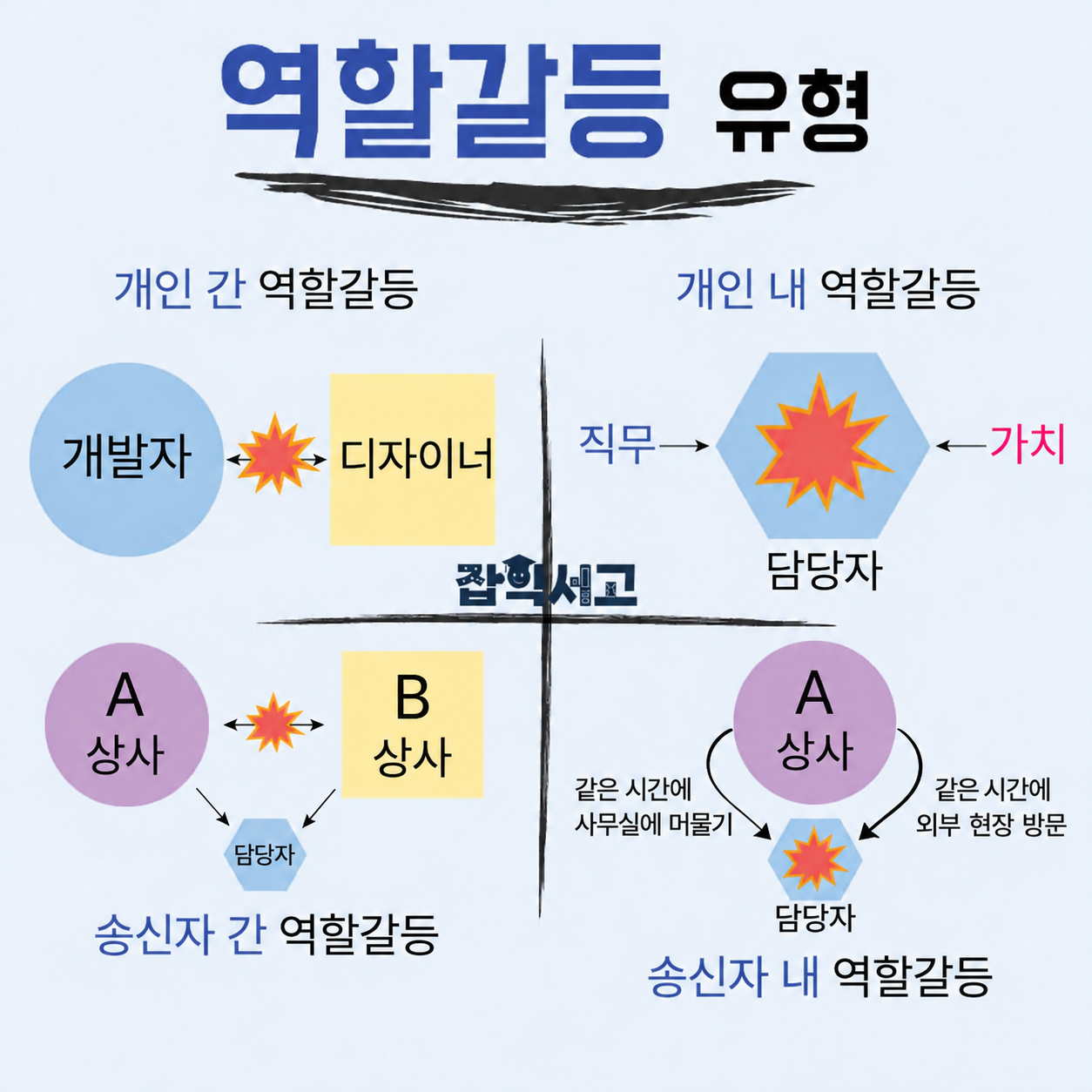 4 Types of Role Conflict
Role conflict is the psychological experience that arises when an employee's own role clashes with a superior's expectations. People experience stress when expectations from two or more sources, including themselves, conflict, and this mainly arises in dilemmas where carrying out one prevents them from carrying out the other.
There are 4 types of role conflict. Referring to the image above and the text below will make them a little easier to understand.
- Interpersonal role conflict - A clash between the demands of one's occupation and demands outside that occupation (developer vs designer)
- Intrapersonal role conflict - A clash between the work a person is responsible for and their personal values and interests (performing unwanted work)
- Inter-sender conflict - Occurs when the demands of two or more people differ (a clash between Supervisor A and Supervisor B)
- Intra-sender conflict - Occurs when one person giving work instructions makes incompatible demands (one supervisor instructs the employee to remain in the office and visit an off-site location at the same time)
Role Ambiguity
 What am I supposed to do??
Role ambiguity is stress that arises when employees do not clearly understand a superior's expectations of their role. It mainly occurs when work is ambiguous and arises within the individual.
Such factors may also manifest as taking on challenges to acquire better skills, and they appear more frequently among people in higher positions.
Role Overload & Role Underload
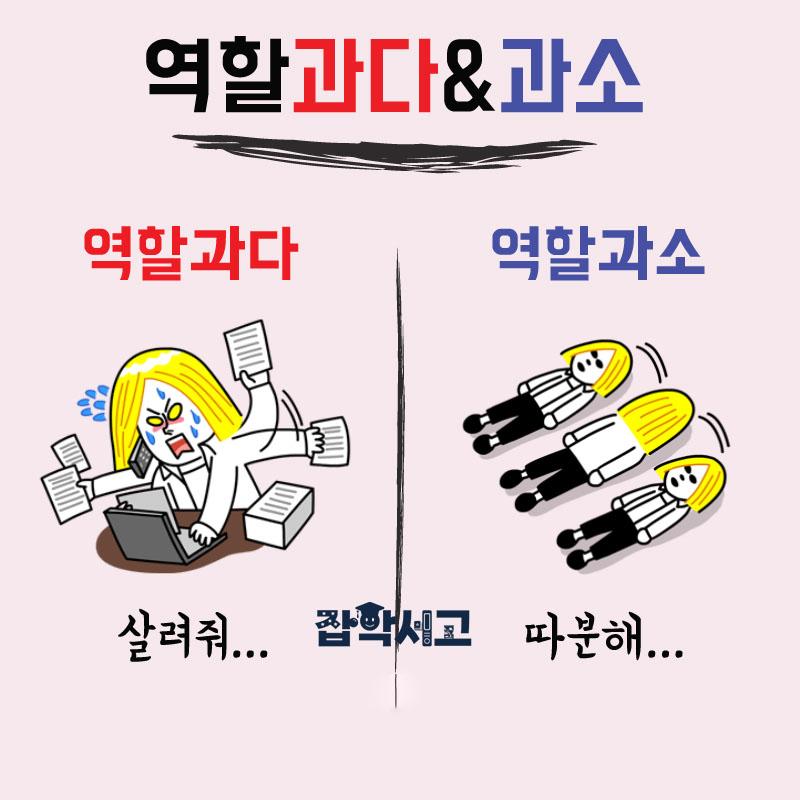 Too much is a problem. Having none is also a problem.
Role overload occurs when employees are given additional work beyond their usual duties and reach a point where they find it difficult to cope. It can be divided into quantitative overload, where the amount of work is difficult to complete within the allotted time, and qualitative overload, where insufficient ability makes the work difficult to perform.
Conversely, role underload occurs when employees perform work that falls below their level of ability, and it becomes a source of stress.
Ways to Manage Job Stress
A/B Personality Types
 Type A: A hot-tempered perfectionist / Type B: A laid-back pacifist
Job-related personality types can be divided into Type A and Type B. These two personality factors display opposing characteristics.
Type A personalities are basically aggressive and proactive. They are competitive when performing work and pursue speed and perfection. (To others, they may seem passionate, but also hot-tempered and combative.)
In contrast to Type A, Type B personalities are defensive and passive. They are relaxed and calm when working and accept various situations with an easygoing attitude. (Others may see them as gentle as a bodhisattva, yet find them frustrating and feel dissatisfied with the way they handle work.)
Ultimately, however, people with Type A personalities have a strong desire for achievement and high aspirations, so they experience more stress than those with Type B personalities as they strive to fulfill them.
Locus of Control
 Can I control it? (Internal) Does luck need to be on my side? (External)
Locus of control refers to where people believe control over events or outcomes in everyday life lies. People are divided into those with an internal locus of control, who look for the causes of problems within themselves, and those with an external locus of control, who look for the causes in their environment (opportunity and luck).
Under ordinary circumstances, people with an external locus of control experience more stress, while those with an internal locus of control generally respond to situations flexibly and appropriately. However, when a situation goes beyond their control, people with an internal locus of control may attribute the problem to themselves and experience greater helplessness and stress.
Social Support
 Encouragement from those around you is a great source of strength
Social support refers to the comfort or encouragement that family members, acquaintances, and colleagues provide to help ease an employee's job stress. Sources within the organization include supervisors, coworkers, and subordinates, while sources outside the organization include friends and family.
Although social support weakens the sources of job stress, it does not reduce dissatisfaction or boredom that develops from stress.
--
We have now examined the psychology of stress that people may experience in working life and ways to manage it. Since it is difficult to offer clear answers about management methods across countless situations, I have presented categories that can help you identify and understand the situation you are in.
With this basic knowledge, you will be able to identify which category applies to you when you feel stressed, and you can then view the situation a little more objectively and work toward overcoming it.
Even if your working life is full of stress, I hope you can manage it strategically and turn it into a life you find satisfying.