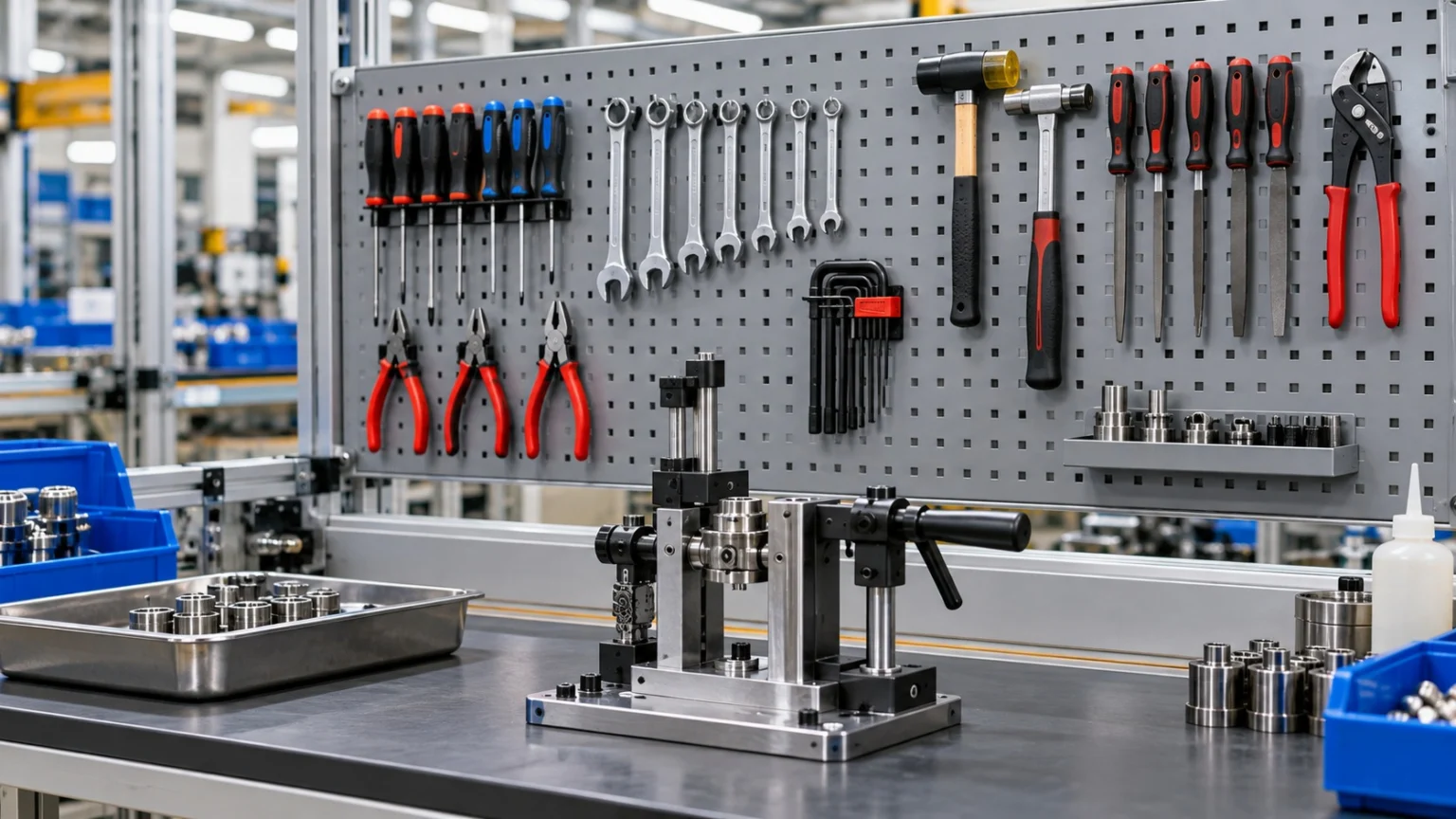
If you move the tools on a factory workbench to spots within easy reach, you might save a few seconds each time. That may not seem to change anything, but on a shop floor where the same motion is repeated hundreds of times a day, the story is different. When small fixes like this pile up every day in the hands of many people, the quality and speed of the whole company change noticeably. The management approach built on this idea is ‘Kaizen.’
Put simply, Kaizen means ‘a management approach in which everyone on the front line keeps piling up small improvements, instead of making one grand change, so that the whole organization gets better.’ The word is simply the reading of the Japanese 改善 (improvement), and it became known around the world along with Toyota’s production system.
In this article, we will look in turn at what the word Kaizen means and where it started, the three kinds of waste the front line tries to eliminate, the main tools that keep Kaizen running, and the lessons and limits this approach has left behind.
Small Fixes Add Up to a Big Difference: How Kaizen Works and Where It Is Used
What Is Kaizen?
In Japanese, Kaizen is just an ordinary word meaning ‘changing for the better.’
(1) An Ordinary Word in Japanese
In Japan, Kaizen refers to any improvement, large or small, one-time or repeated. The word itself carries no sense of ‘continuous’ and no special philosophy.
(2) It Became a Management Concept Abroad
As Japanese companies, especially Toyota, used the word for their shop-floor improvement activities, it took hold outside Japan as a management term meaning ‘continuous improvement.’ The book “Kaizen: The Key to Japan’s Competitive Success,” published in 1986 by management consultant Masaaki Imai, was widely read around the world and turned the word into part of the business vocabulary.
(3) It Started in the United States
The practice of carrying out small improvements right away, day by day, came from the U.S. Training Within Industry program during World War II. In wartime there was neither the time nor the resources to attempt big changes. After the war, the program was introduced to Japan, and the influence of W. Edwards Deming, who taught statistical quality control, was added to it. The fact that a 1951 training film introducing this program in Japan was titled ‘Improvement in Four Steps’ shows well how the word spread across Japanese shop floors.
Three Things to Eliminate: Muda, Mura, and Muri
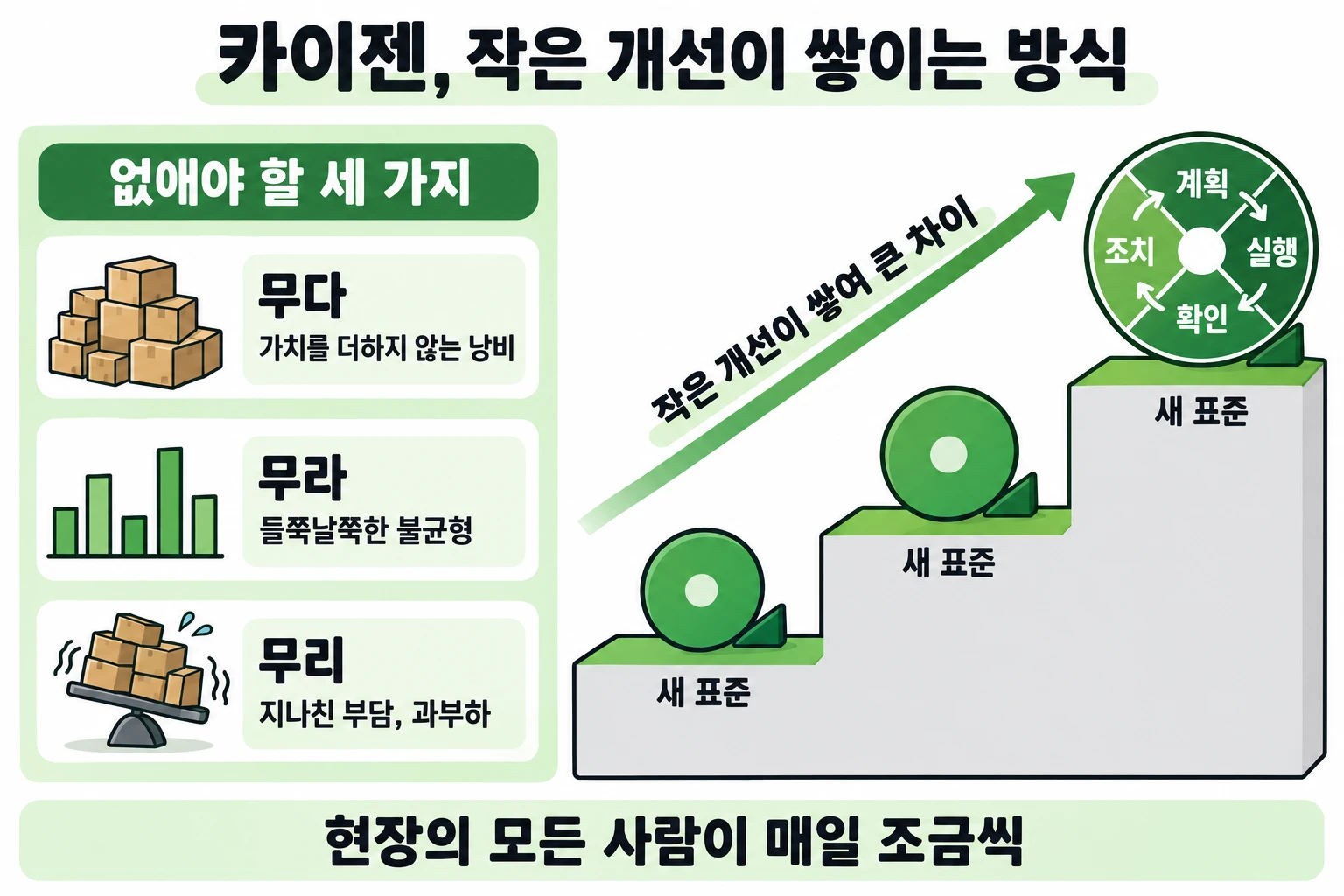
The Toyota Production System divides the roots of loss into three kinds.
- Muda: waste that adds no value.
- Mura: unevenness, where workload or flow is irregular.
- Muri: overburden, placing excessive strain on people or machines.
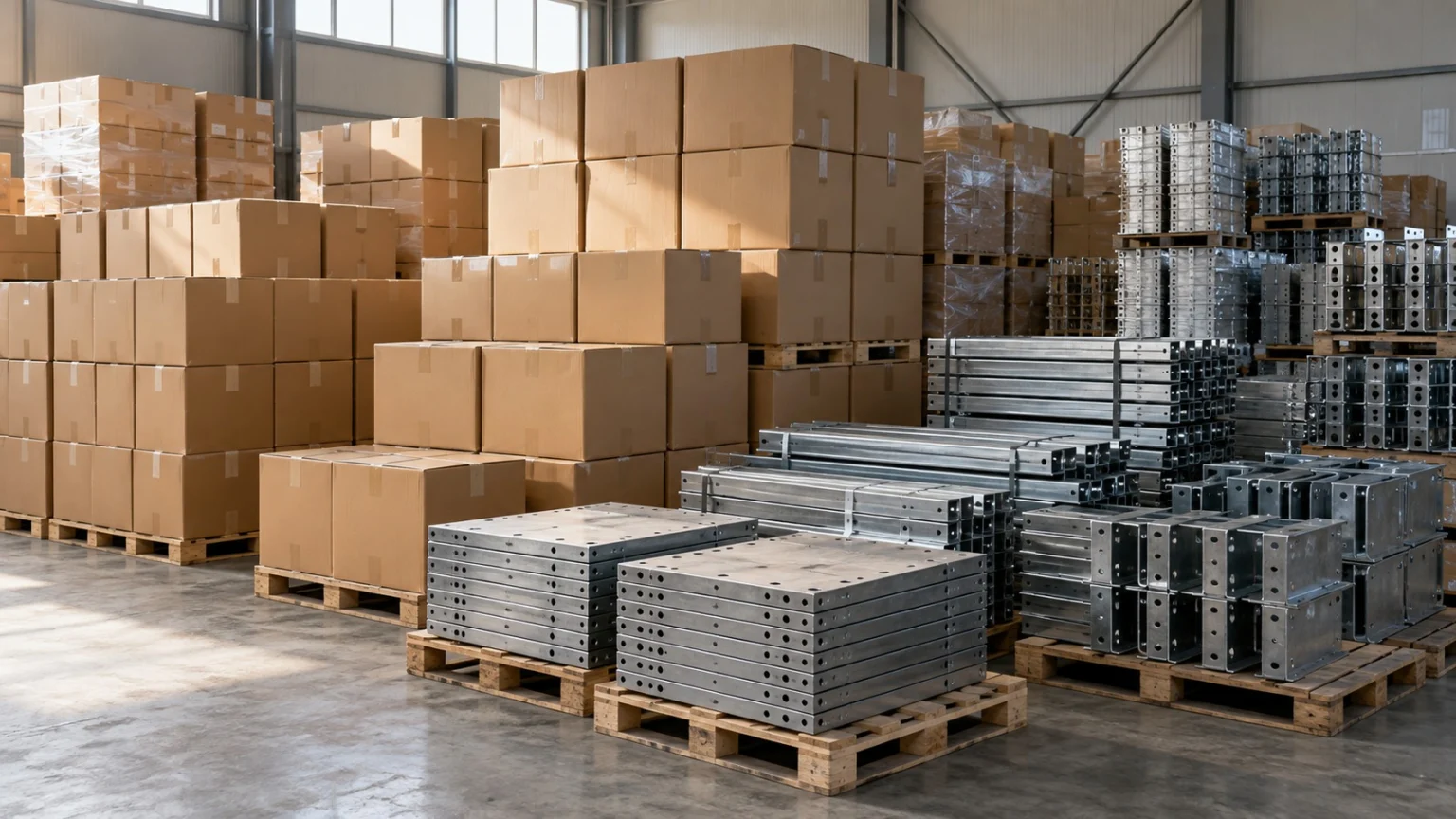
Of these, Muda is further divided into seven types: overproduction, making more than needed; waiting, when hands sit idle; unnecessary transportation; defects; excess inventory; unnecessary motion; and overprocessing, adding features the customer does not even want. Kaizen begins by finding and reducing these wastes one at a time.
The Tools That Keep Kaizen Running
Kaizen does not run on attitude alone; it works together with tools used again and again on the shop floor.
(1) PDCA
This is the cycle of Plan, Do, Check, and Act. Rather than drawing up a big plan in advance, you make a small change, look at the result, and fix it again. When one cycle is complete, the improved method becomes the new standard, and the next cycle starts from that standard.
(2) The Five Whys
When a problem occurs, you ask ‘Why?’ about five times in a row to find the root cause rather than the visible symptom.
(3) 5S
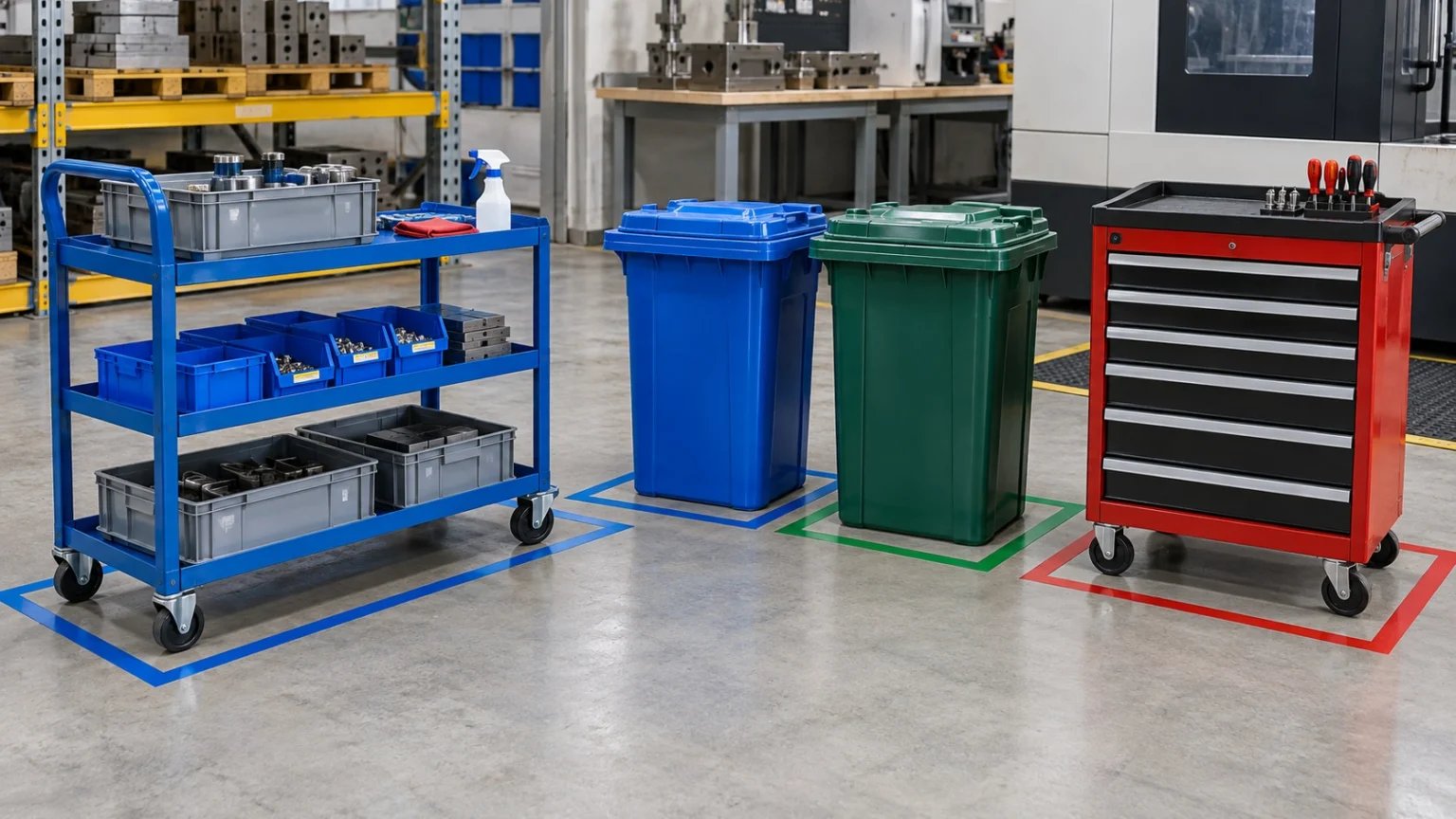
The workplace is maintained through five practices: Sort (Seiri), Set in order (Seiton), Shine (Seiso), Standardize (Seiketsu), and Sustain (Shitsuke). Once you clear away what is not needed and assign everything a place, waste and mistakes become easy to spot.
(4) On-the-Spot Improvement and Focused Improvement
There are small improvements in which a breakdown or error found on the floor is fixed right then and there, and there is also the ‘Kaizen Event,’ in which several people pick one problem and concentrate on fixing it for about a week. The former is a daily habit; the latter is a way to clear a major bottleneck in a short period.
(5) The Authority to Stop the Line
At Toyota, any worker who sees something abnormal can stop the moving production line and fix the cause together with a supervisor. It is a mechanism that keeps problems from being covered up and passed over.
The Lessons and Limits of Kaizen

Kaizen has spread beyond manufacturing to hospitals, offices, software development, and more, but there are also points worth considering.
(1) Improvement Is Everyone’s Job on the Front Line
It assumes that everyone takes part, from executives to cleaning staff. Underlying it is the belief that the person who knows a job best is the person who does it.
(2) Use Wisdom Before Money
Rather than bringing in new equipment, it looks for answers in making better use of the people and tools already at hand. That is why many improvements cost little.
(3) When Only the Form Remains, It Becomes a Burden
If it is run only to hit suggestion quotas, or only as events pushed down from above over short periods, it can actually add more strain to the front line.
(4) It Cannot Replace Big Change
The sum of small improvements is strong at refining the current way of doing things, but when the game itself changes, as with a technological shift that overturns a market, bold innovation is needed separately.
Kaizen shows that an organization can keep getting better even without a grand plan. A single day’s small fix may look insignificant, but when such fixes keep piling up without stopping, they become a difference others cannot easily catch up with.
Finding one small thing you can fix in the work you do today: that is the first step in management toward a better workplace.