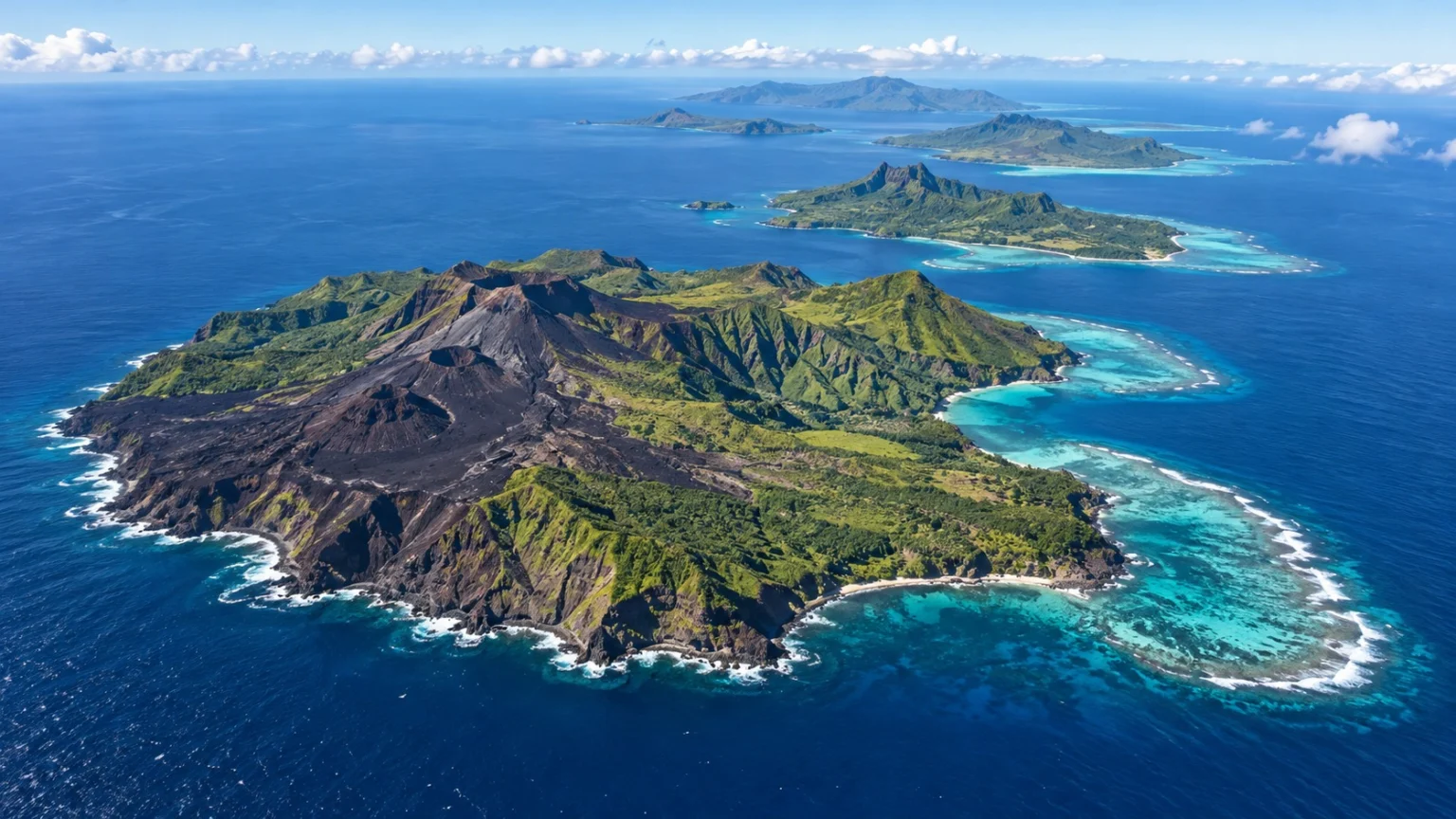
If you look at the Hawaiian Islands on a map, you will see them lined up diagonally from southeast to northwest. Even more curious is that lava still flows on the Island of Hawaiʻi at the southeastern end, while the islands grow older and more worn down the farther northwest you go, until they finally sink into undersea mountains. There is a hot spot deep in the Earth that stamps out islands one after another like this. It is called a ‘hotspot.’
Put simply, a hotspot is a place where unusually hot mantle deep in the Earth supplies magma and drives volcanic activity, regardless of where the plate boundaries are. Unlike most volcanoes, which cluster where plates meet or pull apart, hotspot volcanoes are special because they can form even in the middle of a plate.
In this article, we will look in turn at how the idea of a hotspot came about, how volcanic island chains are formed, Earth’s representative hotspots, and the debates that have yet to be settled.
The Underground Ember That Leaves Volcanic Footprints on the Plates
How the Idea of a Hotspot Began
The concept of a hotspot began as an attempt to solve the puzzle of the Hawaiian Islands.
(1) J. Tuzo Wilson’s Idea
In 1963, Canadian geologist John Tuzo Wilson explained that the Hawaiian Islands were formed as the Pacific Plate slowly passed over a hot spot that barely moves. Since the plate moves while the heat source stays in place, the volcanoes have no choice but to line up in a row.
(2) Joining with Mantle Plumes
Later came the hypothesis that beneath a hotspot lies a mantle plume, a column of hot material rising from near the boundary between the mantle and the core. Today, the hotspot hypothesis is treated almost as one and the same with the mantle plume hypothesis.
(3) How They Differ from Plate-Boundary Volcanoes
Chains of volcanic islands such as the Aleutian Islands form at subduction zones, where one plate dives beneath another. Hotspot volcanoes, by contrast, form in places unrelated to plate boundaries, so they are regarded as fundamentally different volcanoes.
How Volcanic Island Chains Form
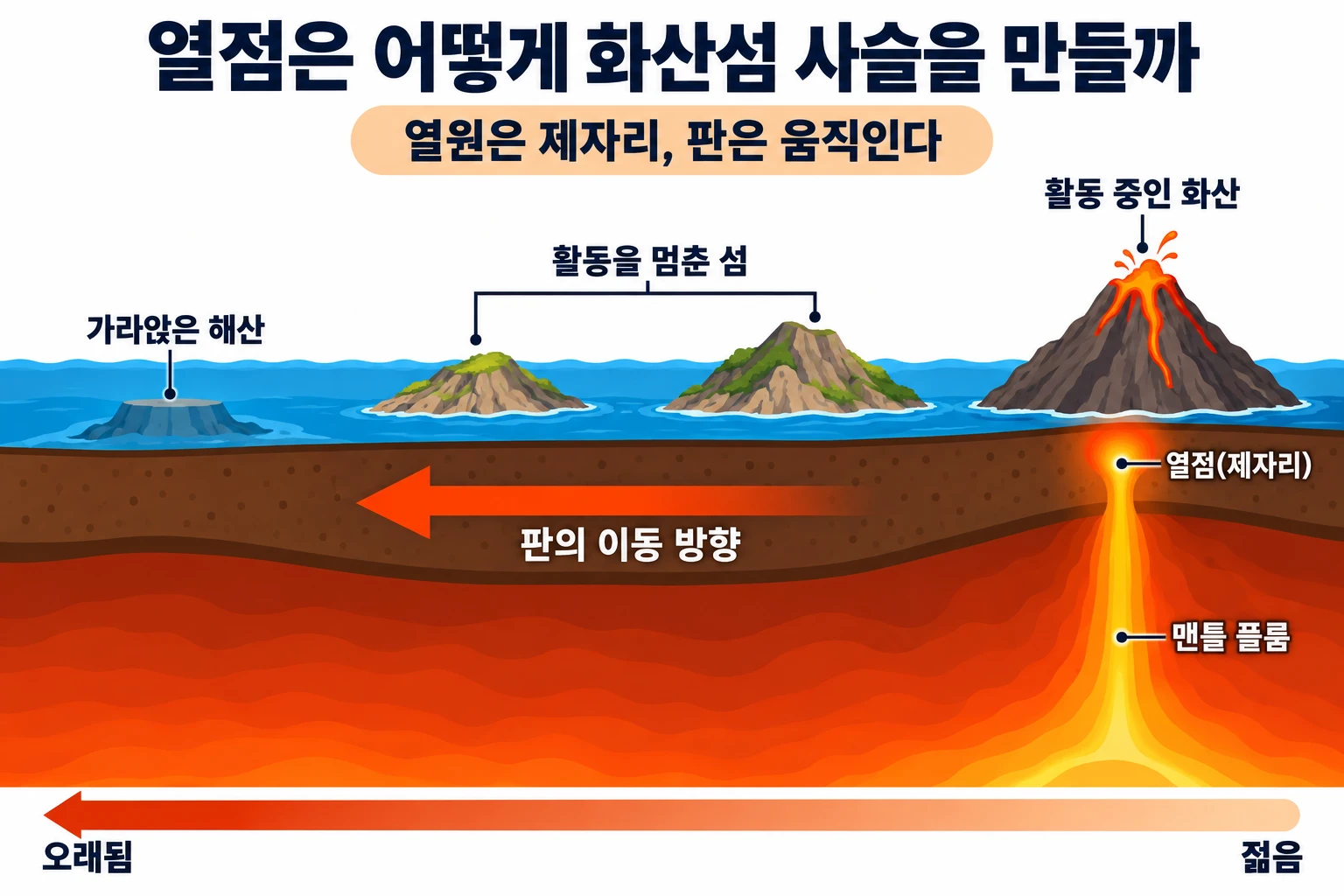
The way a hotspot works resembles a candle leaving soot marks at the same spot on a sheet of paper laid on a conveyor belt.
(1) A Stationary Heat Source and a Moving Plate
On the part of a plate sitting over a hotspot, magma breaks through to the surface and a volcano forms. As the plate moves, that volcano drifts away from the heat source and goes dormant, while a new volcano grows over the hotspot.
(2) Islands Lined Up by Age
As a result, the volcanoes line up in order of age. The main Hawaiian Islands formed between about 400,000 and 5.1 million years ago, and the farther northwest they lie, the older and more heavily eroded they are. Off the southeastern coast of the Island of Hawaiʻi, Kamaʻehuakanaloa Seamount (formerly called Lōʻihi) is still growing beneath the sea.
(3) A Long Tail Stretching Under the Sea
The Hawaiian–Emperor seamount chain is a vast chain of more than 80 undersea volcanoes stretching about 6,200km. The Emperor Seamounts at its northern end formed between 39 million and 85 million years ago, and all of them have sunk beneath the sea.
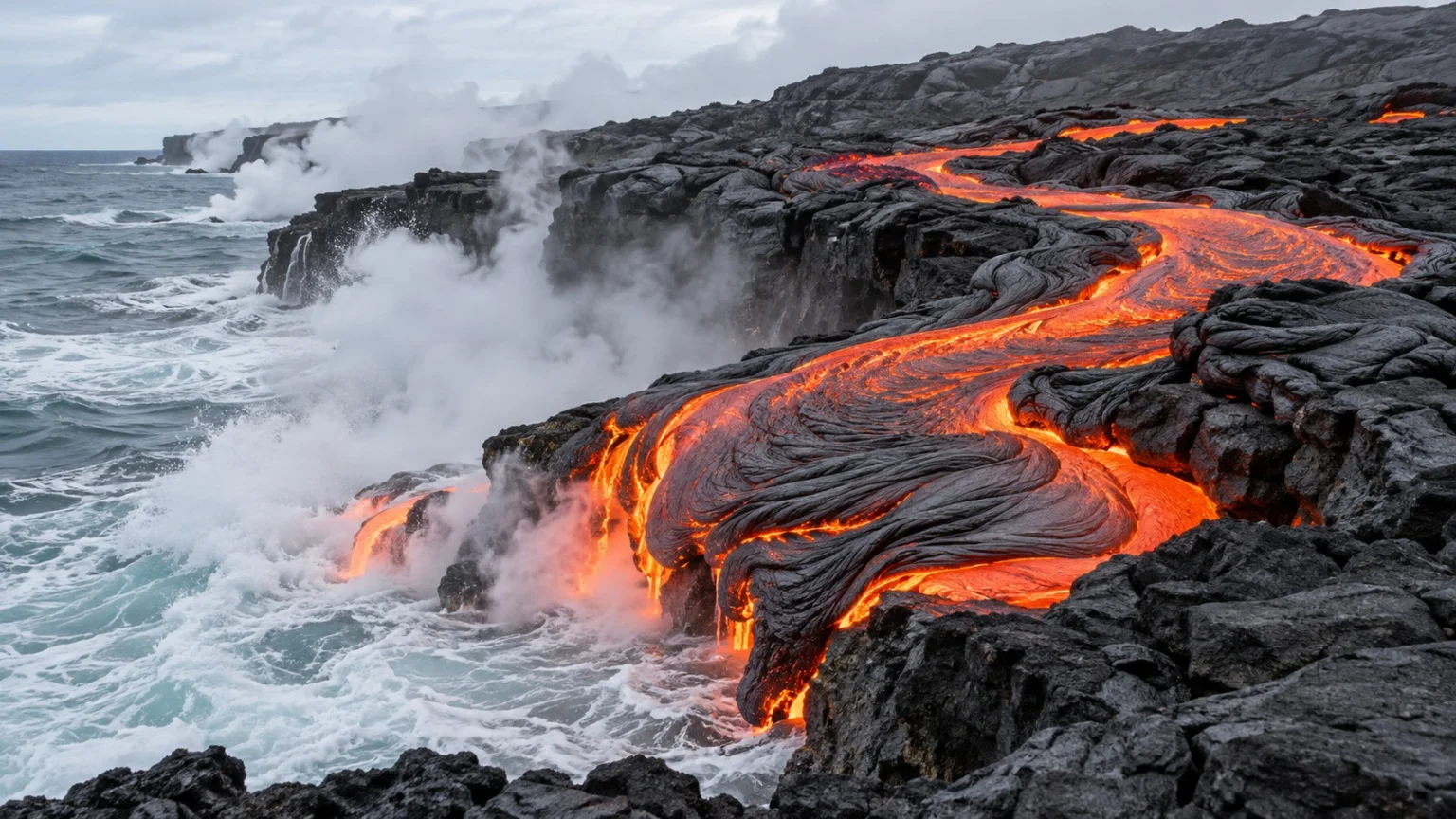
Most hotspot volcanoes erupt basaltic magma, making them less explosive than subduction-zone volcanoes. This is also why Hawaiʻi’s volcanoes are famous for their flowing lava.
Earth’s Representative Hotspots
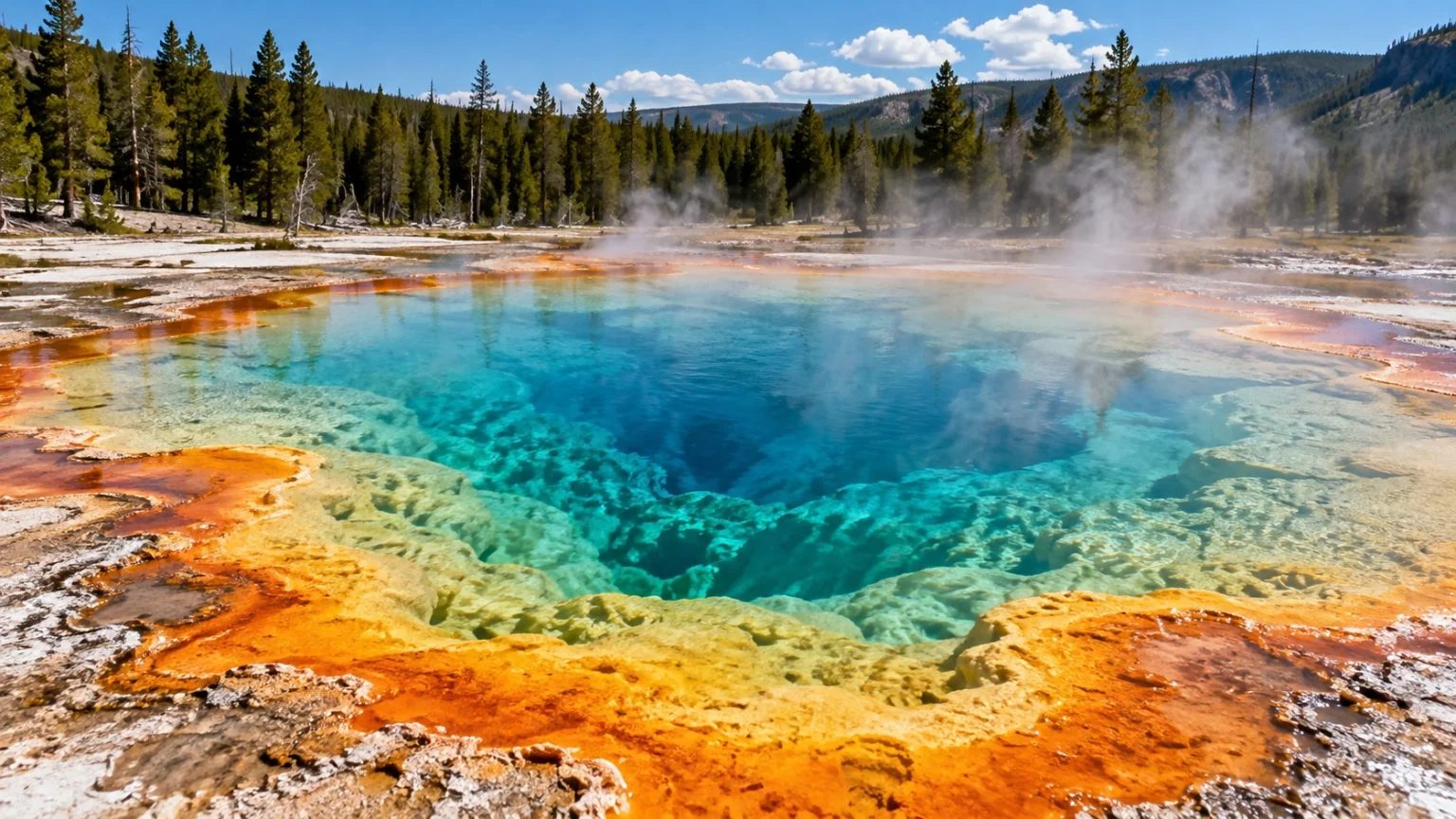
Scholars disagree on how many hotspots there are, with estimates ranging from about 20 to several thousand, but most put the number at a few dozen.
- Hawaii hotspot: The best-known hotspot, which created active volcanoes such as Kīlauea and Mauna Loa on the Island of Hawaiʻi.
- Iceland hotspot: The hotspot overlaps the Mid-Atlantic Ridge, where plates are pulling apart, so the whole island is full of volcanoes and hot springs.
- Yellowstone hotspot: A hotspot beneath a continent. Because its magma melts the continental crust to produce sticky rhyolitic magma, it has caused some of the most powerful eruptions in geologic history. Traces of older calderas line up the farther west you go.
- Réunion hotspot: A hotspot that keeps up vigorous volcanic activity on Réunion Island in the Indian Ocean.
As these show, hotspots appear both in the middle of the ocean and in the heart of continents, and the character of their volcanoes varies greatly depending on where they sit.
The Unsolved Mysteries of Hotspots
Hotspots have been used as powerful evidence explaining plate motion, but as research has deepened, new questions have arisen as well.
(1) Why Does the Seamount Chain Bend?
The Hawaiian Islands and the Emperor Seamounts are bent at an angle of about 120 degrees. For a long time this was explained as a trace of the Pacific Plate changing direction about 47 million years ago, but around 2003 research appeared suggesting that the hotspot itself had moved. Today, the most widely accepted explanation is that a small movement of the hotspot was added to the change in the plate’s direction.
(2) Are Hotspots Really Fixed?
At first, hotspots were thought to be fixed relative to one another, but hotspots that appear to move relative to each other, such as Hawaiʻi and Iceland, have been identified. This has strengthened the view that mantle plumes are more complex than first thought and move independently.
(3) Do Mantle Plumes Really Exist?
There is also a counterargument that the mantle beneath hotspots is not especially hot, and that magma from shallow depths simply rises where the plate is thin or weak. As studies that peer into the Earth using seismic waves accumulate, structures that look like plumes are gradually being confirmed, but the debate continues.
Hotspots are Earth’s recording devices, directly showing through the ages of islands and seamounts that the plates move. Each volcanic island in the line bears the record of a plate’s journey over tens of millions of years.
Imagining the currents deep underground beyond the volcanoes we can see is the first step in studying our living, moving Earth.