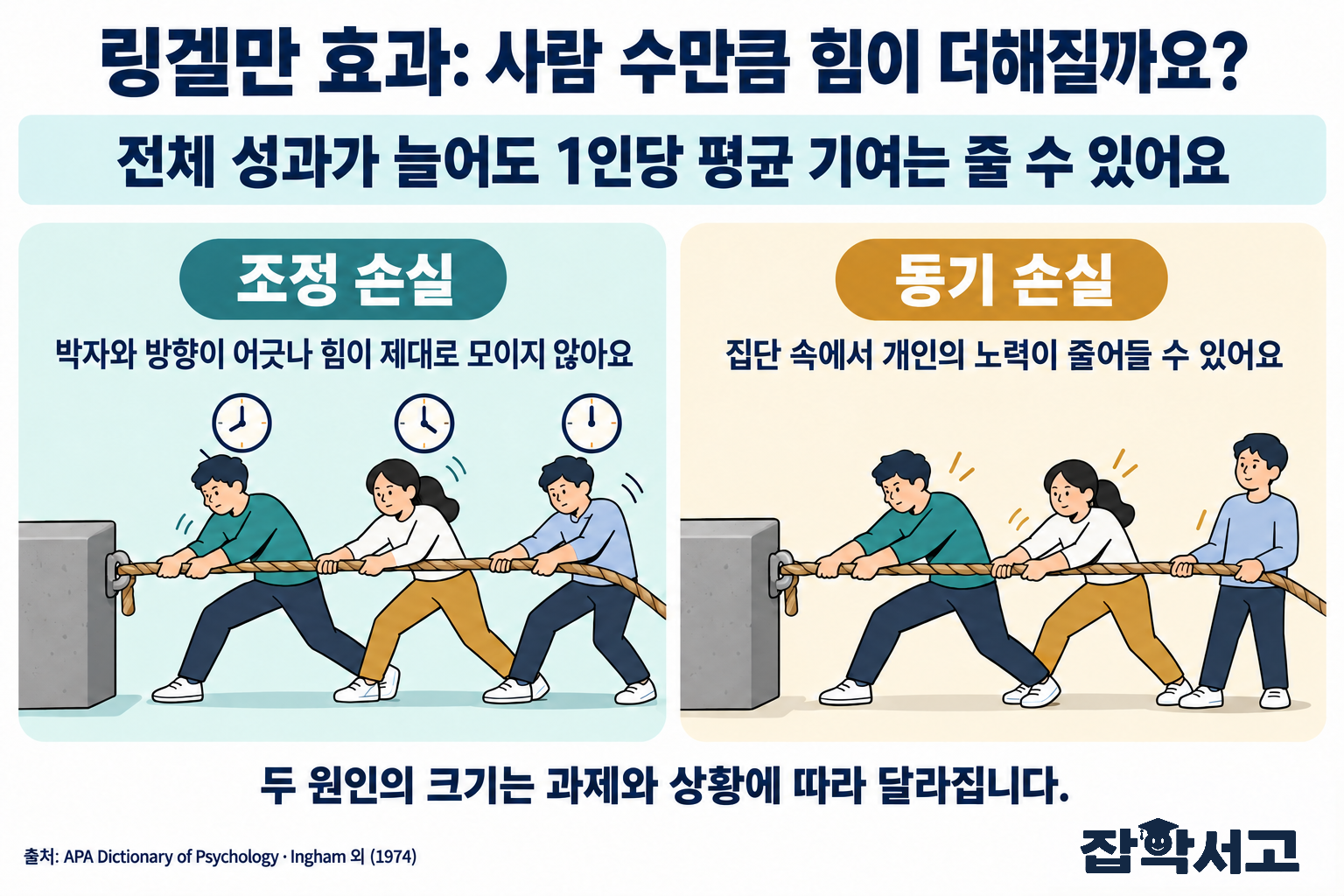
In a tug-of-war, does each person pull just as hard when eight people pull together as when one person pulls alone? Most people think they will find more strength together. But when you actually measure the force, the force each person exerts goes down as more people join in. This phenomenon is the "Ringelmann effect."
Put simply, the Ringelmann effect is "the phenomenon in which the output of each individual member gradually decreases as more people take part in a group." Gathering more people can increase the total force, but not in proportion to the number of people added. It can appear anywhere people work together, such as meetings, group assignments and large-scale projects.
In this article, we will look in turn at the experiment in which the Ringelmann effect was first discovered, the two causes of reduced performance, examples at work and in everyday life, and ways of running organizations that reduce it.
The Ringelmann Effect and Strategies for Overcoming It
What is the Ringelmann effect?

The phenomenon is named after the French agricultural engineer Maximilien Ringelmann. Ringelmann studied how efficiently people, draft animals and machines exerted force in farm work. In the 1880s he measured force by having people haul loads with a rope, and he published the results in a paper in 1913.
The results were not what was expected. Pulling alone, a person exerted an average force of about 85 kg, but when seven people pulled together, the force per person fell to about 65 kg, and with fourteen people it dropped to about 61 kg. The total force grew as more people were added, but not as much as the headcount. This fact, that group size and each member's contribution move in opposite directions, is the core of the Ringelmann effect.
Two causes that eat away at performance

There are two main explanations for why group performance declines. Ringelmann himself focused mainly on the first, but he was aware of the second as well.
(1) Coordination loss
For several people to combine their strength, their timing and direction have to match. If the moments when they pull are slightly out of sync, or they apply force in different directions, the forces do not add up fully even if everyone does their best. It is the same reason a team made up only of star players can lose a game when they fail to play in sync.
(2) Motivation loss
The bigger cause lies in the mind. When working with others, people think "even if I do a little less, someone else will make up for it," and without realizing it they exert less effort. In 1974, Alan Ingham and colleagues repeated the experiment using pseudo-groups in which only one real participant pulled the rope while the others merely pretended to pull. Even though there was no need to coordinate timing, participants who believed they were pulling with others exerted less force. This revealed that performance declines even when there is no coordination problem.
In 1979, Bibb Latané and colleagues gave this phenomenon, in which individuals reduce their effort within a group, the name social loafing. When blindfolded university students wearing headphones were asked to shout, they produced only about 82% of their solo effort when they believed they were shouting with one other person, and about 74% when they believed they were shouting with five others.
The Ringelmann effect in everyday life and at work

The Ringelmann effect shows up all around us, well beyond the rope-pulling lab.
- Group Project: in assignments shared by four or five people, it is common for only a few to do the work while the rest just put their names on it.
- Large Meeting: the more attendees there are, the more people stay quiet thinking "someone will speak up," so meetings drag on and conclusions get blurry.
- Shared Responsibility: tasks assigned to several people become nobody's job the moment they become everyone's job, and they are easily delayed.
- Online Community: many members only read posts without writing any themselves, so a small number of active members fill most of the content.
Add to this the feeling that "if others seem to be slacking, I don't want to be the only one losing out," so I ease off too, and the effort of the group as a whole shrinks even further.
Ways to run organizations that reduce the Ringelmann effect

The Ringelmann effect arises from the structure of the work rather than from people being lazy. That means it can be reduced by changing the structure.
(1) Make individual contributions visible
When each person's share and results are visible, people try harder. Instead of looking only at the team's overall performance, looking at each member's contribution as well and adding peer evaluation leaves fewer places to hide.
(2) Split teams into smaller units
The fewer the members, the bigger each person's share and the easier it is to spot gaps. Amazon's Jeff Bezos's "Two-Pizza Rule," which calls for keeping teams small enough to be fed with two pizzas, comes from the same idea.
(3) Make roles and goals clear
"This part is handled by this person by this date" is far more powerful than "let's all do well together." Clear and challenging goals draw members more deeply into their work.
(4) Share the meaning of the work
People who feel that their role is essential and valuable to the team do not hold back their effort even within a group. Research has also found that social loafing is less common in teams whose members know and care about one another.
The Ringelmann effect shows that having more people does not increase strength by the same amount. A good team is not one that has gathered many people, but one in which each person's share is clear and their effort is properly visible.
Before adding more people, first checking whether everyone's role is clear is the first step toward an organization that achieves greater strength by working together.