In the rough seas of corporate management, not every ship can always sail smoothly. Sometimes fierce storms threaten to sink a ship, and sometimes old cargo must be discarded to chart a new course. At such moments, the most powerful yet painful option a company can choose is restructuring.
When people hear the word 'restructuring,' dark images such as mass layoffs or factory closures often come to mind first. Yet the essence of restructuring lies not simply in cutting costs, but in improving a company's underlying health and regaining its competitiveness, ultimately pursuing survival and sustainable growth.
This material takes an in-depth look at the precise definition and objectives of restructuring, its various methods, and its positive and negative effects on companies and society from a business management perspective.
The Definition and Objectives of Restructuring: Beyond Simple Workforce Reductions
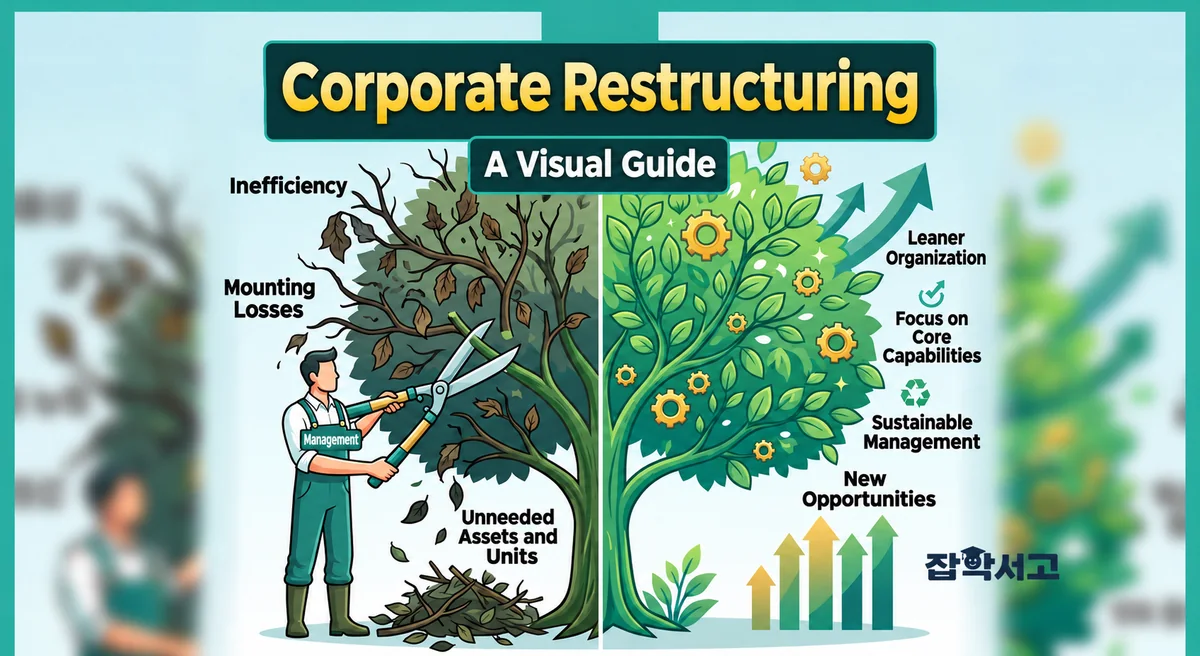
Restructuring refers to a series of processes through which a company deliberately readjusts its overall structure, including its assets, liabilities, capital, and workforce, to respond to changes in its environment or maximize business performance. It is akin to realigning a company's 'skeleton.'
Why, then, do companies carry out restructuring even at the cost of such pain?
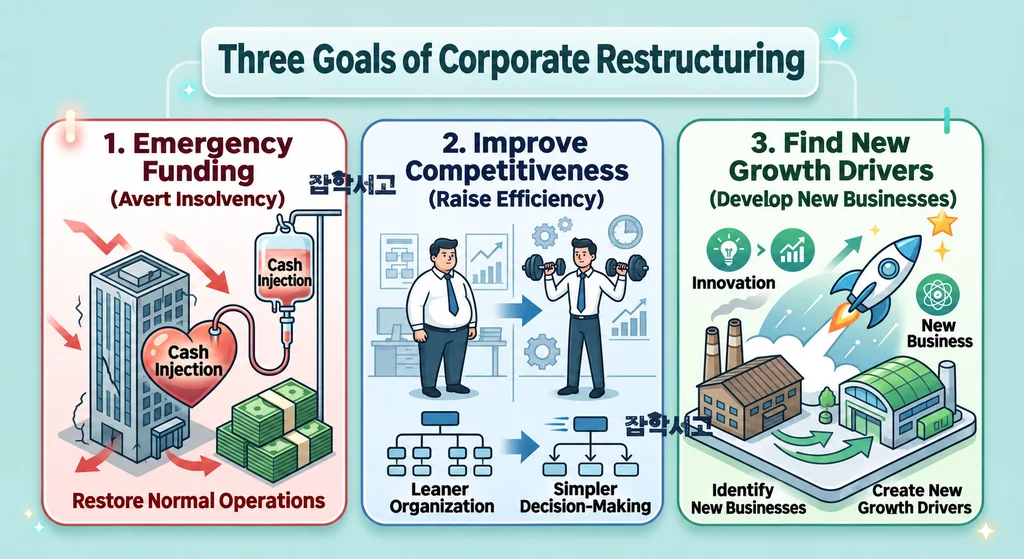
- Restoring Normal Operations and an Emergency Infusion of Funds: The most common reason is to overcome the risk of default caused by accumulated losses, mounting debt, or similar problems. The immediate priority is to sell non-core assets and reduce the workforce to secure immediate liquidity and cut costs.
- Strengthening Competitiveness and Improving Organizational Health: Even a currently sound company may undertake restructuring to prepare for future uncertainty or improve its efficiency when market competition intensifies. This includes streamlining an oversized organization and reducing the number of decision-making stages.
- Securing Growth Drivers and Reshaping the Business Portfolio: Companies use restructuring to withdraw from declining industries and concentrate their capabilities on promising new businesses. This is a strategic choice for a company's future.
The Various Methods of Restructuring: Which Card Should a Company Play?
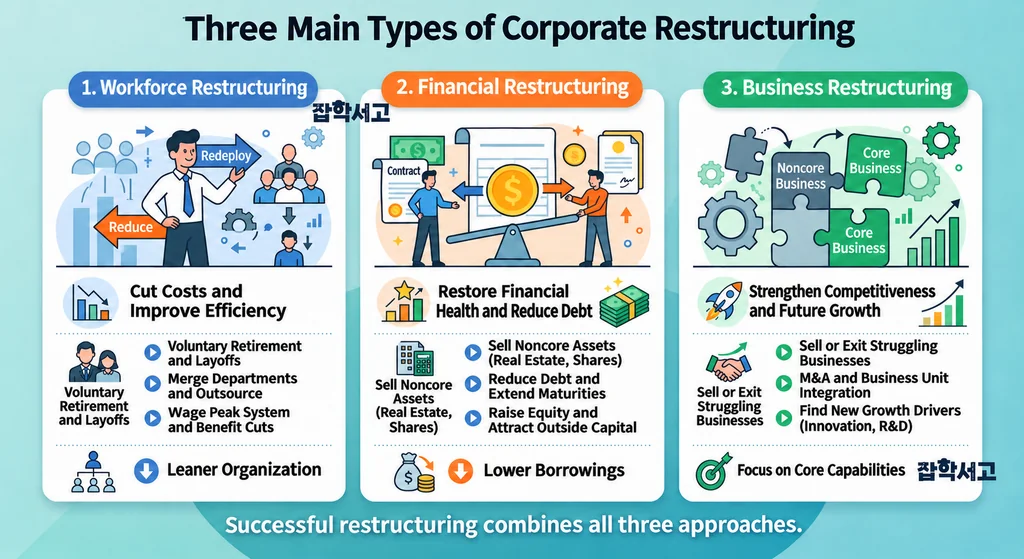
Restructuring takes various forms depending on its objectives and the company's circumstances. It can broadly be divided into labor restructuring, financial restructuring, and business restructuring.
- Labor Restructuring: The Most Contentious Issue
This is the most common form of restructuring and has major social repercussions. Its goal is to cut costs by reducing an oversized workforce.
- Voluntary Retirement/Early Retirement: Employees voluntarily apply to leave, receive compensation, and retire. This approach involves little coercion but carries a substantial financial burden.
- Layoffs: Employees are forcibly dismissed for unavoidable business reasons. The legal requirements are stringent, and layoffs are a major cause of labor-management conflict.
- Outsourcing/Spin-offs: Particular departments or functions are entrusted to outside companies or separated into independent legal entities.
- Financial Restructuring: Debt Settlement and Capital Expansion
This is a process intended to lower a company's debt ratio and ensure its financial soundness.
- Asset Sales: The company sells valuable real estate, shares, patents, and other assets to secure cash and repay its debts.
- Debt Rescheduling: The company negotiates with its creditors to extend loan repayment periods or lower interest rates.
- Issuing New Shares for Cash: The company issues new shares to raise funds from investors.
- Business Restructuring: Reshaping the Playing Field
This involves readjusting a company's business areas to concentrate on its core competencies.
- Selling Non-core Businesses: The company sells business divisions with low profitability or no prospects for future growth.
- M&A (Mergers and Acquisitions): The company acquires other companies that possess the technology or market power it needs, or merges with them to create synergies.
- Splitting/Merging Business Divisions: The company separates oversized business divisions or combines similar divisions into one to improve efficiency.
Examples of Restructuring: Cases to Aid Understanding
Examining past cases is a useful way to understand the effects of restructuring.
Case Study: Korean Companies During the IMF Foreign Exchange Crisis in the Late 1990s
At the time, numerous large Korean companies faced the risk of bankruptcy because of excessively debt-financed management. With heavy hearts, they carried out restructuring.
- Halla Group: The group sold major businesses, including Halla Climate Control and Mando Machinery, to foreign companies to repay massive debts and pursue the group's survival. This is a representative example of agonizing 'business and financial restructuring.'
- Samsung Group: The group withdrew from the automobile business and concentrated its capabilities on core businesses such as electronics and finance. By selling non-core assets and carrying out large-scale workforce reductions, it turned the crisis into an opportunity and laid the foundation for its rise as a global company.
As these cases show, restructuring can be painful in the short term, yet become an indispensable management strategy that saves a company in the long term and creates an opportunity for a new leap forward.
What Are the Necessary Conditions for Successful Restructuring?

A time inevitably comes when restructuring becomes a necessity rather than a choice for a company. Yet it can never succeed merely by cutting costs or dismissing employees.
Key Elements of Successful Restructuring
- A Clear Vision and Strategy: There must be a clear blueprint explaining why restructuring is being undertaken and what the company will look like afterward.
- Transparent Communication and Leadership: Management must honestly explain the need for restructuring to employees and seek their participation. Uncertainty heightens anxiety and lowers organizational morale.
- Fair and Reasonable Procedures: Fair criteria and procedures must be upheld in processes that involve pain, such as workforce reductions. Companies must also fulfill their social responsibilities by treating departing employees respectfully and supporting their reemployment.
- Securing Key Talent and Rebuilding Organizational Culture: Companies must work to prevent the loss of key talent during restructuring and create an organizational culture suited to the new environment.
Restructuring is painful, but it can make a company stronger and healthier, just as a broken bone heals more strongly. What matters is not restructuring itself, but management's foresight about the future it will build through restructuring and its ability to put that vision into action.