This time, I would like to put together material on marketing 4C, a marketing concept in business administration. The existing marketing mix, known as 4P, had the traditional 4 stages of product (Product), price (Price), distribution (Place), and sales promotion (Promotion).
However, as customer perceptions changed with technological advances, consumption trends, and other factors, businesses also needed to change their strategies toward consumers.
Before learning about marketing 4C, it would be helpful to first understand the concept of marketing 4P (the marketing mix) below, so I am providing a link to related material.
 Marketing Strategies in Business Administration
What Is Marketing 4C?
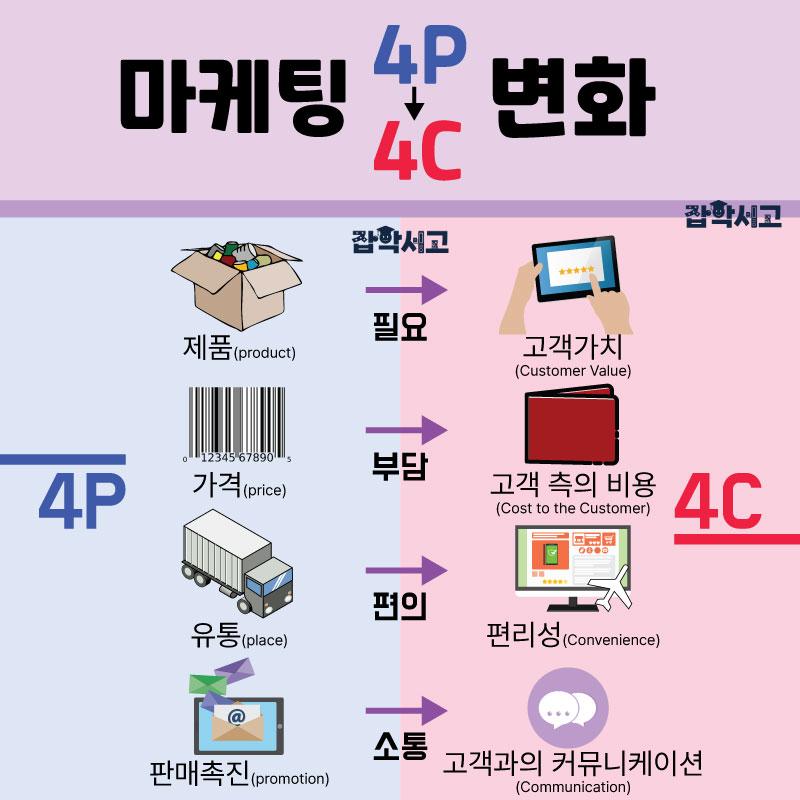 The Shift Toward Marketing 4C
The concept newly added to marketing strategy in response to these environmental changes is marketing 4C. Whereas marketing 4P discussed earlier was a business-centered marketing strategy, 4C involves looking at everything from the customer's perspective and developing strategies accordingly.
Each stage of marketing 4C views the stages of the existing 4P from a different perspective, so the concepts connect at each stage as shown in the image above. Now, I would like to briefly explain, concept by concept, what each stage of marketing 4C means.
1. Value to Customers (Customer Value)
 Providing Products Tailored to Customers
The past was an era of mass production centered on manufacturing, but now products are also evolving to be tailored to consumers. Businesses therefore need to identify what customers want and add value to their products so that each customer can feel satisfied.
To identify these customer needs (Needs), thorough research into customers should come first above all else. (e.g., surveys, big data)
2. Costs for Customers (Cost to the Customer)
 Prices That Customers Find Satisfactory
Now, instead of setting prices from a company's perspective according to the principles of costs and margins, prices should be set with consideration for the burden consumers feel from their perspective. This will be easier to understand if you consider why E-Mart's 'No Brand' is so popular and why companies pursuing 'value for money' are succeeding in the food service industry as well.
3. Convenience (Convenience)
 How Conveniently Can Customers Use a Product or Service?
This area of convenience is a concept introduced as a counterpart to distribution, one of the components of the existing marketing 4P. Whereas traditional distribution (Place) considered the routes through which products would be delivered to stores visited by customers, the focus now is on how customers can receive products as conveniently as possible at home.
In this regard, you can think of the parcel delivery wars among related companies that have unfolded since Coupang launched Rocket Delivery in the social commerce market.
4. Communication with Customers (Communication)
 Active Two-Way Communication with Customers
Whereas sales promotion, the final stage of the existing 4P, was a one-way concept that considered how a company would publicize its products, communication (Communication) involves interaction based on the premise that the company and its customers are on an equal footing.
Examples include efforts to listen to what customers want, engage with them, and reflect their wishes as much as possible in products and services. Typical examples are events and satisfaction surveys conducted through SNS such as blogs, Facebook, and websites.
This concludes our look at the concept and stages of marketing 4C. Because marketing strategies and concepts continue to change as technology advances, marketers need to continually observe and study newly introduced technologies and how customer perceptions are changing.
In addition to marketing 4C, the growth of the online market has also given rise to a separate concept known as online 4C (content, community, personalized services, and e-commerce).
Even with newly emerging concepts such as these, further new concepts are quickly being added as the environment changes, so we should make an effort to maintain our interest and keep studying so that we do not fall behind.