The more of your friends use a messenger, the more likely you are to switch to it; the more sellers a secondhand marketplace app has, the more things there are to buy. A telephone is nearly useless if you are the only one who owns one, but as more people around you get phones, you have more people to call. This phenomenon, in which a product or service becomes more valuable as more people use it, is called the network effect.
Put simply, a network effect means that “as users increase, the product or service also becomes more valuable to existing users.” Unlike improving quality or spending more on advertising, the source of the value lies in the connections between users themselves. That is why growth tends to accelerate once a tipping point is passed, and why, conversely, a product with few users can feel unappealing no matter how good its features are.
In this piece we will look in turn at what network effects are, their direct and indirect types, two-sided platforms and critical mass, easy everyday examples, and finally their limits and common misconceptions.
The Power of Connection: Value That Grows with Use
What Is a Network Effect?

The network effect is a concept that comes up often in business and strategy: rather than the product’s specs, “who else uses it” determines a large part of its value. It is especially clear in communication tools such as the telephone and fax machine, where connection is the whole point, and today it is also a core driver of services that link people to people, or different groups to one another, such as messengers, social networks, marketplaces, and app stores.
You cannot simply assume that value is proportional to the number of users. Still, the intuition that a product becomes more useful as the number of people you can connect with grows is clear. The so-called Metcalfe’s law, associated with Robert Metcalfe, is a heuristic stating that the value of a communications network is roughly proportional to the square of its number of users. It comes from the observation that the number of possible pairwise connections grows as n(n−1)/2; it is not an exact formula for calculating what a company is actually worth.
- Network effect: the phenomenon in which a product or service becomes more valuable as the number of users grows.
- Metcalfe’s law: a heuristic that a network’s value is roughly proportional to n squared; it is not an exact valuation formula.
Direct and Indirect Effects, and the Critical Mass of Two-Sided Platforms

Network effects fall into two broad branches, depending on who adds value for whom.
(1) Direct network effects
As more users of the same type join, they benefit one another. When more friends come to a messenger, you have more people to talk to; the more acquaintances gather on a social network, the greater the opportunities for news and connection.
(2) Indirect (cross-group) network effects
When one group grows, the value for the other group increases. Many buyers attract sellers, and many sellers draw in still more buyers. Structures like app stores, where users and developers attract each other, are close to this type.
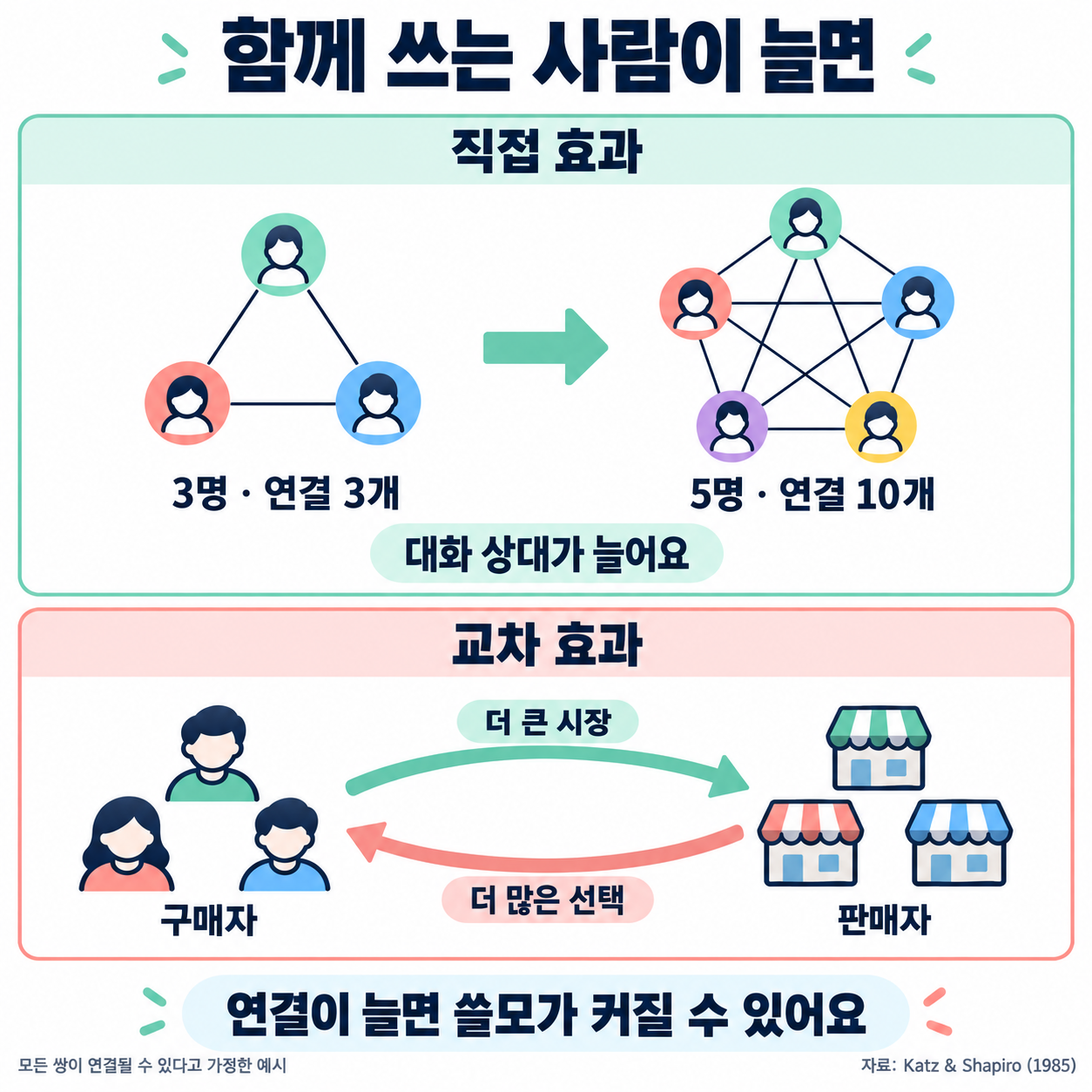
A business that brings two different groups together in one place like this is called a two-sided platform. It often runs into a “chicken-and-egg” problem: one side will not come without the other, and the other side will not come without the first. The point at which both sides have gathered in large enough numbers to attract each other on their own is called critical mass, and before reaching it, platforms commonly hold on to early users with subsidies, free trials, or features that are useful even with only one side present.
- Direct network effect: the effect in which value grows for everyone as more users on the same side join.
- Indirect / cross-group network effect: the effect in which growth in one group increases the value for the other.
- Two-sided platform: a platform that intermediates between two different groups, such as buyers and sellers.
- Critical mass: the turning point at which enough users have gathered for the network to grow on its own.
Understanding Network Effects Through Everyday Examples

In everyday life, network effects show up as situations where “the more people gather, the more you want to use it.”
(1) Telephones and messengers
With only one telephone, there is no one to call. As more numbers appear around you, the phone becomes more useful, and messengers naturally gravitate toward the app most of your friends use.
(2) Social networks
The more acquaintances and shared interests gather, the more valuable the feed and the interactions become. That said, if your connections grow too broad, the noise can grow along with them.
(3) Marketplaces
In secondhand trading, lodging, and delivery services alike, the more buyers and sellers there are, the more choices you have and the more likely a deal is to go through.
(4) App stores and operating systems
When there are many users, developers build more apps, and as apps multiply, more users gather. This is a classic structure in which direct and indirect effects overlap.
Limits, Misconceptions, and Negative Effects

Having a network effect does not guarantee victory. If waiting, congestion, and spam grow as users increase, a negative network effect (congestion) can arise in which value actually falls. Jammed roads and slowing servers are examples.
Also, when multihoming, using several services at the same time, is easy, users are not locked into a single place, and winner-take-all dynamics can weaken. Network effects also interlock with switching costs: when your friends and trading partners are gathered on one side, moving away becomes more burdensome. Switching costs, however, are a separate concept, the “hidden price that makes changing feel wasteful,” so here we will only note that connections strengthen lock-in.
There is a common misconception as well. Treating Metcalfe’s law as a formula, as if the number of users equals a company’s value, is an exaggeration. Actual value varies with the quality of connections, the level of activity, congestion, and the presence of competing services. Network effects are a powerful engine of growth and defense, but without good design and operation they can turn into noise and user churn.
A network effect is the phenomenon in which a product or service becomes more valuable as users increase, and its key elements are the direct and indirect types and the critical mass of two-sided platforms. They are easy to see in telephones, messengers, social networks, marketplaces, and app stores, but congestion, multihoming, and exaggeration must always be considered alongside them.
Weighing both sides, what gets better and what gets clogged as connections grow, is the first step toward reading network effects wisely.