At a movie theater snack bar, when there is only a small and a large popcorn, plenty of people hesitate and end up taking the small. But slip in a medium that costs only a little less than the large, and hands tend to reach for the large: “For just a bit more, I get the large.” This phenomenon, in which an option almost nobody buys changes what people choose, is the decoy effect.
Put simply, the decoy effect is when a deliberately less attractive option is placed next to the product a seller wants to sell, making that product look better. A decoy is the wooden duck model hunters use to lure ducks, in other words, a lure. Because we judge the value of things not by an absolute standard but by comparing them with what sits beside them, how the comparison is arranged can change what we choose.
In this piece we will look in turn at what the decoy effect means and how it works, easy examples such as subscription prices and store displays, and finally the limits research has revealed and smart ways to respond.
The Invisible Lure That Designs Our Choices
What Is the Decoy Effect?

The decoy effect became widely known through an experiment that Joel Huber, John Payne and Christopher Puto published in a consumer research journal in 1982. They showed that adding a third option of a particular kind between two options actually increases the share of people who choose one of them.
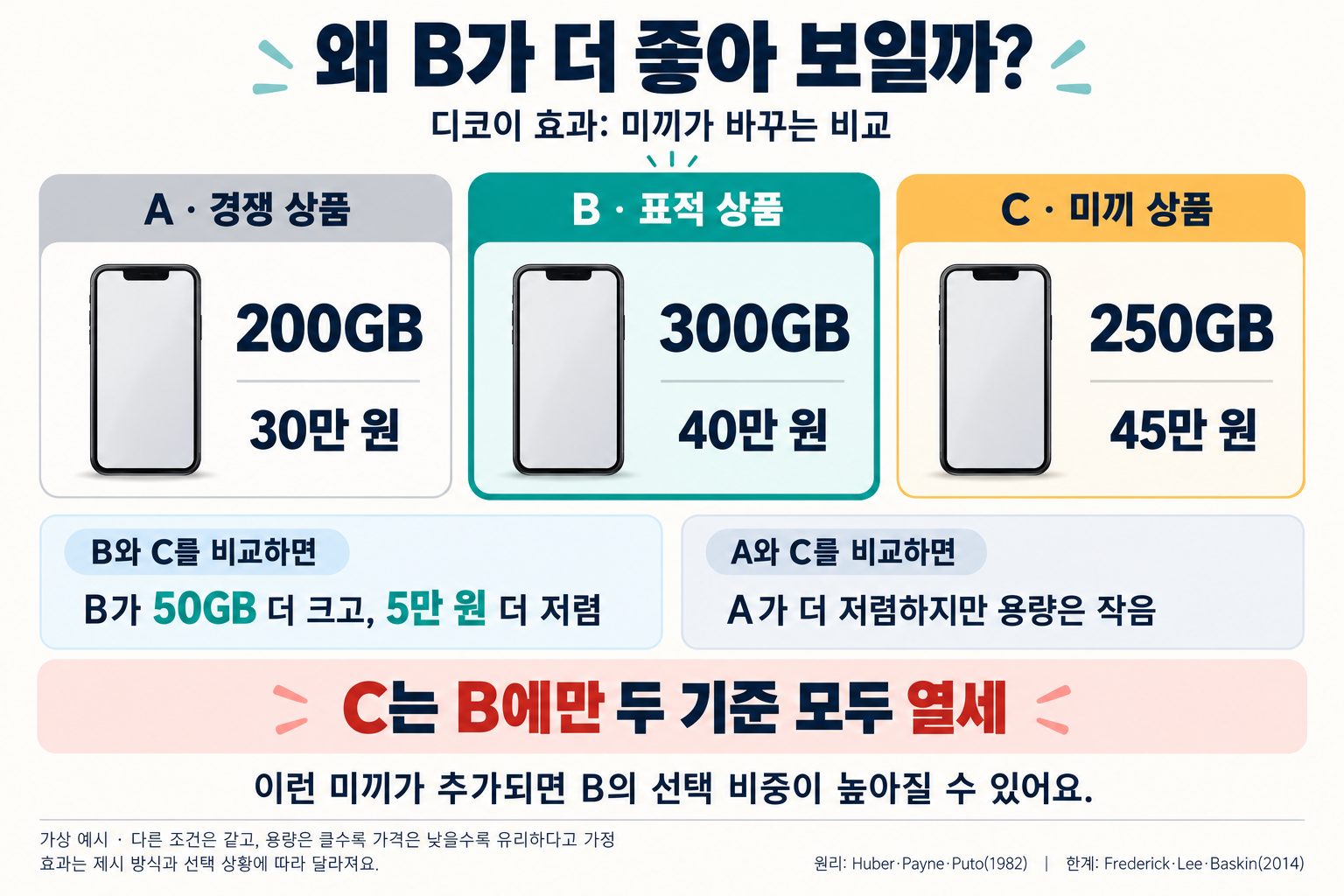
The key is an option that is asymmetrically dominated. Compared with one product, the decoy is worse in every respect; compared with the other, it is better in some ways and worse in others. As a result, the product that beats the decoy on every count stands out all the more. Traditional choice theory held that adding a new option could never increase the share of an existing product, and the decoy effect turned that assumption on its head.
- Decoy Effect: the phenomenon in which adding a less attractive option raises the share of people choosing a particular product.
- Asymmetric Dominance Effect: the academic term that highlights how the decoy is completely beaten by only one of the products.
- Attraction Effect: another name, meaning that the decoy pulls choices toward the product it resembles.
How a Decoy Changes Our Choices

Three roles appear in the decoy effect: the target product the seller wants to sell, a product that competes with it, and the decoy that makes the target stand out.
(1) We lean toward what is easy to compare
Weighing different criteria against each other, such as price and performance, is hard. The target and the decoy, by contrast, can be compared directly on the same criteria, so the judgment that the target is “clearly better” comes easily.
(2) The choice becomes easier to explain
People like choices backed by reasons that make sense to others and to themselves. An explanation like “you get one more thing for the same price” becomes the justification for choosing the target.
(3) The decoy does its job even if it never sells
The purpose of the decoy is not to be sold but to create a reference point for comparison. Even an option that hardly ever sells moves the sales of other products just by being on the shelf.
- Target: the product the seller wants to sell more of.
- Competitor: a product whose strengths and weaknesses cut the other way from the target’s, leaving customers torn.
- Decoy: an option worse than the target in every respect, which makes the target stand out.
The Decoy Effect Through Easy Examples

The decoy effect can be found all over price lists and store shelves.
(1) A magazine subscription price list
In his book Predictably Irrational, behavioral economist Dan Ariely described a subscription ad for The Economist: online for 59 dollars, print for 125 dollars, and print plus online for 125 dollars. When students were asked to choose, 16% picked online, 84% picked the bundle, and no one picked print alone. But when the print-only option that nobody had chosen was removed, the result flipped to 68% online and 32% bundle.
(2) Smartphone storage
People are split between a 200GB phone for 300,000 won and a 300GB phone for 400,000 won. Add a 250GB phone for 450,000 won, and the 300GB phone, which is cheaper and has more storage than the new one, suddenly looks like the smart choice.
(3) Coffee and popcorn cup sizes
Here the price gap between the small and large cups is set wide, while the gap between the medium and large is set very narrow. The medium cup effectively serves to recommend the large.
The Limits of the Decoy Effect and Smart Responses

The decoy effect does not always appear strongly. In 2014, Shane Frederick’s research team and others reported that when options were shown as pictures rather than tables of numbers, or when the setting was made closer to a real purchase, the effect was weak or barely visible. The original researchers, for their part, re-emphasized the conditions under which the effect shows up well: when people are genuinely torn between two products, when the two criteria matter about equally, and when the decoy is not absurdly bad and the dominance relationship is visible at a glance.
As a consumer, it helps to get in the habit of stepping back from the frame of comparison. If one option looks oddly half-hearted, suspect that it may be a decoy, then cross it out and compare again. It is also better to ask first “Do I really need this storage or this size?” rather than “Which one is the better deal?”
Sellers need balance too. Organizing options so they are easy to understand can be a design that helps customers, but once it becomes a device that pushes them into spending they do not need, it can easily cost the seller their trust.
The decoy effect is the phenomenon in which a single less attractive option shifts the basis of comparison and makes a particular product stand out. Knowing about the asymmetrically dominated decoy, our tendency to lean toward what is easy to compare, and the limits that can weaken the effect in real life will help you read a price list far more calmly.
Asking once more whose design lies behind the comparison in front of you, and starting from what you actually need: that is the first step toward smart spending that does not get pushed around.