
This time, I would like to put together material on budgets in public libraries. Public library budget preparation is the process of developing, analyzing, and finalizing plans for activities to be carried out in the next fiscal year, expressing them in financial terms and monetary amounts, and preparing draft revenue and expenditure budgets.
Public Library Budget Preparation
 An intense tug-of-war over a limited budget
Budget preparation generally begins 6 months before the start of the next fiscal year and encompasses budget requests, adjustments, and finalization. Here, a fiscal year refers to the period during which a budget is valid, established to clearly manage revenue and expenditure within a defined timeframe.
This process can be considered part of the political sphere because the library's supervising department, staff in charge, and others are all involved and draw fully on personal relationships and power.
An appropriate term related to this is 'budget politics.' According to the definition in a dictionary of public administration, budget politics refers to participants in the budget decision-making process mobilizing their influence to have their preferences and values reflected in the budget.
Since budgeting is a process of allocating limited resources, participants compete and mobilize their influence to obtain greater budgetary benefits; the term refers to the struggles that arise during this process.
Types of Public Library Funding Sources
- Own-source funding: Local taxes under the Local Tax Act, non-tax revenue, and local government bonds
- External funding: Local allocation tax provided by the national government to supplement local finances, and subsidies provided by the national government or metropolitan and provincial governments to make up funding shortfalls in lower-tier local governments or improve equity
- Donations: Article 9 of the Libraries Act (Donations of Money, etc.)
Principles for Public Library Budget Administration
 Transparent budget management
Because library budgets are funded by taxes, they must be managed transparently and in accordance with established principles. Some principles for budget administration established as policy by the national or local governments are introduced below.
- Principle of budget comprehensiveness: A library treats all income for the year as revenue and all spending as expenditure, incorporating both revenue and expenditure budgets into the budget without omission. This is the most fundamental of the budget principles.
- Principle prohibiting the direct use of revenue: A library must remit all revenue to the designated collection agency and must not use it directly unless otherwise provided by the relevant laws.
- Principle of fiscal year independence: A library must cover its expenditures for each fiscal year with revenue from that same year.
- Principle of sound finances: A library must manage its finances soundly and must not act contrary to the policies of the national and local governments.
- Principle of prior approval and public disclosure: The library director must submit a financial report to the head of the local government and disclose it to local residents as prescribed by Presidential Decree.
- Principle of budget unity: In managing a budget, its content, structure, and format are handled uniformly to maintain a consistent order.
Criteria for Public Library Budget Allocation
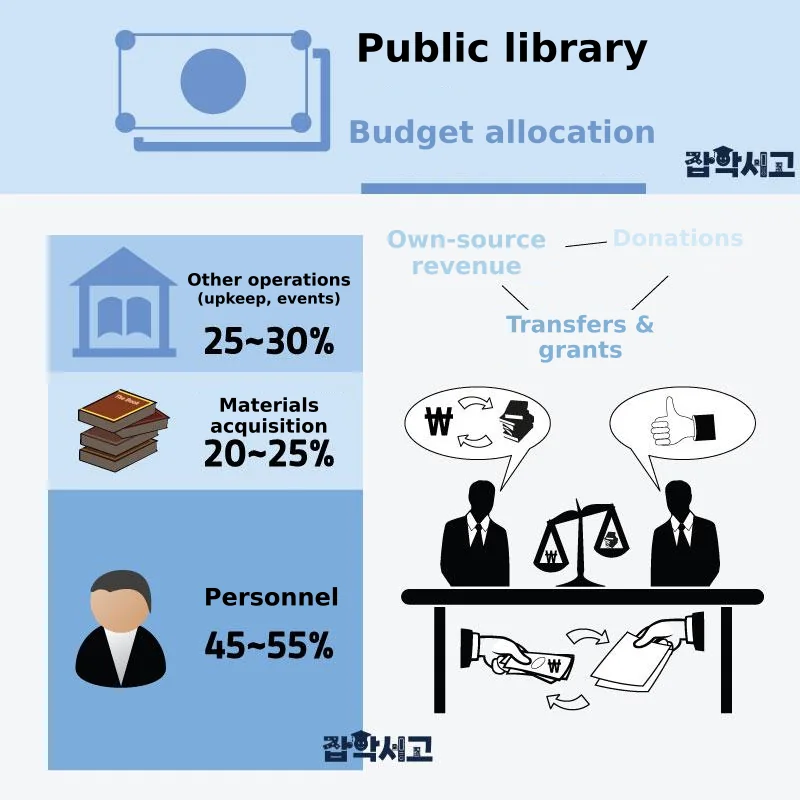 Public Library Budget Allocation
Public library budget categories consist of personnel expenses, materials acquisition expenses, and other operating expenses. The Korean Library Association (KLA) recommends allocating 25–30% of library budgets to other operating expenses, 20–25% to materials acquisition expenses, and 45–55% to personnel expenses.
In practice, however, the proportion allocated to materials acquisition falls far short of the recommended standard, so the proportion allocated to other operating expenses needs to be reduced and materials acquisition funding increased.
We have now examined public library budget allocation and its criteria, along with the principles that must be followed in practice. Because the funds used to operate libraries come from taxes paid by the public, libraries must ensure that these funds fully benefit their users.
To achieve this, rather than engaging in an administrative tug-of-war over money for the benefit of one's own department, more funding than at present should be allocated and spent on materials acquisition, events, and programs for users.