This time, we will explore the concepts of the Semantic Web, which is attracting attention as a next-generation web technology, and the related concept of ontology, as well as their relationship.
Whereas the web 2.0 we commonly encounter today features two-way communication in which users participate and share, web 3.0 involves an AI-powered web independently selecting and presenting the information users need.
Here, ontology is the core concept underlying web 3.0 (the Semantic Web), known as a next-generation web technology. In an ontology, words and their associated relationships are organized hierarchically, and it also includes inference rules for expanding it, allowing the web and applications to share knowledge.
 Making Human Language Understandable to Machines!
The web 3.0 referred to here is called the Semantic Web, and implementing this technology first requires machines to understand language at the level that humans do.
The Semantic Web refers to an environment in which human language is represented on computers and made usable by them, enabling computers to infer information and provide it to users, while ontology represents concepts that humans have jointly established through agreement in a form that computers can handle.
Computers can then use the concepts represented through ontology to acquire knowledge and process information. In other words, ontology can be described as the framework for implementing the Semantic Web.
(Semantic Web: human language → ontology → computer understanding → provision of appropriate information)
Components of Ontology
 Components of Ontology
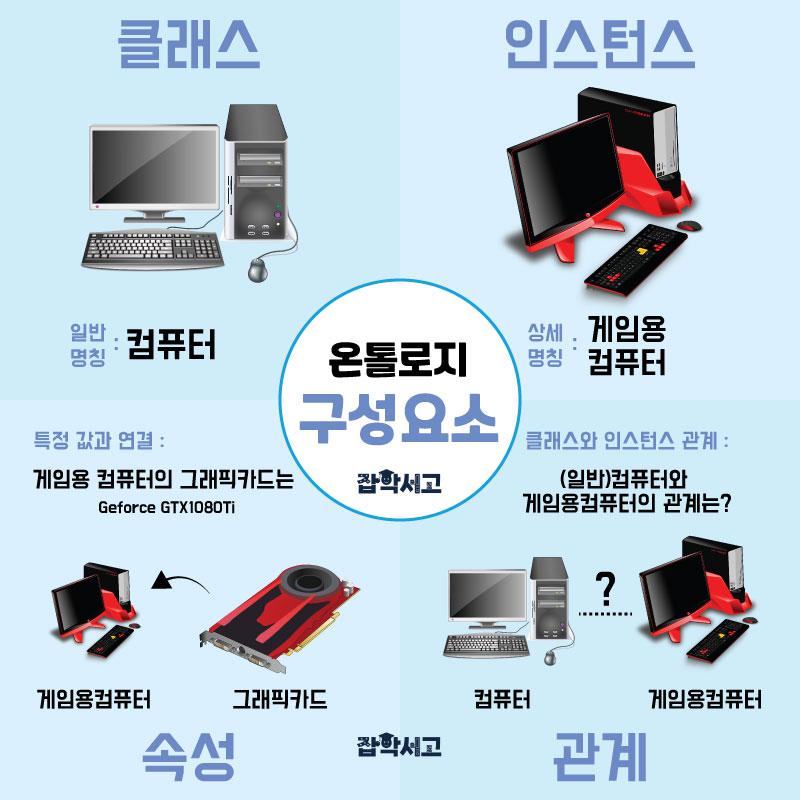
The components of ontology can broadly be divided into classes, instances, properties, and relationships. The image above illustrates these 4 components using a computer as an example to make them easier to understand.
- Class - A name used in everyday life for a thing or concept / e.g., computer, mouse, monitor
- Instance - A concept that represents a class more concretely and may vary depending on the purpose / e.g., XX gaming computer, YY wireless mouse, ZZ curved monitor
- Property - A connection to a specific value used to express the characteristics of a class or instance / e.g., the XX gaming computer is equipped with a [Geforce GTX1080TI] graphics card
- Relationship - A relationship between classes and instances
Representative terms used in ontology include RDF, OWL, and SWRL, whose respective characteristics are as follows.
- RDF - Generally expresses relationships between concepts or instances
- OWL - Expresses precise logical constraints within relationship instances
- SWRL - Defines rules for inferring relationships
Applications of Ontology
 Applications of Ontology
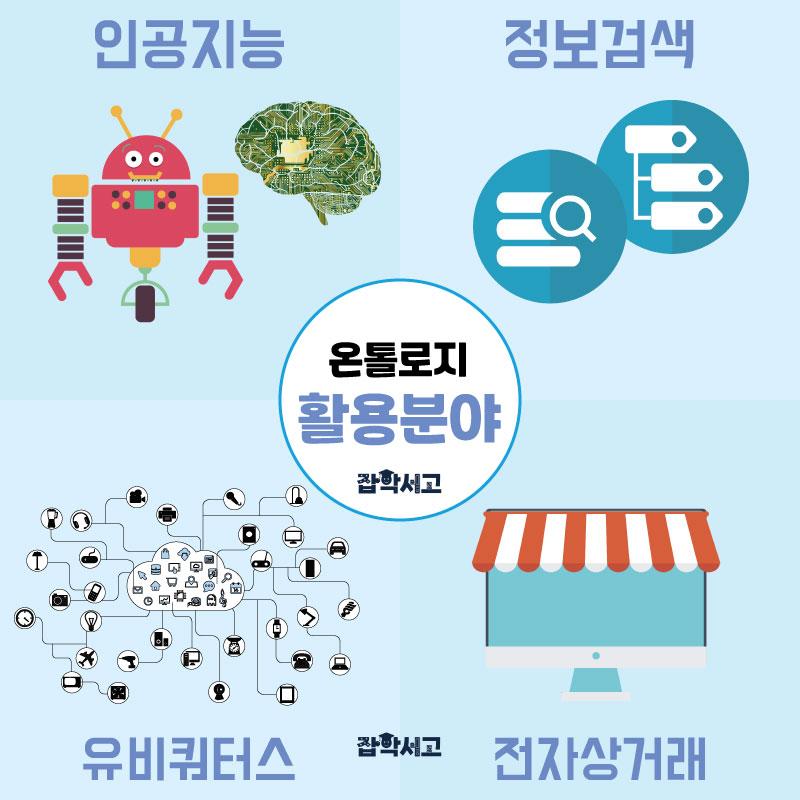
At present, considerable interest and effort are being directed toward using ontology for artificial intelligence and translation. In addition, ontology, as a set of agreed-upon concepts, can be used to connect disparate devices, as in ubiquitous computing and the Internet of Things, as well as in fields such as e-commerce, where complex concepts are applied.
- Artificial intelligence - Research on representing and using knowledge
- Information retrieval - Preventing unnecessary errors and improving search efficiency through subject heading lists, thesauri, and similar tools
- Ubiquitous computing - Multiple devices dynamically form networks over the Internet
- E-commerce - Computer programs handle most commercial activities
The thesaurus mentioned under information retrieval above is a concept frequently discussed in library and information science; please refer to the material below.
 What Is a Thesaurus?
Ontology makes it possible to identify relationships among the various meanings of a single word and perform fast, efficient searches, and it provides a foundation for understanding context through these relationships and offering users better information.
In addition, the Semantic Web (web 3.0), which uses these technologies, goes a step further by allowing computers (artificial intelligence) to independently find and provide the information users want in an environment where all information is connected through relationships, which is why it is attracting attention as the next-generation web environment.
However, because agreement has yet to be reached on concepts across numerous fields, progress is currently stalling at the ontology development stage. We hope these issues will be resolved soon and that the day will come when the rapidly advancing web environment gains even greater momentum.