This time, on the subject of an important concept in cataloging within resource organization theory (information organization theory), authority, I would like to prepare some material.
The dictionary definition of authority is “a basis used as a rule or law.” In library and information science, authority serves as a standard that enables headings (titles, authors, etc.) to be entered consistently during cataloging (MARC work). Here, the collection of information is called an authority file, and the act of controlling headings is called authority control.
 Types of Authority
Broadly speaking, authority can be divided into name authority and subject authority. Name authority relates to 1XX (main entry headings) and 7XX (added entry headings) in MARC, while subject authority relates to 6XX (subject added entry headings).
Representative examples of subject authority files include subject heading lists and thesauri. The name authority I intend to address in this material is used to control the representation of a single author through several similar names, something especially common when rendering foreign authors’ names in Hangul.
Understanding Authority
Example) The Author of Harry Potter
![The author of the Harry Potter series [Joanne K. Rowling]](https://www.gklibrarykor.com/wp-content/uploads/2023/09/%EC%98%88%EC%8B%9C%EC%9A%A9-%ED%95%B4%EB%A6%AC%ED%8F%AC%ED%84%B0-%ED%91%9C%EC%A7%80.jpeg) The author of the Harry Potter series [Joanne K. Rowling]
The author of the Harry Potter series [Joanne K. Rowling]
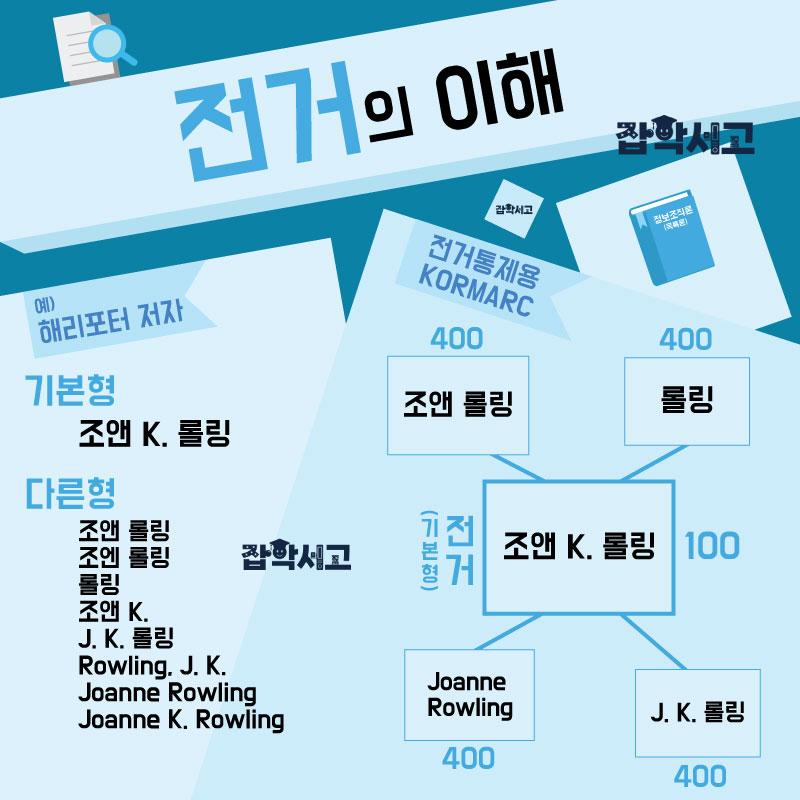
Preferred form - Joanne K. Rowling
Other forms (variant forms) - Joanne Rowling / Joen Rowling / Rowling / Joanne K. / J. K. Rowling / Rowling, J. K. / Joanne Rowling / Joanne K. Rowling
 Understanding Authority
The examples above concern the author of the Harry Potter series, Joanne K. Rowling, and show the various ways her name can be written. The name adopted and registered as the preferred form at the National Library of Korea is Joanne K. Rowling, but as a foreign-language name, it can be referred to in various forms.
To resolve this complexity during cataloging, a preferred form is established, and the remaining forms are treated as variants (other forms) to ensure consistency; this is the concept of authority.
Here, in KORMARC for authority control, the preferred form is registered in 1XX, and variant forms are registered in 4XX. Cataloging the author of Harry Potter mentioned earlier would look as follows.
- Registration in KORMARC for authority control
※ Indicator 1
0 - Name not beginning with a surname
※ Subfield codes
▼a Personal name / ▼d Dates of birth and death (year of birth and year of death)
100 0 ▼a Joanne K. Rowling ▼d 1965-
400 ▼a Joanne Rowling ▼d 1965-
400 ▼a Joanne K. ▼d 1965-
400 ▼a J. K. Rowling ▼d 1965-
400 ▼a Joanne Rowling ▼d 1965-
Authority Flowchart
 Authority Flowchart
When MARC work is carried out under authority control, even if the author’s name is entered in another form, the authority record registered in KORMARC for authority control is located, and the name is automatically converted to the author’s name registered in the preferred form before being recorded.
Also, when a user enters a search term to find a book by its author’s name, the key element in presenting the results is the index; the author’s name registered in the preferred form is found in an index generated from the authority file and returned in the results.
The flowchart above will probably make this a little easier to understand than the written explanation.
This concludes our look at authority, the concept of controlling headings so that they are represented consistently during cataloging. Without authority control of the catalog, MARC becomes extremely complex, resulting in less efficient work.
Understanding and applying the concept of authority, which involves registering the preferred form in a separate KORMARC for authority control to make automatic conversion convenient, can provide an opportunity to improve the consistency and efficiency of the work.