
Walk into a library and you will find books neatly shelved by subject; you can look up a book's location at the catalog terminal, then stroll between the stacks and pull out as many books as you like. It seems natural today, but there was a time when precious books were chained to desks. Behind the open libraries we know now lie five short principles. They are the Five Laws of Library Science.
Put simply, the Five Laws of Library Science are the basic principles that sum up, in five sentences, whom a library exists for and what it exists for. They were published in 1931 by the Indian mathematician and librarian S. R. Ranganathan in his book The Five Laws of Library Science, and they are still regarded as the classic that anyone studying library and information science encounters first.
This article walks step by step through Ranganathan himself and the meaning of the five laws, how each law shows up in actual libraries, and how to reread these laws in the digital age.
The Five Laws of Library Science: Five Promises a Library Must Keep
Ranganathan and His Five Sentences
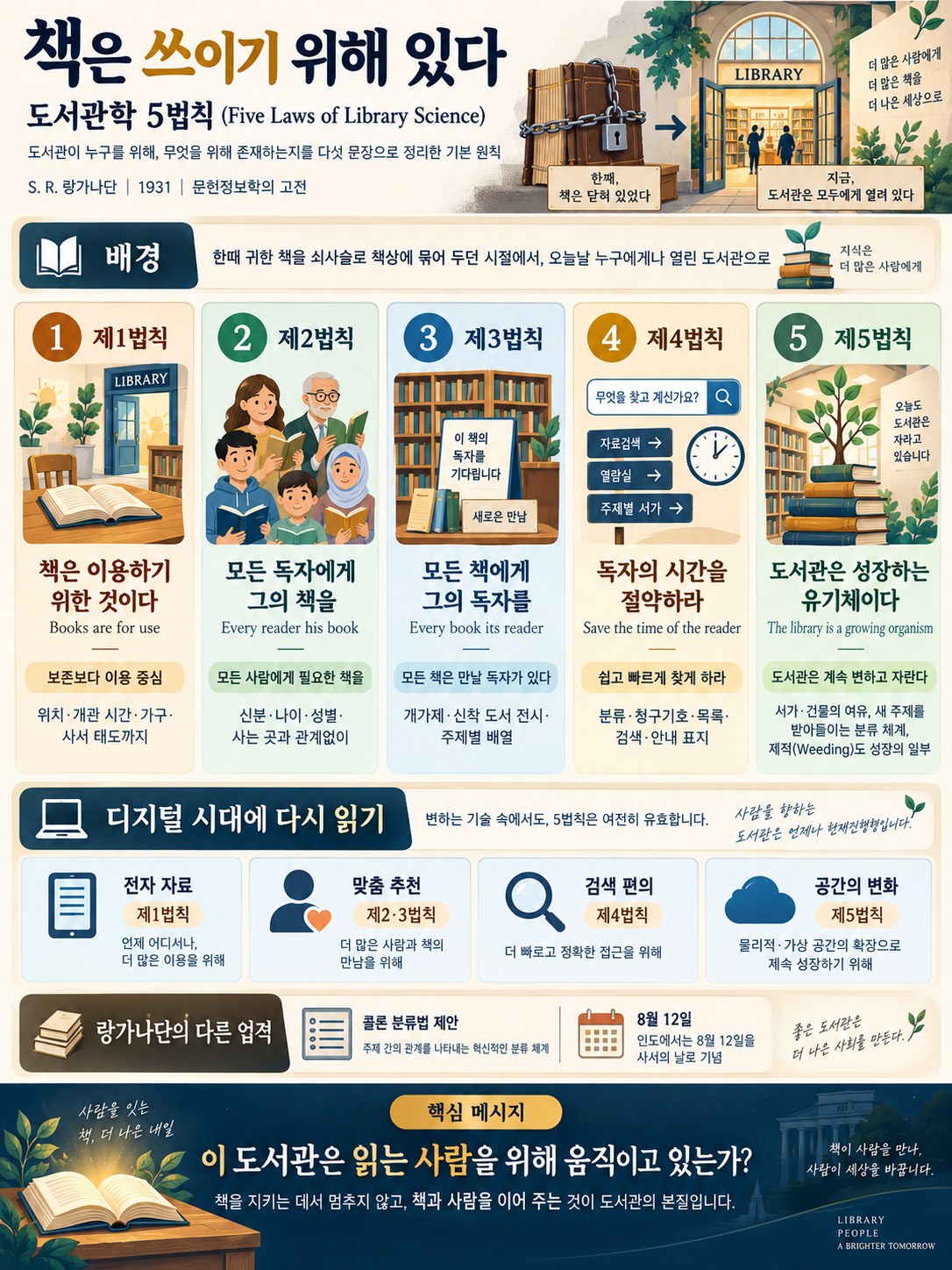

Ranganathan (1892–1972) was originally a professor who taught mathematics at a university. In 1924 he was appointed the first librarian of the University of Madras library in India, studied librarianship in London, England, and after returning devoted his life to running libraries and researching classification. The five laws he set out are as follows.
- First Law (Books are for use): Books are for use.
- Second Law (Every reader his book): Every reader his or her book.
- Third Law (Every book its reader): Every book its reader.
- Fourth Law (Save the time of the reader): Save the time of the reader.
- Fifth Law (The library is a growing organism): The library is a growing organism.
He also created Colon Classification, which had a major influence on classification theory. In India he is remembered as the father of library science, so much so that his birthday, August 12, is celebrated as Librarians' Day.
Three Laws That Connect Books and Readers

The first three laws look at the relationship between books and readers from different directions.
(1) Books are for use
When the urge to protect books goes too far, preservation comes before use. Instead of chaining books down or hiding them away, Ranganathan believed that everything—the library's location, opening hours, furniture, and even the librarians' attitude—should be decided with use in mind, so that anyone could easily come in and read.
(2) Every reader his or her book
A library must provide the books people need to everyone, regardless of social status, age, gender, or where they live. This law is the basis for libraries actively reaching out to diverse users, as with services for children, older adults, and residents who live far away.
(3) Every book its reader
Conversely, every single book on the shelf also needs to meet a reader who will read it. Open stacks where users browse the shelves themselves, displays of newly arrived books, and arrangement by subject are all ways of bringing dormant books out in front of readers.
A Library That Saves Time and Keeps Growing

The last two laws deal with how a library works and how it survives over the long term.
Fourth Law: Save the time of the reader
- Classification and call numbers: Gathering books on the same subject in one place helps readers find the book they want quickly.
- Catalog and search: Readers can see a book's location and loan status right away without walking through every shelf.
- Guidance and signage: Floor plans of the reading rooms and shelf signs cut down the time spent wandering.
Reducing cumbersome borrowing procedures and not making users wait long are also tied to this law.
Fifth Law: The library is a growing organism
A library's books, users, and staff increase over time. That is why shelves and buildings should be planned with room to spare from the start, and the classification system should be designed to accommodate new subjects. Just as a living organism replaces old cells with new ones, weeding—removing materials that have outlived their usefulness—is also part of healthy growth.
Rereading the Five Laws in the Digital Age

More than 90 years have passed since the five laws appeared, yet they still fit well even if you read "books" as information and "libraries" as online services.
- E-resources: If materials are meant to be used, anyone should be able to access them easily, whether on paper or on screen.
- Recommendation: Finding materials that match a reader's interests is a present-day way of putting the Second and Third Laws into practice.
- Usability: Designing systems so that users reach the materials they want in just a few clicks ties in with the Fourth Law.
- Library as Place: Libraries embracing new roles, such as spaces for talks, meetups, and making things, is the growth the Fifth Law speaks of.
In 1995, librarian Michael Gorman built on these laws to propose "five new laws of librarianship," summarizing that libraries should serve humanity, respect all forms by which knowledge is communicated, and use technology wisely. Ranganathan's five sentences keep being rewritten as times change because, in the end, they all carry a single question: Is this library working for the people who read?
Not stopping at protecting books but connecting books with people: that is the first step toward building a good library.