This time, I would like to put together information on the types of contracts that library staff should know about when purchasing books from suppliers. This material also concerns local government contracts as well as library contracts, and will provide some brief help to anyone curious about the types and characteristics of contracts for transactions in goods.
Contracts cover a variety of subjects, including construction contracts, contracts for the manufacture and purchase of goods, and service contracts, and there are countless subtypes within these categories. Among these, this article will introduce some types of contracts for the manufacture and purchase of goods.
Types of Contracts Used by Libraries and Local Governments
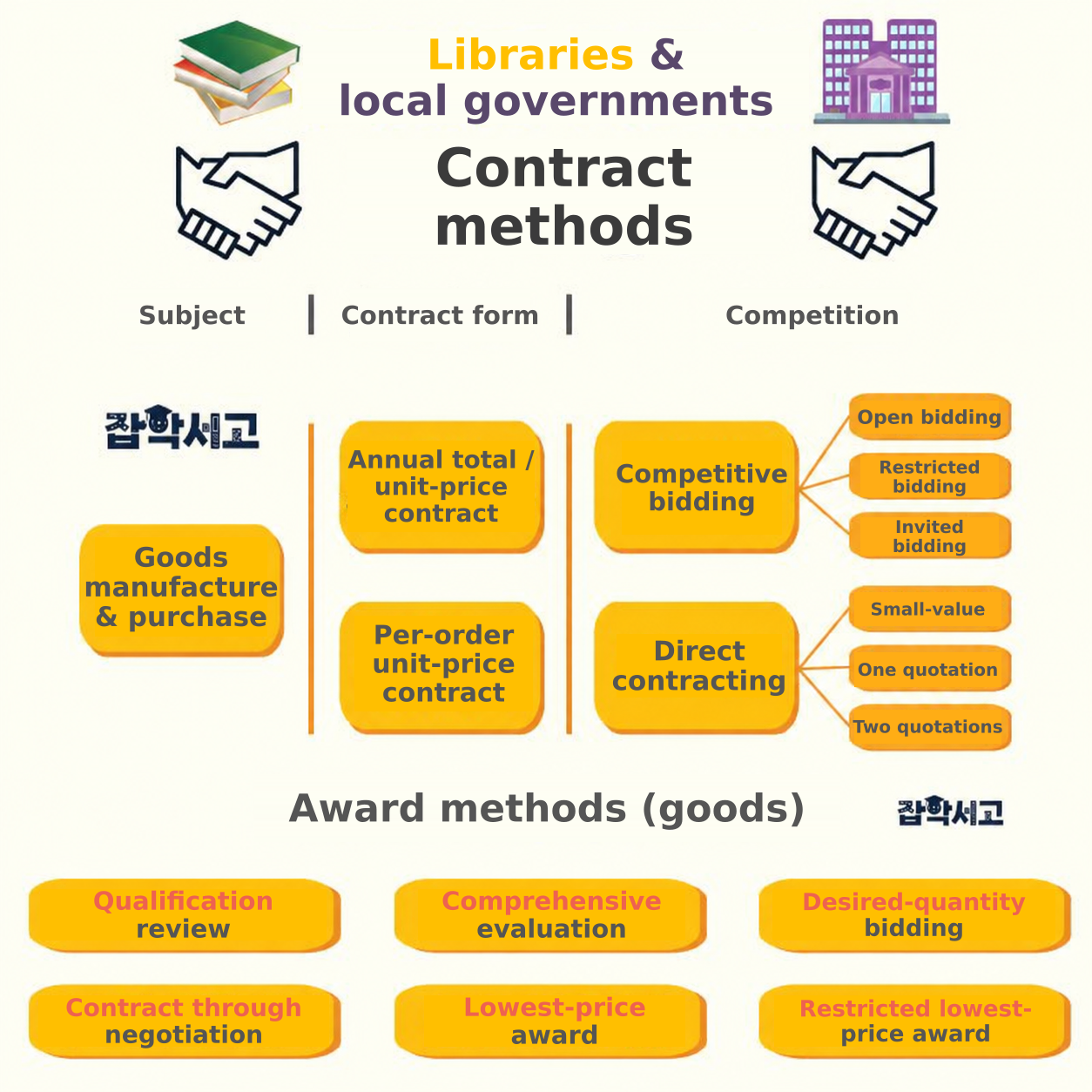 Types of Contracts for the Manufacture and Purchase of Goods Used by Libraries and Local Governments
The image above summarizes contracts for the manufacture and purchase of goods and related types of contracts. There are particularly many different forms of contract arrangements, so I have selected and summarized just 2 representative types frequently used by libraries.
Forms of competition are broadly divided into competitive bidding contracts and direct award contracts, each of which has various subtypes, and I will now explain them individually.
1. Forms of Contract Arrangements
Annual Total-Value Unit-Price Contract
 Should contracts be signed as needed? Should they be signed once per 1-year period?
An annual total-value unit-price contract is a method of setting unit prices and entering into a contract annually based on the total purchase amount. When the library places orders with the supplier as needed using a list of books to be purchased, the supplier delivers those books and the total amount is settled in a single payment at the end of the year.
The advantages of this contract include reducing wasted staff resources because a contract for purchasing books only needs to be signed once per 1-year period, building trust through an ongoing business relationship with the same supplier, and achieving the greatest benefits when purchasing new materials.
The disadvantages are that, if the selected supplier is unreliable, book deliveries may be delayed or other problems may arise, leading to complaints from library users, and if the annual total-value unit price is low, fulfillment of book orders may be poor.
Per-Purchase Unit-Price Contract
 More Work, but Stronger Competition
A per-purchase unit-price contract is a method of selecting a book supplier and holding a tender each time books are purchased. The purchasing department must publish the tender notice 7 days before the day preceding the deadline for submitting bids.
The advantages of a per-purchase unit-price contract are that selecting a supplier for each book purchase opens bidding opportunities to many suppliers, encourages participation by a variety of suppliers, and enables transparent competition.
The disadvantages are that the inconvenience of repeatedly entering into contracts results in wasted administrative effort, and the time required for delivery increases, ultimately delaying the receipt of books. In addition, if suppliers change frequently, cataloging work such as MARC processing becomes less consistent.
2. Forms of Competition
Direct Award Contract
 The library chooses a supplier at its discretion
A direct award contract, which is used by a considerable number of libraries, is a contract in which a supplier is selected at the library’s discretion without competition or bidding. Whether a direct award is permitted and which monetary criteria apply depend on the contracting entity, subject matter, grounds for the award, and supplier qualifications, so the applicable laws and criteria must be checked. For example, direct awards for goods manufacturing or purchase governed by South Korea’s Local Government Contracts Act are subject to Article 25 and other relevant provisions of its Enforcement Decree; under Article 30, a quotation may be obtained from 1 party when the estimated price is 20 million won or less. Other grounds permitting a single quotation and the detailed procedures are also governed by the relevant provisions.
The advantages of a direct award contract are that the book purchasing procedure is simple and the contract can be concluded quickly. In addition, because the supplier is selected at the library’s discretion, unsuitable suppliers can be excluded in advance, allowing the contract to proceed on terms favorable to the library.
However, the disadvantages are that entering into a contract without competition creates a risk of misuse, such as the so-called abuse of a dominant position, and external pressure may lead the library to enter into a contract with an unwanted supplier.
Competitive Bidding Contract
 Intense Competition Among Suppliers
Competitive bidding contracts are a form of contract used by even more libraries than direct award contracts. This method involves multiple suppliers participating in a tender and the contracting party being selected under the applicable award criteria. For tenders governed by South Korea’s Local Government Contracts Act, Article 42 and other relevant provisions of its Enforcement Decree provide for methods that assess contract-performance ability as well as price. They can generally be divided into open competition, restricted competition, and invited competition, with local governments usually adopting open competition as the basic principle.
The advantages of a competitive bidding contract are that fairness can be secured in the bidding process and budget savings can be expected through price competition among suppliers. In addition, many suppliers can gain opportunities to secure delivery contracts.
However, a disadvantage is that the period from the tender announcement to the conclusion of the contract becomes longer, creating the problem of a lengthy wait before new books are received and placed on the shelves. In addition, inadequate assessment of delivery capability and quality under the applicable evaluation procedure can raise concerns about a decline in the quality of delivered books, and frequent changes in suppliers bring inconvenience because work procedures and methods also change.
3. Methods of Selecting the Successful Bidder (Goods)
Lowest-Price Award System
 Decisions Based Strictly on Low Unit Prices
The lowest-price award system is a method of selecting, from among the many suppliers participating in a tender, the supplier quoting the lowest unit price as the contracting party. However, because of the fixed book price system, this method is more suitable for purchasing goods or software than books.
The advantages of this contract are that price competition among suppliers can reduce the budget needed to purchase books or goods, and the library’s purchasing power increases. This results in a greater capacity to acquire additional materials at low unit prices.
However, a disadvantage is that suppliers offering low prices have an advantage simply because of their price, raising concerns about a decline in delivery quality, and if a supplier goes bankrupt or operates on a very small scale, delivery times may become longer or deliveries may not be made.
Negotiated Contract
 Evaluation Primarily Based on Supplier Capabilities
A negotiated contract is a method of negotiating with multiple participating suppliers and entering into a contract with a supplier likely to offer outcomes favorable to the library in terms of technical capability, supply price, and other factors.
The advantage of this contracting method is that emphasizing the participating suppliers’ technical capabilities makes it possible to expect prompt delivery and accurate bibliographic information.
However, the disadvantages are that an evaluation committee is difficult to form, and the tender may be canceled because few suppliers can satisfy the library’s requirements. In addition, there is a risk that contracts will be concentrated among a small number of particular suppliers with technical capabilities, which can cause other problems, such as further subcontracting by subcontractors, and lead to a decline in quality.
Other Contracts
Other types include the qualification-assessment award system, which selects a supplier that passes an assessment of its ability to perform the contract from among suppliers bidding at the lowest price; the comprehensive award system, which selects a supplier by considering both bid price and quality; and the desired-quantity bidding system, which selects suppliers able to meet the required quantity.
We have now examined the types of contracts mainly used by libraries when purchasing materials, along with their advantages and disadvantages. Points to consider include whether to enter into contracts as needed or once per 1-year period, whether participating suppliers will compete, and what criteria to use for the final decision.
Because there are so many types of contracts and they are an important matter that needs careful attention, they may seem complicated at first, but understanding the characteristics of frequently used contracts beforehand will make it easier to work through them individually.