This time, we will examine catalogs, one of the concepts frequently used in libraries. Catalogs are intended to ensure that the same book can be registered according to the same standards regardless of who creates the record, and cataloging rules were established to regulate this.
In Korea, these are the Korean Cataloging Rules (KCR), which are currently available through edition 4. This article discusses edition 4 of KCR, and the concepts covered here will provide the basic theory for MARC work. In fact, MARC was developed on the basis of these cataloging rules.
For the tags and related information you need to know when creating MARC records, please refer to the resource below.

1. The Structure of a Catalog
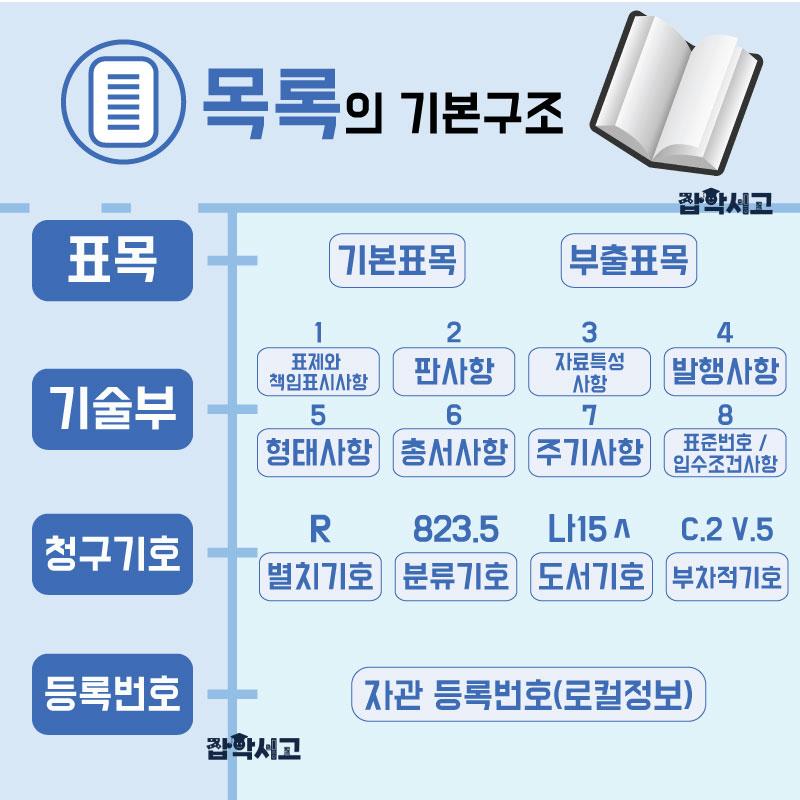 Overall Structure of a Catalog
A catalog can be broadly divided into four parts: headings, the descriptive section, call numbers, and accession numbers. Before MARC was introduced, libraries created card catalogs based on these concepts, and in automated MARC, this information was applied to the respective fields through the concept of tags (Tag).
Headings - Main entry heading / added entry heading
Descriptive Section - 1. Title and statement of responsibility area 2. Edition area 3. Material-specific details area 4. Publication area 5. Physical description area 6. Series area 7. Notes area 8. Standard number and terms of availability area
Call Number - 823.5 나15ㅅ Separate shelving mark / classification number / book number / supplementary mark
Accession Number - A number assigned sequentially to each item in the library's accession register
Here, a heading refers to a search term used to find a catalog entry (book), and has the same meaning as an access point or index term. Headings are further divided into main entry headings and added entry headings, and main entry headings involve considering whom to record as the representative when there are multiple authors and how to represent the entity. Added entry headings are created to enable searching through the remaining access points not adopted as the main entry heading.
However, because of the complexity of these selection and representation issues, edition 4 of KCR does not use main entry headings.
For information about the descriptive section, please consult [Points to Note When Cataloging], presented in section 3.
2. Features of KCR Edition 4
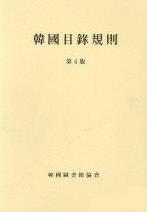 Korean Cataloging Rules (KCR), Edition 4
Cataloging began with the 'Cataloging Rules for Eastern Books,' first compiled by Park Bong-seok in 1948, and editions 1 and 2 of the Korean Cataloging Rules were published in 1964. These were Korea's first official standard cataloging rules, and were compiled based on the author main entry principles of the Anglo-American Cataloguing Rules.
Next, edition 3 of the Korean Cataloging Rules appeared in 1983, and 20 years later, in 2003, the Korean Cataloging Rules (KCR edition 4) were published. Current cataloging work is based on this edition 4 of KCR.
The most notable feature of the transition from edition 3 to edition 4 of KCR was the expansion from edition 3, which was limited to monographs, to rules covering materials in all formats, and the other basic changes are as follows.
▣ General
# Presents the functions of a catalog for the first time (searching, identifying materials, indicating locations, and notifying users of holdings)
# Integration of still-image and moving-image materials
# Developed with the use of MARC in mind
▣ Headings
# Excludes provisions for headings such as main entry headings, added entry headings, and uniform headings (authority rules are needed)
▣ Scope and Terminology
Title and author area → Title and statement of responsibility area / illustrative figures → illustrations / colored → full color / heading → access point / author statement → statement of responsibility / terms of acquisition area → terms of availability area / book title → title, subtitle / miscellaneous title → other title information / medial dot → middle dot / full stop → period, etc.
▣ Description of Statements of Responsibility
# In KCR3, the author statement was omitted when the author was included in the title information, but in KCR4, the author statement is mandatory
# KCR4 allows all authors to be recorded when there are 4 or more authors
▣ Object of Description
# Treats describing an entire collection or series as an alternative method
▣ Original Titles and Parallel Titles
# In KCR3, original titles were treated as parallel titles, but in KCR4, original titles are separated out
3. Points to Note When Cataloging (KCR 4)
 Standards are needed to register numerous books consistently
To undertake cataloging or MARC work in earnest, books must be registered consistently based on the Korean Cataloging Rules, which set out the standards for registering books.
For this purpose, the points you need to know when recording information for each descriptive area are briefly set out below for reference.
▣ Sources of Information by Area
1. Title and statement of responsibility area: Title page, colophon, cover
2. Edition area: Title page, colophon, cover, half-title page, front matter, spine
3. Publication area: Title page, colophon, cover, half-title page, front matter, spine
4. Physical description area: The book itself
5. Series area: The book itself
6. Notes area: Any source
7. Standard number and terms of availability area: Any source
▣ Title Proper
# A single author with 4 or more works: Record only one work; omit the rest
# Multiple works by 2-3 authors: 1 work per author
# A collection by 4 or more authors: Only the first work
# When omitting entries, use [and others] without … for Eastern books, and …[et al] for Western books
# Record all included works in a note
▣ Parallel Titles and Other Title Information
# Describe parallel titles and original titles separately
# Record only the first parallel title; record the rest in the notes area
# Integrate subtitles and miscellaneous titles into other title information
# Place other title information that has the nature of a statement of responsibility at the end
▣ Volume, Issue, and Year Designations
# Provisions limiting description
# Except in special cases, record these in contents notes or holdings notes
# Supplement the physical description area at the same time
# When both an issue designation and a year designation are present: Record the year designation in parentheses ( ) after the issue designation
▣ Statement of Responsibility
# Statements of responsibility (authors, translators, etc.) cannot be omitted
# Record all statements of responsibility shown on the chief source of information
# Language: Choose the language or script that matches the title proper
- If the title page gives the statement of responsibility only in a foreign script, but the material itself contains a statement of responsibility in Korean or Hangul, choose Korean
# Omit degrees, positions, honorifics, country names, clan origins, courtesy names, pen names, legal forms of corporations, and industry names
- Exceptions (e.g., when omitting them would leave only a surname or only a given name)
# In Western books, phrases that appear before a statement of responsibility: Record them as other title information when they indicate the nature or content of the work, and as statements of responsibility when they indicate a role
# When there are multiple different roles but no role terms are given, record the role terms in [] - Author name[written by]
▣ Edition Statement
# Printing designations are generally not recorded
# When an accurate description is needed in relation to price or similar matters, the printing designation may be recorded, but it has no significance
# If the word 'edition' is absent, supply it in square brackets [] (e.g., Revised [edition])
# Facsimile editions and the type used for printing (e.g., an edition printed with Gabinja type) are treated as edition statements
# Format or physical form (e.g., a reduced-format edition), language (an edition in English), and regional edition information (a Daegu edition) are also treated as edition statements
# Phrases describing the characteristics of a work are not considered edition statements [Examples - color edition, latest edition]
▣ Publication Area
# Use the year of the first printing of the edition in question. (That is, printing 1 of the book's latest edition)
# Give priority to the Common Era year, and record all years in Arabic numerals (ex-1988)
# Dates in calendars other than the Common Era: Record them as given, and record the Common Era year in square brackets []
# If publication years differ by volume, record them as a range
# An incorrect publication year → Record it as given, then give the corrected year in square brackets [] preceded by 'actually' or 'ie' =1987 [actually 1988]
# If the publication year and distribution year differ, record the distribution year after the publication year, adding a role term
# If no publication, distribution, or printing year is given, record an estimated year
# If the publication and distribution years, as well as the publisher and distributor, differ, record each year paired with the corresponding body
# Indicate the copyright year by adding 'c' before the Common Era year
▣ Physical Description Area
# Describe physical dimensions (height, width, diameter), etc.
# Use cm as the default unit of measurement for dimensions; for other cases, refer to the relevant rules
Monographs
# For dimensions of 10 cm or less, record in millimeters (mm)
# For nonstandard dimensions, use [height x width]
# For multivolume works whose volumes differ in size, record the dimensions as a range
# Always round up to a whole number (23.2 cm → 24 cm)
# For single sheets, scroll-format books, hanging scrolls, etc., use [height x width]
# For folded materials, record [original dimensions] followed by [folded dimensions]
Accompanying Material
# Record the type and quantity of accompanying material
# Record the remaining physical description information in parentheses ()
▣ Series Area
# Take care not to confuse a series with a collective title (representative title) - e.g., Complete Collection of World Literature
# A series is regarded as supplementary information in catalog descriptions (recorded in parentheses) - e.g., (Complete Collection of World Literature ; 4)
# Most provisions match those for the title and statement of responsibility area, except for information sources and punctuation used
# Elements of description: Series title proper, parallel title, other title information, statement of responsibility, ISSN, volume/issue designation, subseries, and subseries number
▣ Notes Area
# Use the prescribed introductory phrases or common phrases
# Follow the order of entries in the descriptive section
# For information found in other sources, record only the source whenever possible
# Put quoted phrases in double quotation marks (“ ”), and record the source after a hyphen
# Include sufficient information in notes about other related works
▣ Standard Number and Terms of Availability Area
Standard Number
# Record the name of the standard number first - ISBN, ISSN
# Record the binding type, volume, or similar information used to identify the standard number in parentheses () - e.g., (set), (volume 3)
# Separate 2 or more standard numbers with [.-]
Key Title
# Applies only to serial publications
# Record the title assigned by ISDS (key title) preceded by an equals sign
Terms of Availability Statement
# Record the list price
# If the price of the same edition changes depending on the printing year, record it together with the accession number and printing year
# Record the official currency designation first (₩14,000)
# If there are 2 or more prices, record the 2nd price in parentheses ()
We have now examined the basic concepts of catalogs for cataloging or MARC work. Because the MARC used in actual libraries is computerized, a more detailed understanding of the rules is needed based on this theory and these rules. Use this material only as a basic introduction to cataloging, and for information on MARC, please refer to the resource linked at the top of this article.