Think back to the first day you walked into a university library for an assignment, and many of you will remember wandering for a long time among tall shelves, unfamiliar call numbers, and people sitting quietly, not knowing where to go. Asking the librarian at the help desk would have sorted it out in no time, yet you may have felt it was a silly question, searched on your phone instead, and turned away. This sense of helplessness and fear isn’t just a quirk of your personality; it’s a phenomenon that library and information science has studied for a long time, called ‘library anxiety.’
Put simply, library anxiety means ‘the discomfort, worry, and fear people feel when they need to find and use materials in a library, and the state of mind that makes them avoid asking for help because of it.’ This anxiety grows less from a lack of library skills than from the urge to hide that lack for fear of being found out.
In this piece, we’ll look in turn at the study in which the concept of library anxiety first appeared, the five factors used to measure it, the effects anxiety has on studying and research, and the ways users and libraries can reduce it together.
Feeling Small in Front of the Library
How Was Library Anxiety Discovered?

The term library anxiety was first established as a theory in a 1986 paper by American librarian and researcher Constance A. Mellon, published in the journal College & Research Libraries.
(1) What students’ writing had in common
Over two years at a university in the American South, Mellon collected personal writing by students in first-year composition classes and analyzed the recurring themes. She found that 75–85% of the students described their first experience of searching for materials in the library in terms of ‘fear.’
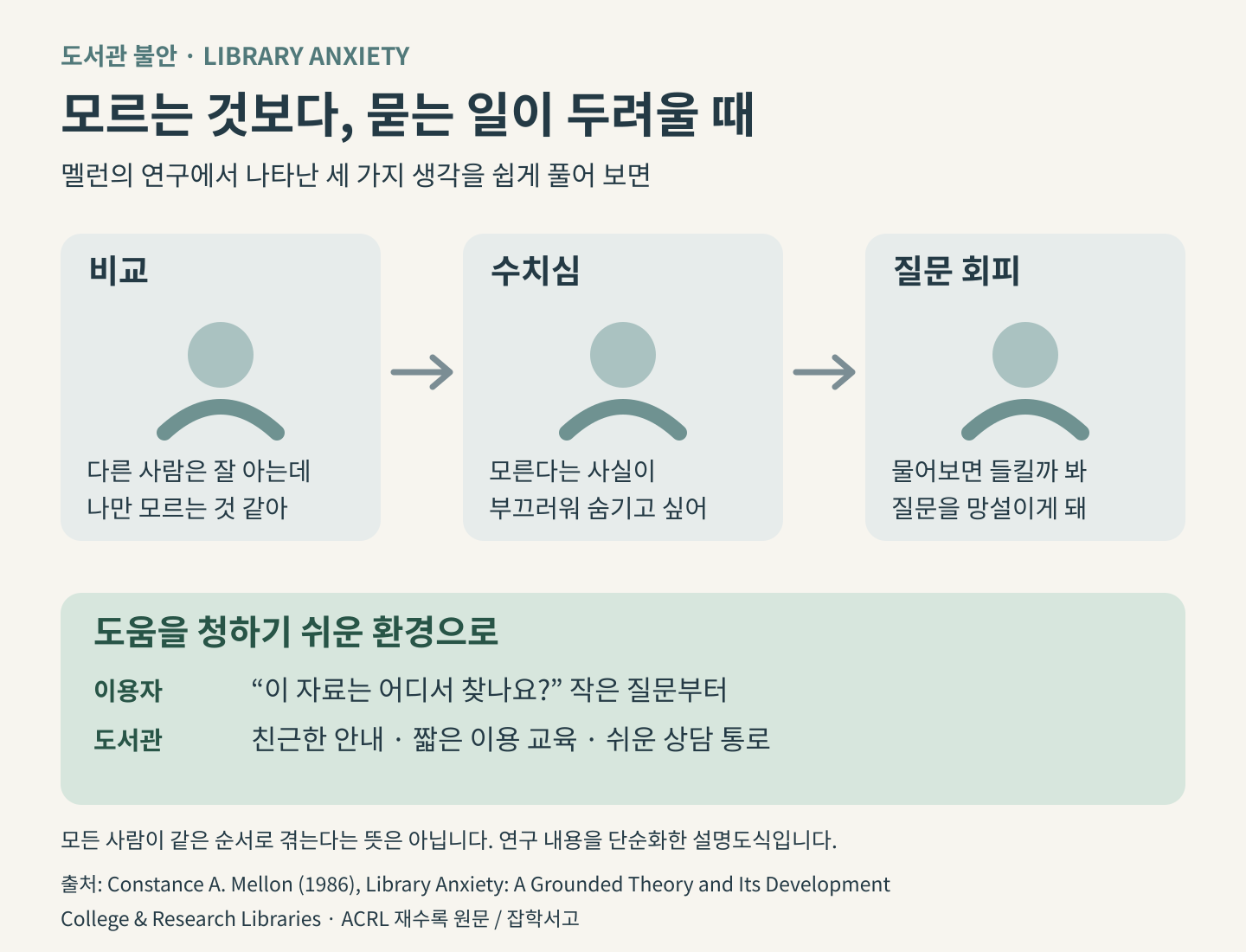
(2) Three patterns of thought
Three ideas appeared again and again in the students’ writing.
- Comparison: They felt that other students used the library well and they alone could not.
- Shame: They believed that being so inept was embarrassing and had to be hidden.
- Avoidance: Since asking a question would reveal their ineptness, they didn’t ask and struggled on alone.
Rather than counting numbers, Mellon used a qualitative research method called grounded theory, which draws concepts out of what people write and say, and her study became the starting point for seriously examining library users’ emotions.
The Five Factors That Make Up the Anxiety

Because Mellon’s theory had never been confirmed with numbers, Sharon L. Bostick created the ‘Library Anxiety Scale’ for measuring library anxiety in her 1992 doctoral dissertation. With 43 items answered on a five-point scale, it divided anxiety into five factors.
- Barriers with Staff: Librarians seem too busy or hard to approach, so people hesitate to ask for help. Of the five factors, this one explained the largest share of anxiety.
- Affective Barriers: Asking feels like being a bother, and people feel helpless, as if they alone don’t know how to use the library.
- Comfort with the Library: This concerns whether the library feels like a safe and welcoming place, and whether its rules and atmosphere feel familiar.
- Knowledge of the Library: How well people know where materials are and how to find them.
- Mechanical Barriers: Difficulty with equipment such as computers, photocopiers, and printers.
The scale has since been translated into many languages and adapted, becoming the most widely used tool in library anxiety research.
How Anxiety Affects Studying

Library anxiety doesn’t stop at being a matter of mood; it affects the quality of studying and research.
[Effect 1] Getting by without asking
Instead of asking a librarian, anxious users tend to try a few search terms they already know, use whatever materials come to hand, and stop there. As a result, they miss more accurate and reliable sources, and their assignments end up shallower.
[Effect 2] Putting things off and avoiding them
When finding materials feels frightening, people put off even starting the assignment. Library anxiety is known to be especially strong among people in unfamiliar surroundings, such as students just entering university, adults returning to study after a long break, and international students from other countries.
Ways to Reduce Library Anxiety

Since library anxiety isn’t a problem for users to solve alone, libraries and users can work together to reduce it.
(1) A library that reaches out first
Mellon named warm encounters between librarians and users as the key to reducing anxiety. When librarians speak up first and libraries offer channels where people can ask without pressure, such as short orientation sessions and tours for newcomers, easy-to-read signs, and chat reference, the barriers with staff drop considerably.
(2) Accepting that not knowing is normal
Knowing how to use a library isn’t an innate ability but a skill that is learned. Simply realizing that many people feel the same fear, and starting with small questions, can be enough to break the cycle of anxiety.
Library anxiety is an invisible wall that makes people hesitate at the door to knowledge. That wall rises or falls not so much with how big the library is as with how comfortable people feel asking questions.
Not being ashamed of what you don’t know and saying a word to a librarian: that is the first step toward getting closer to the library.