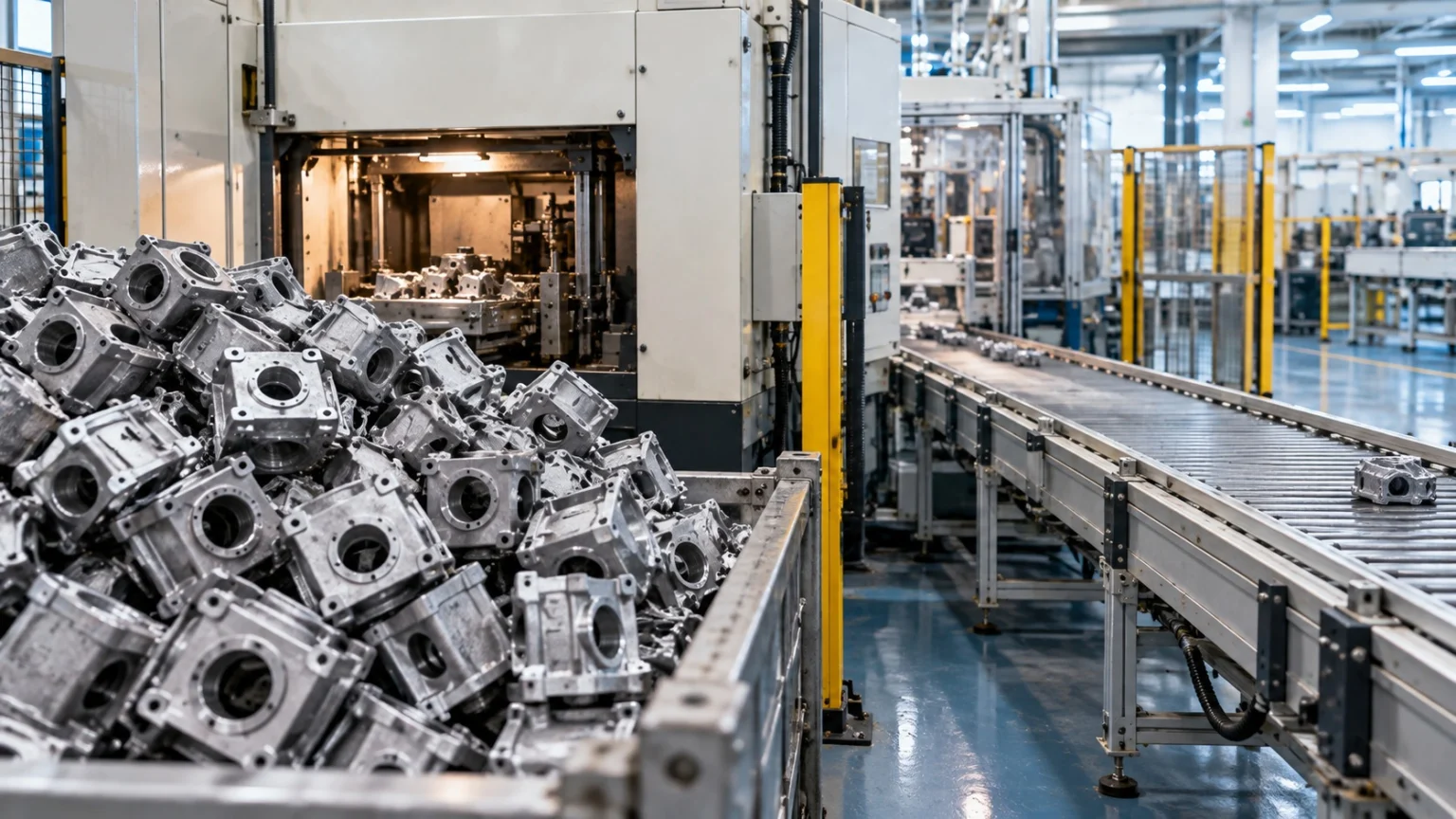
Look at a factory's machines one by one, and most of them seem to be running busily, yet the finished products never come out as fast as expected. Parts pile up like a mountain in front of one machine, while the machines after it often stand idle with nothing to do. Everyone is working hard, but the speed of the whole is tied to the single slowest spot. The idea that puts this phenomenon at the center of management is the “Theory of Constraints.”
Simply put, the Theory of Constraints is “a management theory holding that the performance of any system is determined by its single weakest link, the constraint, so that constraint must be found and managed with focus.” It was popularized by Eliyahu M. Goldratt, an Israeli physicist turned management thinker, through his 1984 business novel The Goal.
In this article, we will look in turn at what the Theory of Constraints is and why you should focus on one spot, the five steps for dealing with a constraint, the Drum-Buffer-Rope method used on the production floor, and finally the lessons and limits this theory leaves us.
The Weakest Link Sets the Pace for the Whole: How the Theory of Constraints Works and How It Is Used
What Is the Theory of Constraints?

The Theory of Constraints starts from an old saying: “A chain is no stronger than its weakest link.”
(1) Every system has a constraint
Whether it is a company or a factory, any system moving toward a goal has at least one factor that keeps it from increasing its performance further. If there were no constraint at all, performance would grow without limit, but no such system exists in reality.
(2) Constraints are few
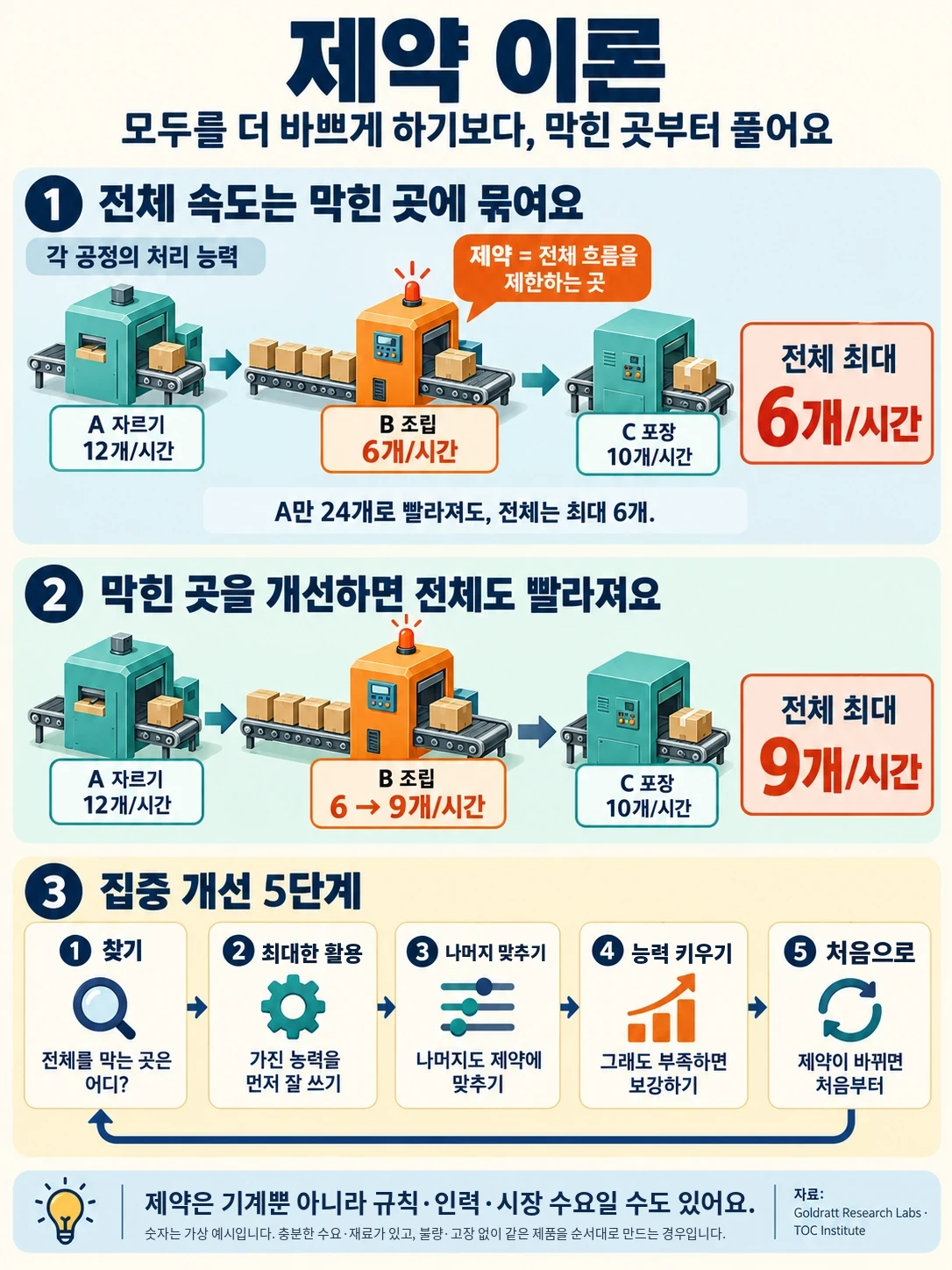
Problems may seem to be everywhere, but the constraints that actually hold back overall performance are usually just one or a few. That is why finding that one spot comes before fixing a little bit of everything. No matter how much you improve places that are not the constraint, overall performance barely changes.
(3) Constraints take many forms
Equipment such as a slow machine, a shortage of skilled workers, and even company rules or practices such as “it is more efficient to make a lot at once” can all be constraints. If market demand is smaller than production capacity, the constraint lies outside the company, that is, in the market.
Five Steps for Dealing with a Constraint
Goldratt organized the order for dealing with a constraint into five steps. These are called the “Five Focusing Steps.”
(1) Identify
Find where the constraint holding back the performance of the whole system lies. The place where work piles up and waits the most is a typical clue.
(2) Exploit it to the fullest
Before spending money, make sure the constraint you already have never sits idle for even a minute. An hour lost at the constraint is an hour lost for the entire system. You might keep it running in shifts even over lunch, or screen out defective parts beforehand so they never pass through the constraint.
(3) Subordinate everything else
Processes that are not the constraint move at the pace of the constraint. If other processes run fast on their own, they only increase piled-up inventory without increasing overall performance.
(4) Elevate its capacity
If that is still not enough, raise the capacity of the constraint itself by bringing in more equipment or adding more people.
(5) Go back to the beginning
Once a constraint is broken, somewhere else becomes the new constraint. At this point, start again from the first step so that inertia, clinging to the old way of doing things, does not become the next constraint.
Drum, Buffer, and Rope

On the production floor, this principle is put into practice through a method called “Drum-Buffer-Rope.”
- Drum: The pace at which the constraint process works. The whole factory moves in time with the beat of this drum.
- Buffer: Extra work or time stocked in front of the constraint in advance. Even if a small problem arises in an earlier process, it keeps the constraint from stopping for lack of work.
- Rope: A mechanism that ties the timing of releasing raw materials into the process to the pace of the constraint. It prevents inventory from swelling because materials were released earlier than needed.
The Goal has a scene that shows this simply. The main character goes on a hike with a group of Boy Scouts, and the line keeps stretching out because of Herbie, the slowest boy. The main character puts Herbie at the very front and shares out his load among the other boys. The line then stops spreading out, and the overall pace gets faster. Matching the whole to the pace of the slowest spot and lightening that spot's load is exactly how a constraint is managed.
Lessons and Limits of the Theory of Constraints

The Theory of Constraints spread beyond the factory into many fields, but there are also points worth examining along with it.
(1) Local efficiency is not overall efficiency
It overturned the idea that keeping every machine and every person busy at all times is good management. Being busy in places that are not the constraint can actually increase inventory and confusion.
(2) It expanded into other fields
In 1997, Goldratt applied this idea to project management through Critical Chain. Attempts to use the same principle in supply chains, accounting, and sales management followed.
(3) It is also used as a thinking tool
For cases where the constraint is not visible equipment but invisible rules or practices, Goldratt also introduced the “Thinking Processes,” which work through causes and effects by drawing them in the shape of a tree. They are tools that ask, in turn, what to change, what to change to, and how to cause the change.
(4) There are also criticisms
Critics point out that it is hard to say it is always better than other planning techniques, that it borrowed heavily from existing production management theories, and that more research is needed to show its relationship to actual financial performance.
The Theory of Constraints reminds us of a simple fact: even an organization that looks complex ultimately moves according to its single weakest link. Concentrating your effort on one spot creates a bigger change than trying to fix everything at once.
Asking first what single constraint is holding us back right now is the first step in management toward better performance.