In this article, we will explore two principles that can be applied in various fields, including marketing in business administration, economics, and statistics: the Pareto principle and the long tail principle. The two principles can be considered related to some extent; the Pareto principle had previously been popular as a theory, but as the internet developed, the long tail principle emerged and successful applications appeared. This provided an opportunity to view the existing theory in a new light.
 Pareto (the big few) VS Long Tail (the small many)
This article aims to provide a brief, easy-to-understand overview of the concepts and examples of the Pareto principle and the long tail principle.
1. Pareto Principle
 The Concept and Examples of the Pareto Principle
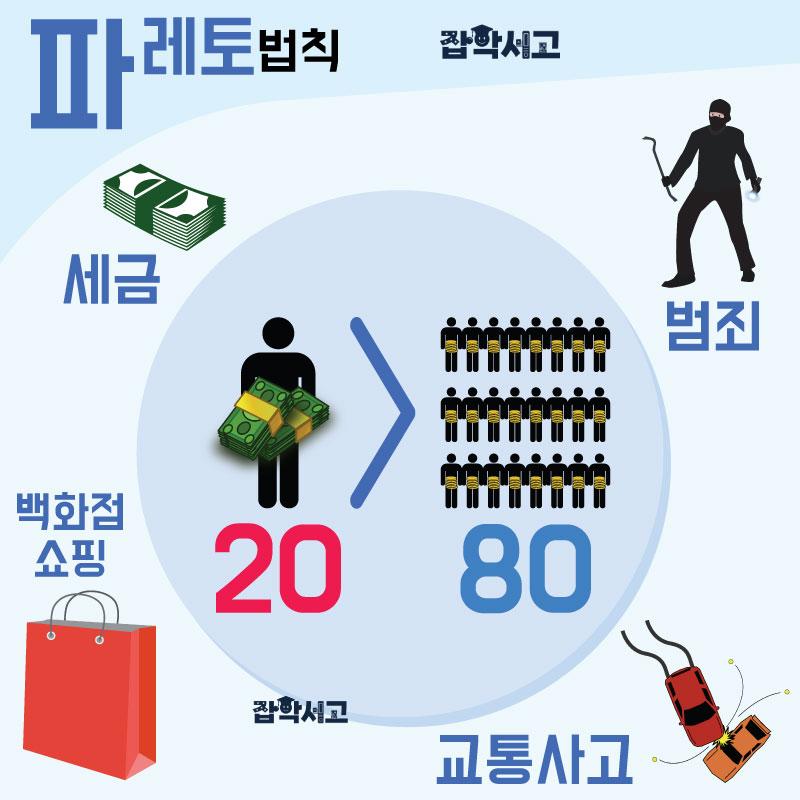
The Pareto principle describes a phenomenon in which 80% of the outcomes are produced by the top 20% of the overall set of causes. Based on this ratio, it is also called the '80:20 rule' and refers to situations where phenomena and outcomes are dictated by a small group at the top. Even when the ratio is not exactly 2:8, the principle can be applied to cases where a small minority has a large influence.
This principle was established through research by the Italian economist Vilfredo Pareto and was mainly discussed before the internet began to develop in earnest. Following this logic, the South Korean government also supported major companies and stimulated the economy, hoping for a trickle-down effect that would get money circulating, but the companies ultimately only stockpiled money, which led to a widening wealth gap between social classes.
Representative examples of the Pareto principle include department store VIP customers (20%) accounting for 80% of the store's total sales through their spending, drivers who habitually cause traffic accidents (20%) being responsible for most accidents and accounting for 80% of all traffic accidents, or taxes paid by the wealthy in the top 20% of income earners accounting for 80% of all national tax revenue, illustrating cases where a small minority has a major impact on the whole.
2. Long Tail Principle
 The Concept and Examples of the Long Tail Principle
While the Pareto principle was a popular theory before the internet developed, the long tail principle is a theory that emerged as the internet became widespread. It refers to the rediscovery of the remaining portion that had previously been overlooked in the Pareto principle's graph. Here, the bottom 80% resembles a long tail, which is why it was given the name 'long tail.'
In other words, while the Pareto principle states that the large 20% produces 80% of the outcomes, the long tail is a theory that even the small remaining 80% can have a massive effect when brought together through the internet as a point of connection, much as 'grains of dust can accumulate into a mountain.'
Representative examples of the long tail principle include Amazon and Google AdSense, with Amazon.com generating substantial sales revenue by using e-commerce to sell large quantities of low-ranking books that had previously sold poorly. Google AdWords and AdSense also made it easy for small-scale advertisers running small businesses, rather than the large advertisers associated with traditional media such as TV and newspapers, to place ads, allowing many internet users to encounter advertisements without difficulty. The advertising revenue earned from targeting these countless small advertisers has now grown to the point of threatening the existing large-scale advertising market.
We have now examined two principles that can be adapted or applied in various fields: the Pareto principle and the long tail principle. Depending on the type of business (e.g., department stores), the Pareto principle may be more effective, while the long tail principle is more effective in industries that incorporate the internet, so you should consider these theories in light of the environment you operate in.
We hope that understanding these concepts will help you carry out work in areas such as business and marketing.