Freshly baked bread grows mold within just a few days, yet honey rarely spoils even when the lid is left open. Honey contains nearly 20% water, so why can't microorganisms grow in it? The key to this difference lies not in the ‘amount’ of water but in its ‘state,’ and the measure that expresses this is water activity.
Put simply, water activity is ‘a value indicating how much of the water in a food is free water that microorganisms and chemical reactions can actually use.’ As a key criterion for judging a food's shelf life and safety, it is widely used in food science and nutrition and in the food industry.
This article explains, in easy-to-understand terms, what water activity is and how it is measured, the thresholds below which microorganisms cannot grow, traditional and modern preservation methods that lower water activity, and how it is used to protect food quality.
How Water Activity Works and Food Preservation
What Is Water Activity?
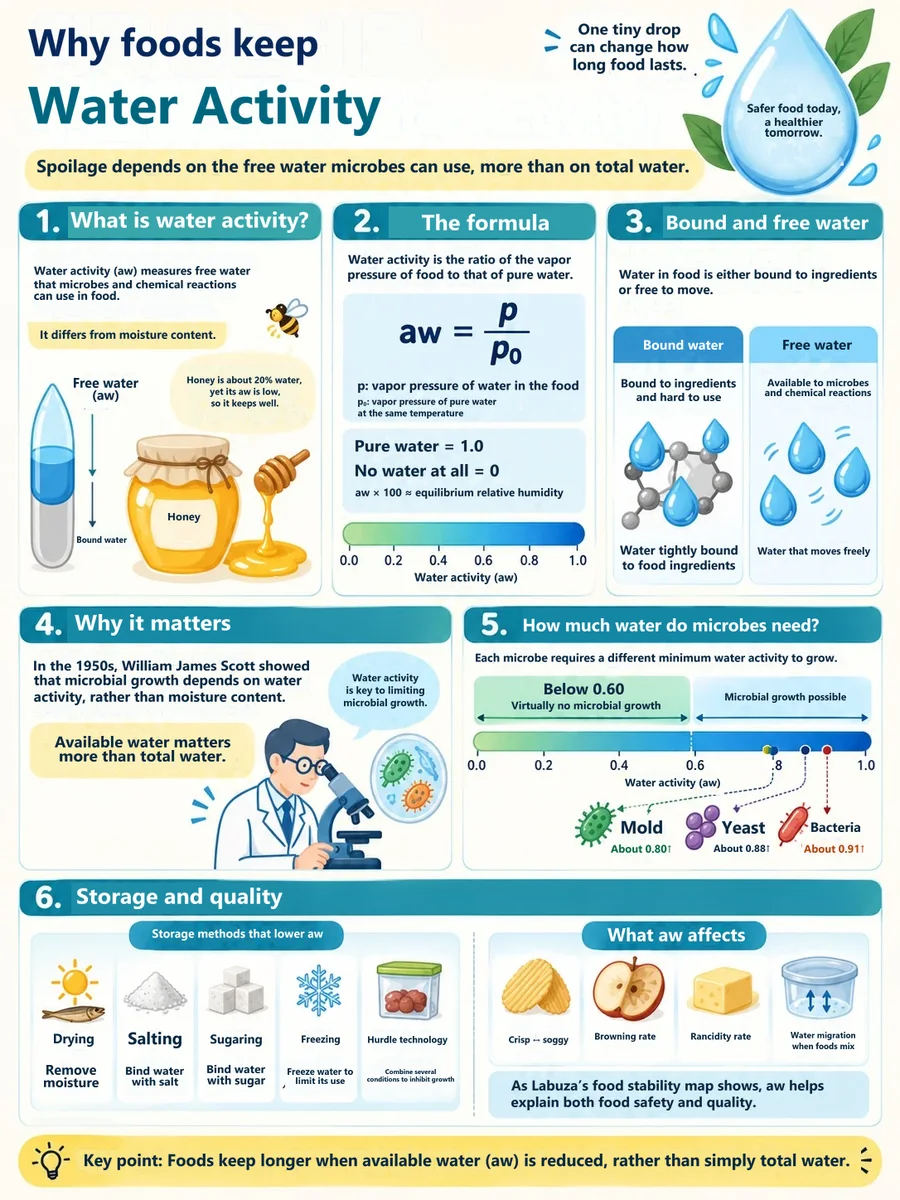

Not all the water in food is the same. Some water is held tightly by components such as proteins and carbohydrates, while other water moves relatively freely. It is mainly this freely moving water that microorganisms use to grow and that takes part in chemical reactions.
- Bound water: Water tightly bound to food components, which microorganisms find difficult to use.
- Free water: Water that moves freely between components and can be used by microorganisms and in reactions.
Water activity is the vapor pressure of a food divided by the vapor pressure of pure water at the same temperature. Written as a formula, aw = p / p0; pure water has a value of 1.0, and a state with no water at all has a value of 0. The more salt or sugar is dissolved in a food, the more water is held, and the lower its water activity. Today, it can be checked within minutes by sealing a sample in a closed container and measuring the relative humidity of the air above it. This works because water activity multiplied by 100 equals the ‘equilibrium relative humidity.’
This concept became a standard for food safety thanks to the Australian microbiologist William James Scott. In the 1950s, he showed that what governs the growth of microorganisms is not moisture content but water activity.
The Limits for Microbial Growth

Each type of microorganism has a different minimum water activity at which it can survive. If water activity is lowered below this threshold, microorganisms cannot multiply even if they are present.
(1) Bacteria: about 0.91 or higher
Most bacteria do not grow well below a water activity of 0.91. One exception is Staphylococcus aureus, a bacterium that causes food poisoning, which can hold out down to about 0.86 when oxygen is present.
(2) Yeasts: about 0.88 or higher
Many yeasts can grow down to about 0.88. Some yeasts that have adapted to environments very high in sugar survive at much lower levels.
(3) Molds: about 0.80 or higher
Molds tolerate dry environments better than bacteria, and many can grow down to about 0.80. Some molds that are especially resistant to dryness can grow at around 0.61.
(4) Below 0.60: a microbial desert
When water activity is below 0.60, practically no microorganism can multiply. This is why well-sealed snacks and powdered milk keep for a long time.
For reference, fresh meat, vegetables, and fruit are usually 0.95 or higher and spoil easily, jam is around 0.80, and honey is very low, between 0.5 and 0.6.
The Wisdom of Preservation: Lowering Water Activity

Long before anyone knew the name water activity, people were using this principle to preserve food.
- Drying: Food is dried in the sun and wind to reduce the water itself. Dried persimmons, dried pollack, and dried wild greens are typical examples.
- Salting: Salt binds water and reduces the free water. Jeotgal (salted fermented seafood) and gulbi (salted dried yellow croaker) keep for a long time thanks to this principle.
- Sugaring: Adding a large amount of sugar has the same effect. Jam, cheong (fruit preserved in sugar), and yanggaeng (sweet red bean jelly) fall into this category.
- Freezing: When water turns into ice, the amount of water available to microorganisms drops sharply.
The modern food industry has gone a step further. ‘Hurdle technology,’ developed by the German food scientist Lothar Leistner, stops microorganisms by setting up several hurdles at once, such as water activity, acidity, temperature, and preservatives, each raised only a little. Because no single condition has to be changed drastically, the taste and texture of food can be better preserved.
Protecting Food Quality with Water Activity

Water activity has a big impact not only on microorganisms but also on the taste and texture of food.
(1) Crispness and sogginess
Snacks and gim (dried seaweed) are crisp when their water activity is low, but they quickly go soggy as they absorb moisture from the air and their water activity rises. This is why opened snacks are sealed again.
(2) The speed of chemical reactions
The speed of browning reactions, which turn food brown, and of the reactions that make fats go rancid also varies with water activity. In the early 1970s, the American food scientist Theodore Labuza summarized these relationships in a single graph known as the ‘food stability map.’ According to this map, browning reactions are fastest at intermediate water activity, while fat oxidation can actually speed up when food is very dry. That is why food companies set an appropriate water activity for each product to control its quality.
(3) Caution when mixing foods
When foods with different water activities are packed in the same container, water moves from the food with the higher water activity to the one with the lower water activity. A familiar example is dried fruit mixed into cereal: the fruit becomes hard while the cereal goes soggy.
Water activity teaches us that ‘how free the water is’ matters more than ‘how much water there is.’ The time-honored preservation wisdom behind honey, jeotgal, and dried persimmons can all be explained by this one principle.
Understanding the nature of the water in food and managing it properly: that is the first step toward a safe and delicious table.