Have you ever seen someone who, even after leaving the hospital, finds care, housing, livelihood, and rehabilitation all blocked at once? Even when each agency faithfully performs its own role, the services remain fragmented for the very person who needs them. The social work practice that ties such scattered help into a single flow is ‘Case Management.’
Simply put, case management refers to ‘a method of practice that coordinates resources through assessment, planning, linking, monitoring, and evaluation so that a person with complex needs can receive the services they need without interruption.’ Rather than solving one person’s problems on their behalf, it is closer to building a path so that multiple services mesh with one another.
This article lays out case management in an easy-to-understand way, from its background and concept, to its core functions, examples that are easy to grasp in everyday terms, and the points of caution and limitations in the field.
The Concept and Practice Process of Case Management
What Is Case Management?

Case management spread in earnest in the United States in the 1970s and 1980s. At the time, as ‘deinstitutionalization’ moved services away from care centered on psychiatric hospitals and large institutions and into the community, a situation arose in which users had to go from agency to agency on their own. Services increased, but because they were not connected to one another, the problem of ‘service fragmentation,’ in which people could not get the help they needed in time, grew larger.
The role that emerged to fill this gap is the case manager. A case manager is a coordinator who identifies needs together with the person, finds and connects suitable resources, and checks whether services are actually being delivered. In Korea as well, similar methods of coordination are used in many settings, such as Community Social Security Councils, Hope Welfare Support Teams, and case management for people with disabilities.
- Deinstitutionalization: The shift from institution-centered care to community-based services.
- Service Fragmentation: A state in which work is divided among agencies, making it difficult for users to receive the help they need in one place.
- Case Manager: A practitioner who coordinates the flow of services, from assessment to linking and monitoring.
The Core Functions of Case Management

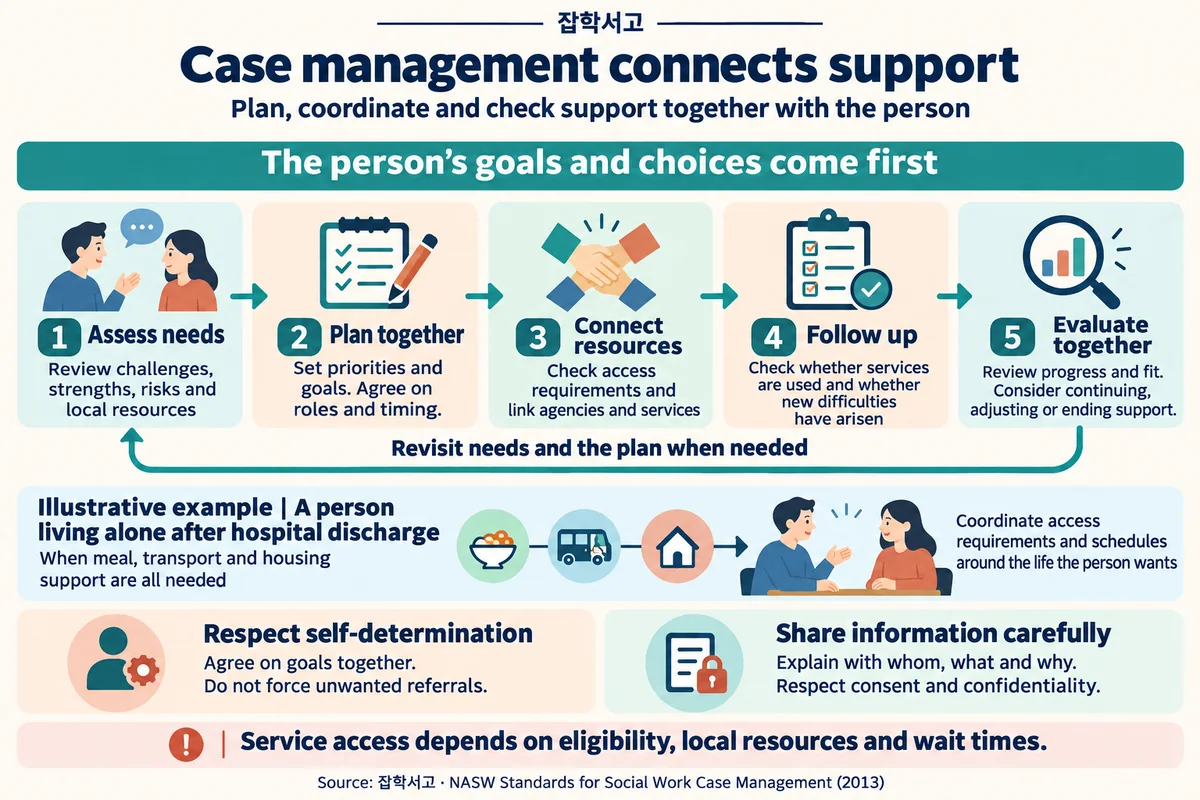
There are many models of case management, but in the field it is commonly described as a cycle of assessment, planning, linking, monitoring, and evaluation. Rather than ending after a single pass, each stage is part of a continuous process that circles back when circumstances change.
(1) Assessment
This stage identifies the person’s needs, strengths, and risk factors, together with family, neighborhood, and community resources. It does not look only at diagnoses or eligibility for programs; it is the stage of sorting out ‘what is most urgent right now.’
(2) Planning
Priorities are set, and specific goals and roles are divided up. The key is for the person and the agencies to agree together on who will do what and by when.
(3) Linking
Needed services such as medical care, caregiving, housing, employment, and counseling are connected with the agencies that actually provide them. Going beyond a simple referral, it is closer to opening the way together until use of the service begins.
(4) Monitoring
This stage regularly checks whether the promised services are continuing without interruption and whether any new difficulties have arisen. It allows adjustments to be made before small changes escalate into major crises.
(5) Evaluation
This stage looks back at how far the goals have been achieved and whether the plan is still appropriate. If necessary, the assessment and plan are revised again, leading into the next cycle.
Understanding Case Management Through Simple Examples

Case management is easier to see in everyday life, where complex needs overlap, than in abstract theory. The following are hypothetical examples that do not refer to any specific real person or agency.
[Example 1] An Older Adult Left Alone After Discharge
Suppose there is an older adult who has been discharged from the hospital but has difficulty moving around, feels unsafe at home, and finds it hard to manage meals and medication alone. The hospital alone cannot ensure continued care, the care agency alone cannot organize the medical schedule, and livelihood support sits at yet another service window. The case manager assesses the person’s health and housing environment, then plans in-home care, mobility support, meal services, and, if needed, home repairs, and links each with the relevant agency. Afterward, through visits and phone calls, the case manager checks whether the services are actually being delivered and readjusts the plan if the person’s condition worsens.
[Example 2] A Mental Health Service User Whose Work, Treatment, and Daily Life Were Shaken All at Once
A similar structure appears when returning to work, outpatient treatment, housing stability, and family relationships are all shaken at the same time. If one agency handles only treatment, another only employment, and yet another only housing, the person has to keep moving from window to window. Case management bundles these fragmented forms of help into a single plan and coordinates them so that the treatment schedule and daily-living support do not clash.
In both examples, the key is not ‘piling up more services’ but ‘connecting existing services so they are not cut off.’
Points of Caution and Limitations in the Field

Case management is a powerful coordination tool, but it is not a cure-all. Knowing in advance the limitations frequently encountered in the field helps set the direction of practice.
(1) Overload and Formalism
When a single case manager takes on too many cases, assessment and monitoring may remain only on paper, and real accompaniment may weaken. Balancing quality over quantity is important.
(2) Lack of Resources
If the services to be linked do not exist in the area at all, or the waiting periods are long, even the best plan has difficulty turning into action. This is because case management is not a system that ‘creates’ resources but a practice that ‘connects’ existing ones.
(3) The Person’s Self-Determination
When professionals set schedules unilaterally, the person is pushed back into a passive position. It is necessary to set goals together and to avoid forcing linkages the person does not want. This also connects to the empowerment perspective, which builds up the person's own strength. Still, the core of case management lies, above all, in linking services so that they are not cut off.
(4) Balancing Information Sharing and Confidentiality
For multiple agencies to cooperate, a certain level of information sharing is necessary, but at the same time personal information and confidentiality must be protected. If the procedure of explaining to the person what is shared, with whom, and why, and obtaining their consent, is left out, trust can collapse.
Case management is a practice aimed at reducing situations in which ‘help exists but fails to reach people.’ Simply listing more services is not enough; it only becomes meaningful when those services are coordinated so that they continue without interruption in a person’s life. Even in a reality of limited resources, the process of faithfully repeating assessment and planning, linking and monitoring keeps people from losing their way in the face of crisis.
Connecting scattered help into a single line: that is the first step toward rebuilding daily life amid complex difficulties.