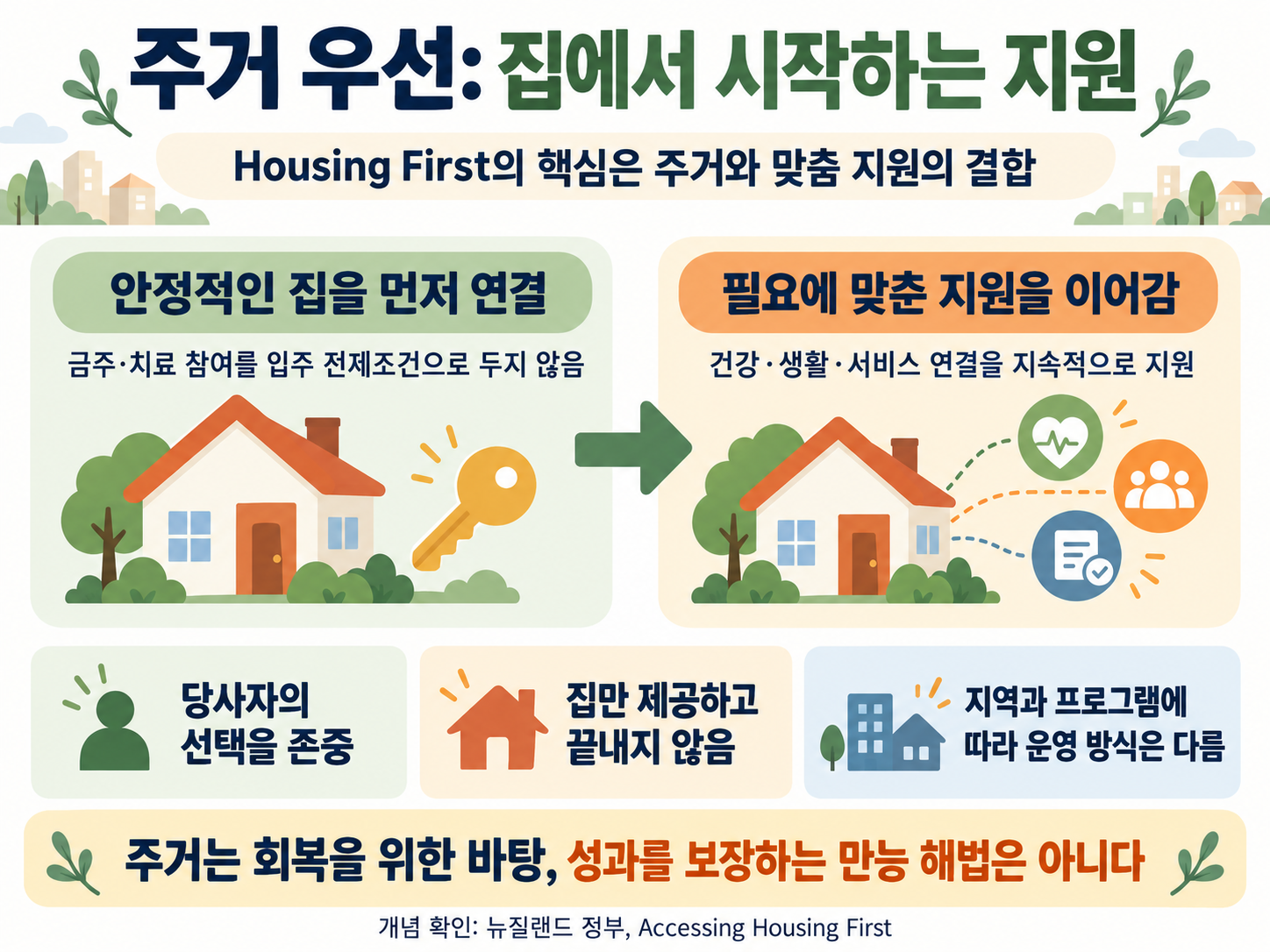
When someone who has lived on the street for a long time asks for help, the answer is often the same: first stop drinking, get treatment, and follow the rules at a shelter. Only after passing every one of those steps do they finally receive the key to a home of their own. There is an approach that turns this order completely around and offers a home first, with no conditions. That approach is Housing First.
Put simply, Housing First is the idea that “a stable home is not a reward for recovery but the starting point of recovery.” People experiencing homelessness are given permanent housing right away, without sobriety or treatment as a precondition, and the support they want continues alongside. It began in 1992 with Pathways to Housing, a nonprofit founded in New York City by psychologist Sam Tsemberis.
In this piece we will look in turn at what Housing First is and how it differs from the traditional approach, its core principles and forms of support, and the results—and remaining challenges—seen in the United States, Canada, and Finland.
Recovery That Starts at Home: How Housing First Works in Principle and Practice
What Is Housing First?
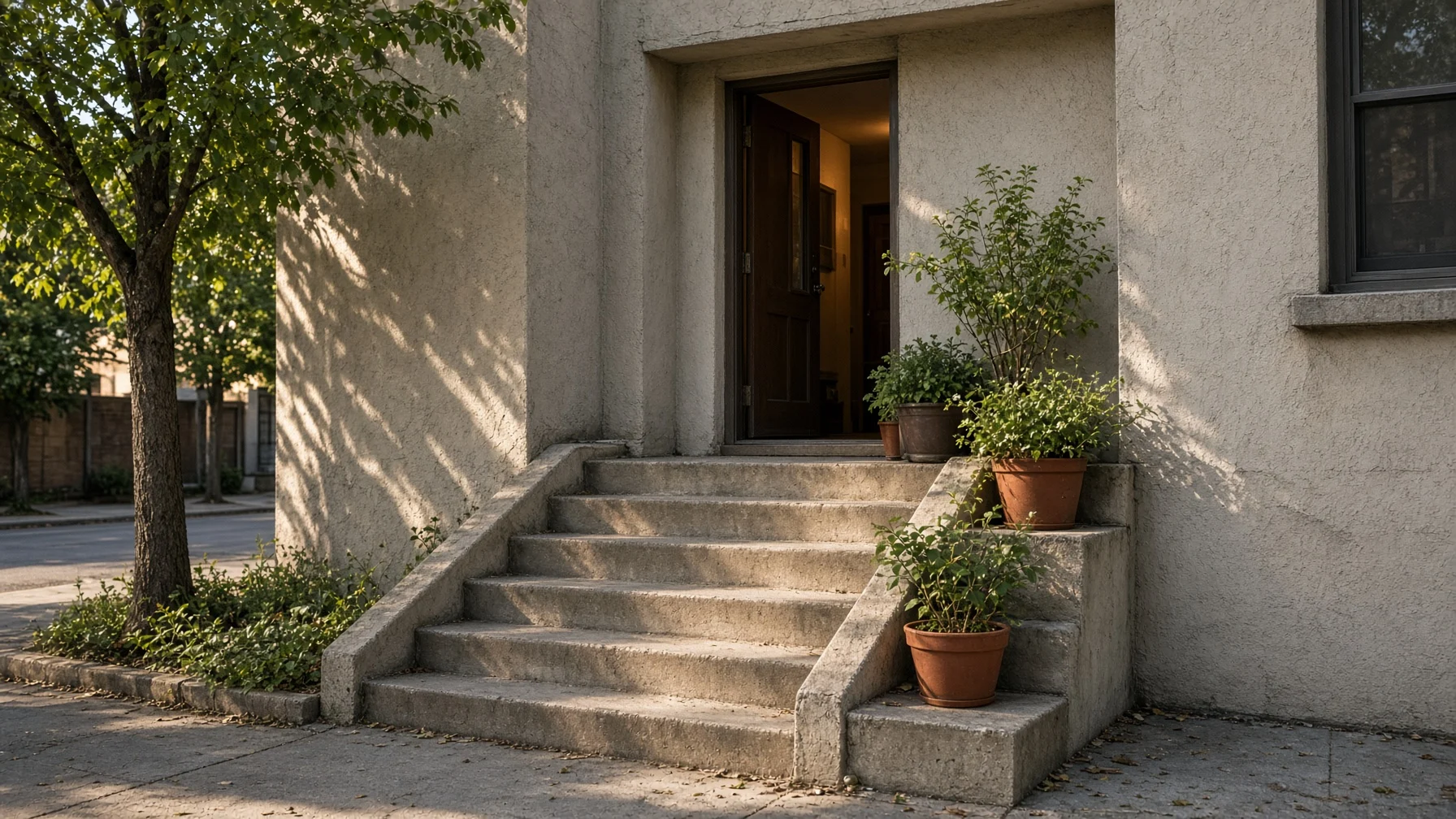
For a long time, help for homeless people worked like climbing a staircase one step at a time. People moved from the street to a shelter, from the shelter to a treatment facility, and then to group housing, proving their eligibility along the way before they could finally reach an independent home. The problem was that many slipped on the middle steps and ended up back on the street.
- Staircase Model: the traditional approach, in which people must earn eligibility step by step—keeping to treatment and house rules—before they can move into a home.
- Housing Readiness: the idea of first judging whether someone is ready to live in a home; it underpins the staircase model.
- Housing First: an approach that provides a home first, without asking about readiness, and then adds support.
Housing First starts from a practical reality: without a home, it is hard to keep up treatment, a job, or relationships. Only once there is a place to sleep and a door that locks, the thinking goes, does a person have room to consider the next step.
Five Principles That Hold Up Housing First

The Pathways model is often summed up in five principles. The point is that it does not end with handing over a home; a system of support that respects the person’s choices has to move along with it.
(1) Consumer choice
People decide for themselves where to live and which services to receive. Respecting self-determination is the starting point for every other principle.
(2) Separating housing from treatment
People do not lose their home if they refuse treatment or cannot stop drinking. In return, like any other tenant, they keep the same obligations of their lease.
(3) Individualized support
Support is chosen to fit each person’s needs, whether mental health, physical health, employment, or life skills.
(4) Recovery orientation
The focus is less on eliminating symptoms than on helping people regain the life they want. Workers stay alongside them steadily so they do not lose hope.
(5) Community integration
Rather than gathering people in one building, the program finds homes scattered across ordinary apartment buildings and helps people live ordinary lives among their neighbors.
Results in Numbers: Experience from the United States, Canada, and Finland
Housing First drew attention because its results showed up clearly in the numbers. In a New York study published in 2000, 88% of Pathways tenants were still housed five years later, compared with only 47% of people who had gone through the traditional step-by-step residential system.
From 2009 to 2013, the Mental Health Commission of Canada ran At Home/Chez Soi, a large randomized controlled trial involving 2,148 people in five cities: Vancouver, Winnipeg, Toronto, Montreal, and Moncton. Over the final six months, 62% of the Housing First group were stably housed all of the time—twice the 31% of the group receiving usual services.
Since 2008, Finland has placed Housing First at the center of its national homelessness policy, steadily converting large temporary shelters into independent supported housing. As a result, between 2008 and 2022, long-term homelessness fell by 68% and homelessness among people living alone fell by 54%. The achievement drew all the more notice because it came during a period when homelessness was rising in most European countries.
Forms of Support and the Road Ahead

In Housing First, what matters most after the home itself is the human touch. The intensity of support varies with each person’s needs.
- Assertive Community Treatment: a team of doctors, nurses, social workers, and others visits people with high needs in their homes to help them.
- Intensive Case Management: for people with moderate needs, a case manager connects and coordinates services.
- Rent Supplement: covering the difference so that people pay only part of their income in rent, helping them keep their homes over the long term.
The challenges are real, though. In cities short of affordable rental housing, simply finding a home is hard. In the Canadian trial, substance use and psychiatric symptoms improved similarly in both groups, without the clear difference seen in housing stability. It shows that a home is only the foundation for recovery, and steady support has to be built on top of it.
Housing First is an approach that gives people experiencing homelessness a home first, without conditions, and then adds the support they want on top of it. Grounded in principles such as respecting choice, separating housing from treatment, and community integration, it has shown high rates of housing retention in the United States, Canada, and Finland. At the same time, it leaves open the homework of housing supply and sustained support.
Before asking whether someone in need qualifies, consider whether you can first offer them a place to stay. That is the first step toward people-centered welfare.