There are times when a complicated explanation seems smarter. Yet if you explain being late by reeling off a list—“the bus came late, the traffic lights were against me, and even the elevator broke down”—the listener only grows more suspicious. In contrast, the single sentence “the traffic was bad” often sounds more convincing. The intellectual habit of trimming away unnecessary assumptions and looking first at the simplest explanation is what we call ‘Occam’s Razor.’
Put simply, Occam’s Razor is a methodological guideline that says, ‘when several hypotheses explain the same phenomenon, favor the one that adds no unnecessary assumptions.’ Linked to the name of William of Ockham, a 14th-century English scholastic philosopher, this principle serves in science, medicine, and everyday judgment as a screening device that warns, ‘don’t start by believing the complicated story.’
In this article, we lay out—in an easy-to-understand way—the origin and precise meaning of Occam’s Razor, the misconceptions that commonly arise, how it is used in science and daily life, and why simplicity is not always the right answer.
Occam’s Razor: A Way of Thinking That Trims Away Assumptions
What Is Occam’s Razor?
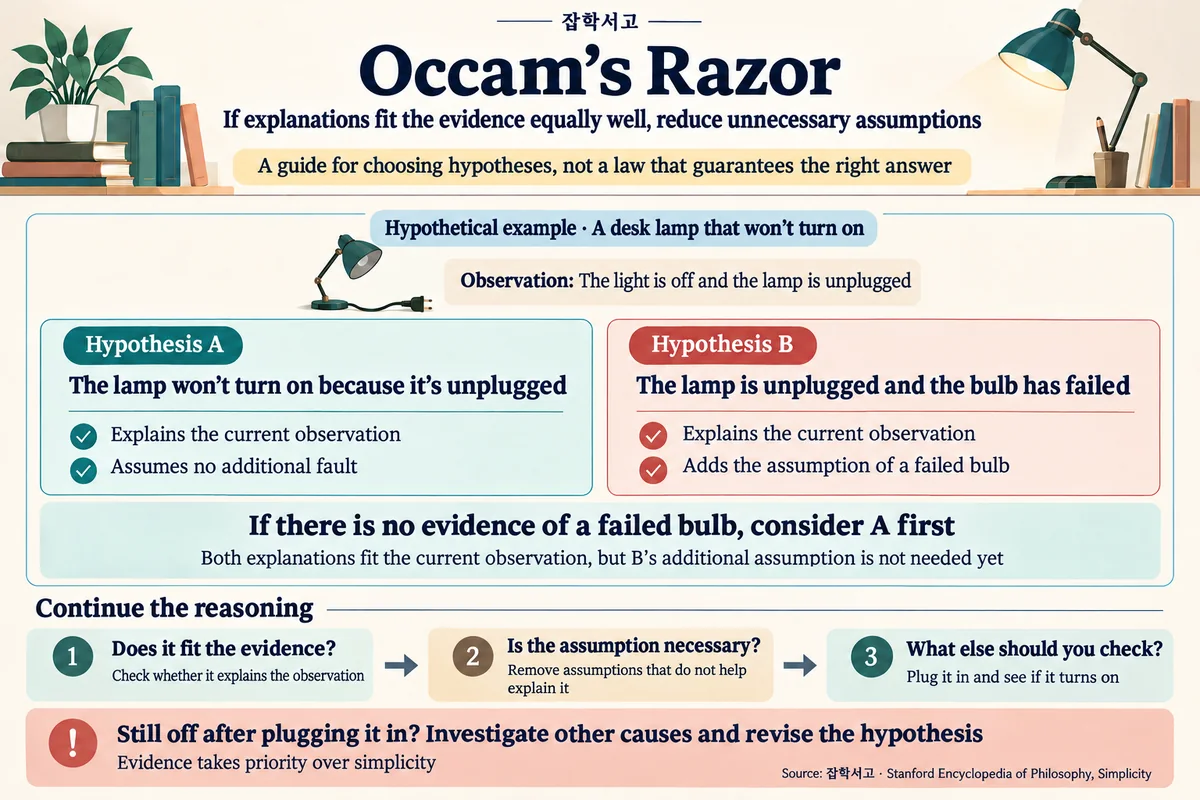

Occam’s Razor does not assert that ‘the truth is always the simplest thing.’ At its core is the principle of parsimony: do not needlessly multiply the entities, causes, or steps required for an explanation. In Latin it is often summarized as “Entities must not be multiplied beyond necessity,” which in plain terms means ‘do not multiply entities beyond what is needed.’ The sentences Ockham himself left behind differ slightly from the maxim later generations distilled, but the direction is the same.
When reading this principle, the following concepts are useful to keep alongside it.
- Hypothesis: A provisional claim put forward to explain a phenomenon.
- Assumption: A premise accepted in advance so that the hypothesis can hold.
- Principle of Parsimony: The attitude of preferring the simpler option when explanatory power is similar.
- Razor: A metaphor for ‘shaving off’ unnecessary assumptions.
As an easy example, when there is a noise on the roof at night, “a squirrel ran across it” is examined before “a ghost is walking around” because the former does not assume a supernatural being. As evidence piles up, more complex explanations can open up, but the starting point is the simpler side.
Three Common Misconceptions

Because Occam’s Razor has become so famous, it is also easy to misquote. Distinguishing the following three points makes the concept clearer.
(1) It Does Not Mean ‘The Simple Thing Is Always Right’
The razor is not a truth detector but a tool for setting priorities. If a simple hypothesis does not fit the data, it must be boldly discarded. ‘Looking at it first’ and ‘believing it to the end’ are different things.
(2) It Does Not Mean ‘An Easy Explanation Is a Good Explanation’
Being easy in everyday language does not mean having fewer assumptions. Conversely, an explanation can use a lot of technical terms and still have fewer core assumptions. What the razor shaves off is not difficult words but superfluous premises.
(3) It Does Not Mean ‘Complex Theories Are Always Bad’
Explaining planetary motion requires a sophisticated structure such as Newtonian mechanics. The problem is not complexity itself, but adding unnecessary assumptions while explaining the same phenomenon.
Once these misconceptions are cleared away, the razor appears not as ‘lazy simplification’ but as ‘a habit of checking explanations for excess.’
What the Razor Does in Science and Everyday Life

In the history of science, Occam’s Razor often appears when choosing between competing theories. For example, the fact that heliocentrism required fewer ‘assumptions that make the Earth special’ than geocentrism became one pillar of its persuasiveness in the debates after Copernicus. In medicine, it shares the spirit of the clinical maxim ‘when you hear hoofbeats, think of horses first,’ which means checking common causes first rather than suspecting a rare disease when symptoms are similar. Both are rules for deciding ‘where to look first.’
Its use in everyday life is clear as well.
- Device malfunctions: Check the ‘battery, cable, and settings’ before concluding ‘I’ve been hacked.’
- Relationships: Look first at ‘misunderstandings or scheduling conflicts’ rather than ‘everyone is plotting against me.’
- Judging information: Rather than reaching for a sensational conspiracy theory, ask whether verifiable facts can explain it.
In other words, the razor is not a switch that turns off doubt, but a compass that tells you where to start verifying. In a reality where time is limited, this compass cuts down on unnecessary detours.
When Simplicity Becomes a Limitation

Real-world problems sometimes involve several overlapping causes. If you apply only the razor to phenomena that are hard to reduce to a single cause, such as climate change, economic crises, or chronic diseases, you risk mistaking important factors for ‘unnecessary assumptions’ and cutting them away. You should also be wary of confirmation bias, which leads us to confuse ‘the explanation I’m familiar with’ with ‘the simple explanation.’ Familiarity and parsimony are not the same thing.
That is why modern thinking places the razor side by side with falsifiability, consistency with data, predictive power. An explanation with few assumptions can still be wrong, and one with many assumptions may still be necessary. The important question is not only “Is it simpler?” but also “How well does this explanation predict new observations?”
Occam’s Razor is not a blade that flattens the world. It is the habit of clearing away needless decoration and putting the explanations worth testing on the table first. Asking once more, before listening to a complicated story, ‘Is this assumption really necessary?’—that is the first step toward clear judgment.