Have you ever scrolled past social accounts with thousands of friends and still realized only a handful of people get the deep conversations? Contact lists grow; relationships do not always keep up. The claim that humans face a cognitive limit on how many stable relationships they can maintain is known as Dunbar’s Number.
In plain terms, Dunbar’s Number is how many people you can keep in stable social relationships at once—knowing who they are and how they connect to one another. British anthropologist and evolutionary psychologist Robin Dunbar proposed the idea in the 1990s; the figure usually cited is about 150. It is not followers or acquaintances you barely know, but people you could bump into at a bar and sit with naturally.
This article walks through where the number came from, the layered structure of relationships, examples from the military, villages, and online life, and the limits of trying to explain everything with a single figure.
What Dunbar’s Number Says About Relationship Limits
The Figure 150 From Brain Size

Primates live in groups, and remembering other individuals and managing relationships costs a lot of cognitive resources. Building on the observation that relative neocortex size correlates with average group size, Dunbar estimated a group size that fits humans. A 1992 study produced a regression prediction of about 148, commonly rounded to 150. The confidence interval is wide—roughly 100 to 230—so the idea is “around here,” not a precise single digit.
Dunbar compared that prediction with real groups such as hunter-gatherer communities, military units, and village scales. The point is not a loose acquaintance list, but that communities where people know one another and share responsibilities often cluster near that range.
- Social Brain Hypothesis: larger brains evolved to handle complex social life.
- Stable Relationship: not merely knowing a name, but tracking someone’s place and mutual ties.
- Cognitive Limit: limits of time, attention, and memory constrain how many relationships can be maintained at once.
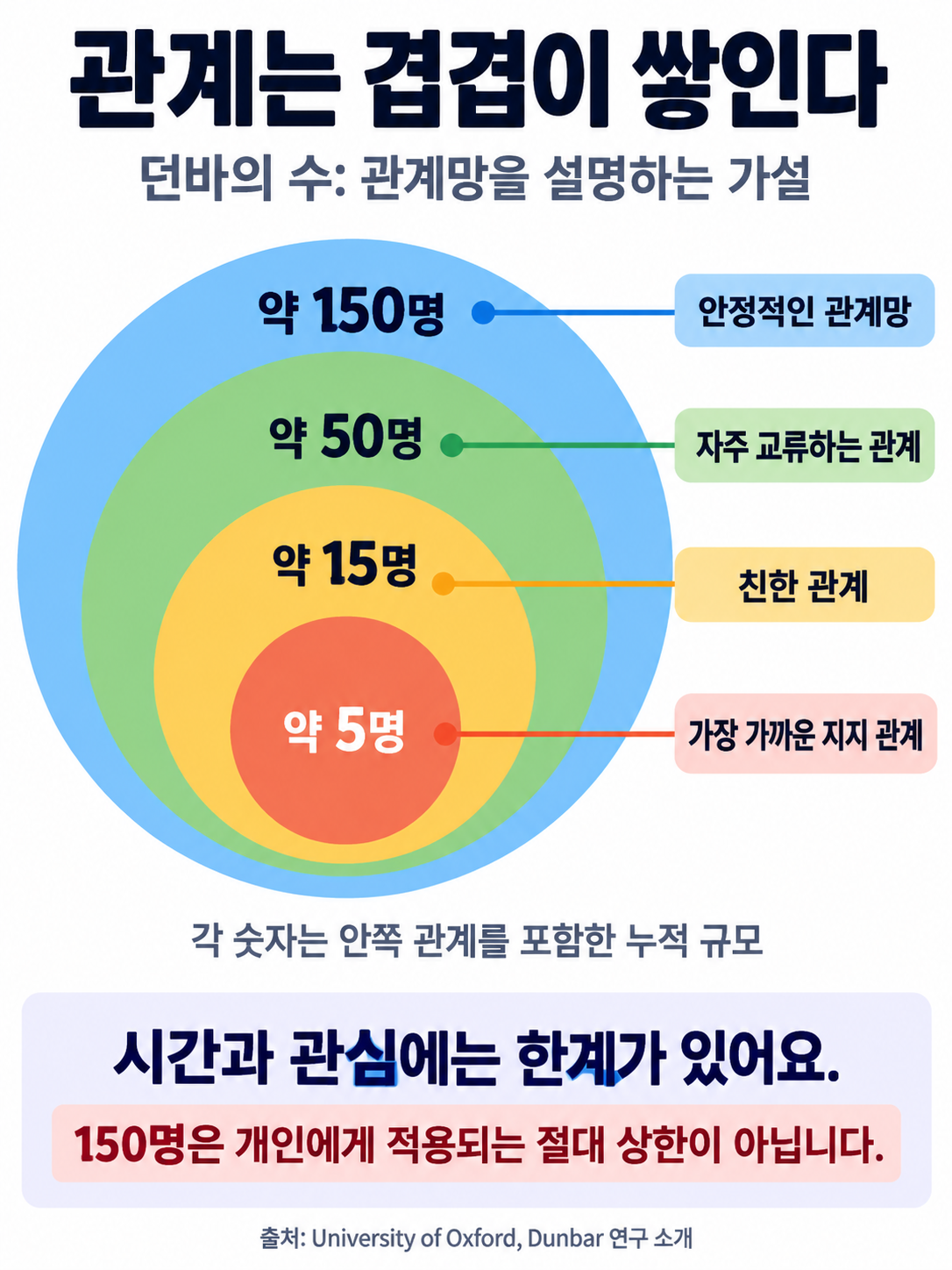
Layers Stacked as 5, 15, 50, and 150

Dunbar’s Number is easier to see as concentric circles widening outward than as a single wall. Inner layers take more time and emotion; farther out, contact and intimacy drop. Each layer is often reported as roughly three times the size of the one inside it.
(1) The closest 5
Core support you turn to first in crisis or joy. A large share of available social time concentrates here.
(2) The sympathy group of 15
Close friends and family that include those 5—people you contact regularly and look after. Dunbar suggests about two-thirds of social time goes to these 15.
(3) 50 and 150
The 50 layer is closer to friends and colleagues you see often; 150 is the outer boundary of “meaningful relationships.” Beyond that, 500 and 1,500 stretch into acquaintances and recognizable faces where deep bonds are hard to keep.
What matters is not “150 friends” but “150 stable relationships.” Thousands of social-media friends mostly sit in outer layers; the brain and a day’s hours prioritize the inner ones.
The Same Scale Showing Up in Villages, Armies, and Companies

One reason Dunbar’s Number became famous is that similar scales keep appearing in very different settings. Discussions of military organization from Rome through modern times place company-sized units roughly in this range, and traditional villages and religious communities are often described as sizes that hold cohesion more easily.
Malcolm Gladwell, in The Tipping Point (2000), recounts the W. L. Gore & Associates story known for Gore-Tex: after finding communication frayed once a building held more than about 150 people, the firm split buildings and parking to that scale. Online, research has again found inner-layer size patterns in phone call networks, Facebook and X (Twitter) interaction, and game guilds.
Points Worth Noticing Day to Day
- List Size: contact and follower counts are not the same as a cognitive limit.
- Maintenance Cost: relationships are something you manage with attention and time.
- Organization Design: as teams and sites grow, rules and role splits matter more.
Critiques, Misreadings, and How to Use It

Dunbar’s Number is an appealing one-line summary, but it should not be treated as an iron law. The prediction interval is wide, and individuals differ by culture, personality, and family size. Bernard–Killworth work has estimated average network sizes larger still, and a 2021 reanalysis argued that primate data under different phylogenetic methods do not pin down a single number. Dunbar himself has continued rebuttals and refinements about methods and data choices.
(1) Do not misread it as “150 friends”
It is not a maximum that includes every casual nod. It is closer to a cognitive and time limit on quality stable relationships.
(2) Be careful with claims that SNS erased the limit
Platforms lower the cost of staying in touch, but many observations say emotionally close layers do not expand easily. More alerts do not stretch a day past 24 hours.
(3) Do not stamp “150” onto organizations mechanically
It can inform how you split teams, yet the sweet spot shifts with industry, remote work, and tools. The number is a starting point, not a universal answer.
When relationships feel heavy, thinking first about “capacity to care for deeply at once” rather than “am I lacking?” can make cutting contact a choice, not coldness. Designing time around a few who matter most often protects relationship quality.
Dunbar’s Number claims that stable social relationships have cognitive and temporal limits, with a representative scale around 150 people. Layers like 5, 15, 50, and 150 map why a long contact list can still leave the heart empty.
Counting the relationships you actually tend—more than follower counts—is a first step toward using Dunbar’s Number wisely in daily life.