Glasses are a tool that has long played an important role in supplementing and improving human vision. Countless people resolve the inconvenience caused by vision problems with glasses, and through them experience a sharper, clearer world. Glasses go beyond being a simple vision aid and play an important role in improving quality of life.
This article takes an in-depth look at the types and characteristics of vision impairment, the scientific principles of lenses, correction methods by cause of vision impairment, various vision correction methods, and the types of glasses for different uses. The aim is to help you understand the importance and function of glasses more clearly.
Types and Characteristics of Vision Impairment
Definition and Causes of Vision Impairment
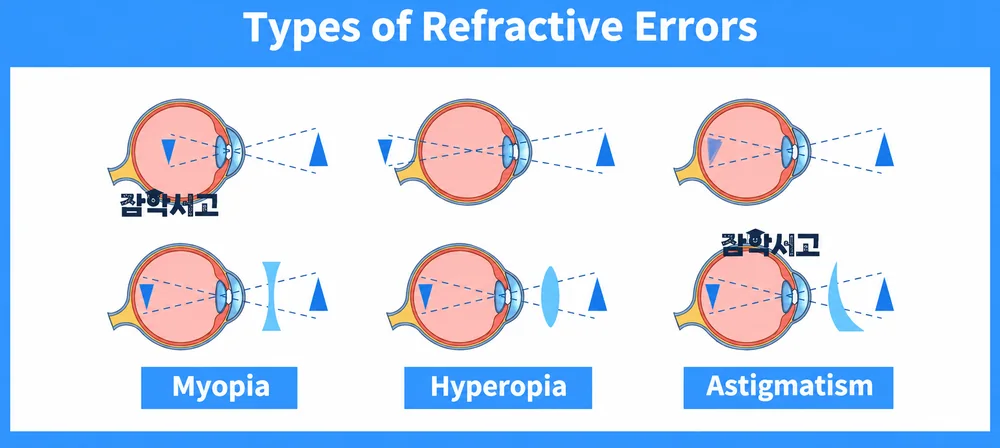
Vision impairment refers to a condition in which objects cannot be perceived clearly because of structural changes or functional problems in the eye. Typical examples are myopia, hyperopia, and astigmatism, and these problems arise from refractive errors of the eye or changes in the shape of the cornea and lens. Vision impairment can be caused by various factors, such as eye strain, genetic factors, and lifestyle habits.
Myopia: Blurred Distance Vision
Myopia is a condition in which distant objects look blurry, and it occurs when the eyeball becomes longer or the cornea refracts light too strongly. It happens because light entering the eye comes into focus in front of the retina, and it is a type of vision impairment common among modern people who do a lot of close work. Myopia can be corrected with glasses or contact lenses.
Hyperopia: Blurred Near Vision
Hyperopia refers to a condition in which nearby objects look blurry. It occurs when the eyeball is short or the cornea refracts light too weakly, so light comes into focus behind the retina. Hyperopia causes discomfort during close work such as reading or using a computer, and the symptoms can get worse with age. Hyperopia can also be corrected with glasses or lenses.
Astigmatism: Distorted Vision
Astigmatism is a condition in which the curvature of the cornea or lens is uneven, so light is scattered in several directions and vision looks distorted or blurry. Astigmatism can occur together with myopia or hyperopia, causing compound vision problems. When astigmatism is severe, the shapes of objects may look distorted, or part of the visual field may appear doubled. Astigmatism can also be improved with corrective lenses.
Presbyopia: A Change That Comes with Age
Presbyopia is a natural change in vision that occurs with age. It usually begins in the early to mid-40s and makes it difficult to see nearby objects. It occurs because the lens gradually loses flexibility, making it harder to adjust focus. Presbyopia appears mainly in older people and can cause discomfort when reading or using a smartphone. Reading glasses or multifocal lenses are commonly used to correct it.
Other Vision Problems: Color Vision Deficiency and Binocular Vision Problems
Color vision deficiency refers to a condition in which the ability to distinguish certain colors is reduced or lost. It is mainly caused by genetic factors, and in many cases people cannot tell red from green. Color vision deficiency can affect daily life and can be a particular inconvenience in jobs that require accurate color discrimination.
Binocular vision dysfunction is a condition in which the two eyes do not work together in harmony, which can cause double vision or difficulty perceiving depth. It causes discomfort in activities that require eye coordination and can be improved through vision therapy along with vision correction.
The Importance of Regular Eye Exams
Vision impairment has a major impact on an individual's quality of life. People with vision impairment feel discomfort in everyday activities, and it can be a bigger problem in activities where vision is important, such as studying, working, and driving. It is therefore important to check your vision through regular eye exams and, if necessary, take steps toward appropriate vision correction. This makes it possible to detect vision problems early and manage them properly.
The Science of Lenses
The Function and Role of Lenses
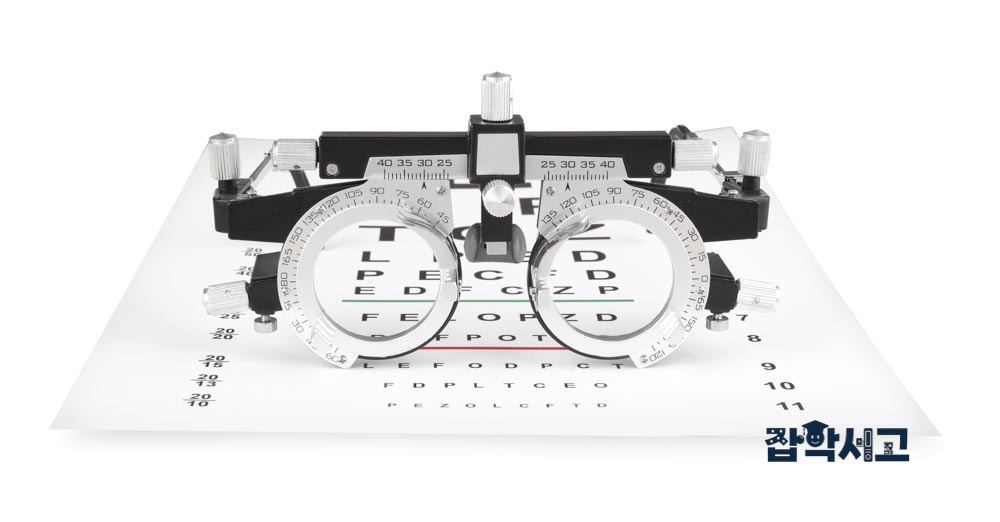
Lenses are an essential tool for vision correction, refracting light appropriately to form a clear image on the retina. In people with impaired vision this refraction does not occur properly, so the key is to compensate for this process with lenses. A lens's curvature and refractive index are important elements of this corrective function, and through them customized vision correction can be provided for various kinds of vision impairment. The greater a lens's curvature, the more it bends light, and materials with a high refractive index can make thinner, lighter lenses.
Single-Vision and Multifocal Lenses
Eyeglass lenses fall into two broad categories: single-vision lenses and multifocal lenses. Single-vision lenses have only one refractive power and are mainly used to correct simple vision impairments such as myopia or hyperopia. Multifocal lenses, on the other hand, are divided into several zones with different refractive powers, making them useful for people who experience several vision problems at once, as with presbyopia. Multifocal lenses are especially suitable when both near and distance vision need to be corrected at the same time.
Types and Properties of Lens Materials
Lenses are made from various materials, and each material has its strengths and weaknesses. In the past, lenses were mainly made of glass, but today lightweight materials such as plastic, polycarbonate, and Trivex are widely used.
- Plastic lenses are light and impact-resistant, making them suitable for everyday use.
- Polycarbonate lenses have excellent impact resistance, making them suitable for sports activities and children's glasses.
- Trivex lenses are lightweight and impact-resistant, making them well suited to children's and sports glasses, but because their refractive index is only moderate (about 1.53), they can end up thicker than high-index lenses as the prescription gets stronger.
As this shows, it is important to choose a lens material that fits the user's type of activity and vision condition.
Lens Surface Treatment Technologies
Lens surface treatment is an important factor that further enhances the effect of vision correction.
- Anti-reflective coatings reduce unwanted light reflection on the lens surface, making vision clearer. This is especially useful when driving at night or working under artificial lighting.
- UV-blocking coatings protect the eyes from harmful ultraviolet rays and are essential for protecting eye health in environments with strong sunlight.
- Blue light–blocking coatings block the blue light emitted by digital devices such as computers and smartphones, reducing eye strain. This is a particularly useful technology for modern people who use digital devices frequently.
The Convenience of Photochromic Lenses
Photochromic lenses are lenses that change color automatically in response to changes in light indoors and outdoors. They are clear indoors and darken outdoors in response to ultraviolet light, which helps reduce UV exposure and ease eye strain. Photochromic lenses offer the convenience of not needing separate sunglasses and are effective at protecting vision in a variety of environments.
Advances in Lens Technology and the Future
The science of lenses continues to advance and is providing more efficient and convenient methods of vision correction. For example, high-index lenses are thinner and lighter while still providing strong correction, and the latest coating technologies increase lens durability and further protect users' eye health. These technological advances are greatly improving the quality of life of people who wear glasses, and further progress is expected.
Correction Methods by Cause of Vision Impairment
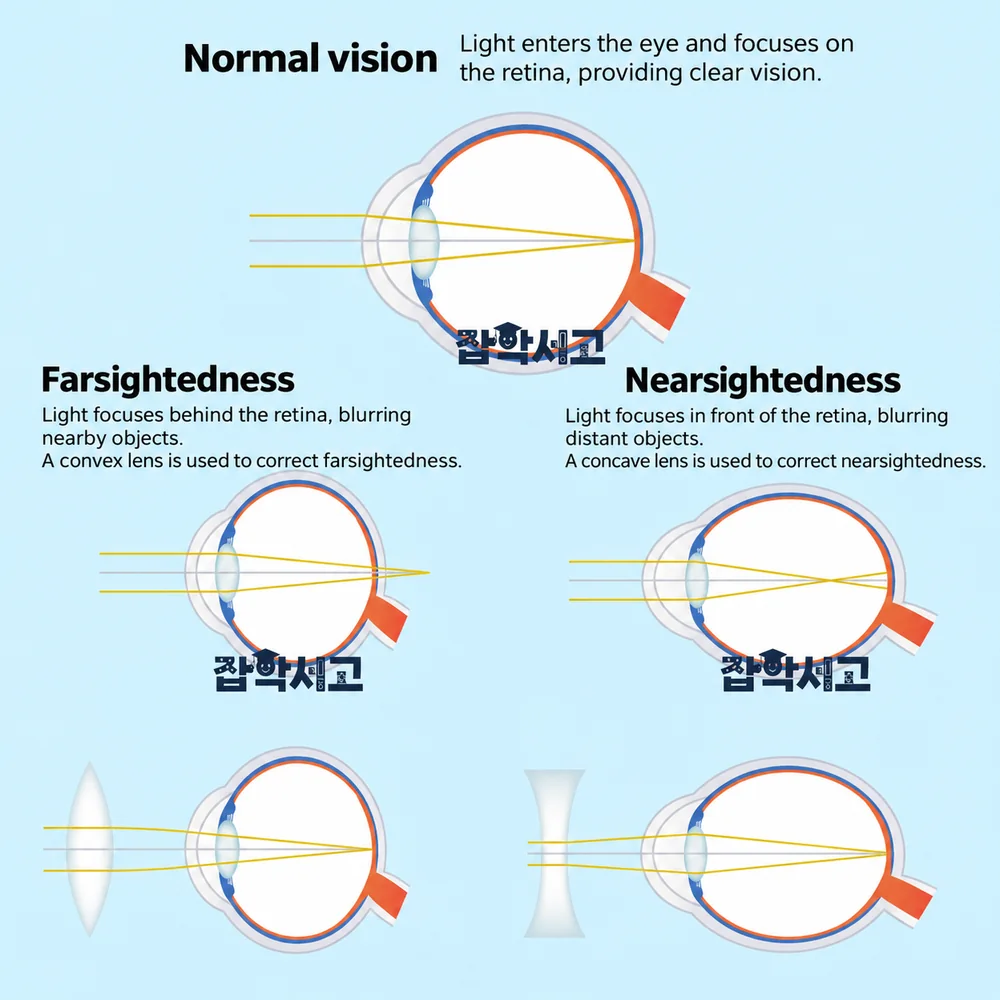
Vision impairment has various causes, and the methods and principles of correction differ depending on each cause. The typical causes of vision impairment, such as myopia, hyperopia, astigmatism, and presbyopia, arise from refractive errors of the eye. A refractive error is a phenomenon in which light inside the eye fails to focus precisely on the retina, producing blurred vision. Vision correction is therefore done by straightening out the path of this light so that it focuses precisely on the retina.
How Myopia Is Corrected
Myopia is a condition in which the eyeball becomes longer or the cornea refracts light too strongly, so light comes into focus in front of the retina. Concave lenses are used to correct it. A concave lens spreads light slightly, helping it focus precisely on the retina. This can be corrected with glasses, contact lenses, or laser surgery.
How Hyperopia Is Corrected
Hyperopia is a condition in which the eyeball is short or the cornea refracts light too weakly, so light comes into focus behind the retina. Convex lenses are used to correct it. A convex lens gathers light, helping it focus on the retina. Hyperopia can also be corrected with glasses, contact lenses, or laser surgery.
How Astigmatism Is Corrected
Astigmatism is a condition in which the surface of the cornea or lens is uneven, so light is refracted in several directions. This makes vision look distorted and blurry, and to correct it a special lens, called a toric lens, is used. A toric lens compensates for differences in refraction in each direction, helping light focus evenly on the retina. Astigmatism is corrected with glasses, contact lenses, or laser surgery.
How Presbyopia Is Corrected
Presbyopia is a form of vision impairment that occurs as the lens loses its elasticity with age and adjusting focus becomes difficult. People have trouble seeing nearby objects, and multifocal lenses or reading glasses are used to correct it. Multifocal lenses provide several focal zones matched to different distances, helping people see both near and far clearly at the same time.
Each cause of vision impairment stems from structural changes or functional abnormalities in the eye, and the principle of correction lies in adjusting the refractive path of light so that it focuses precisely on the retina.
Various Vision Correction Methods
The Importance of Vision Correction
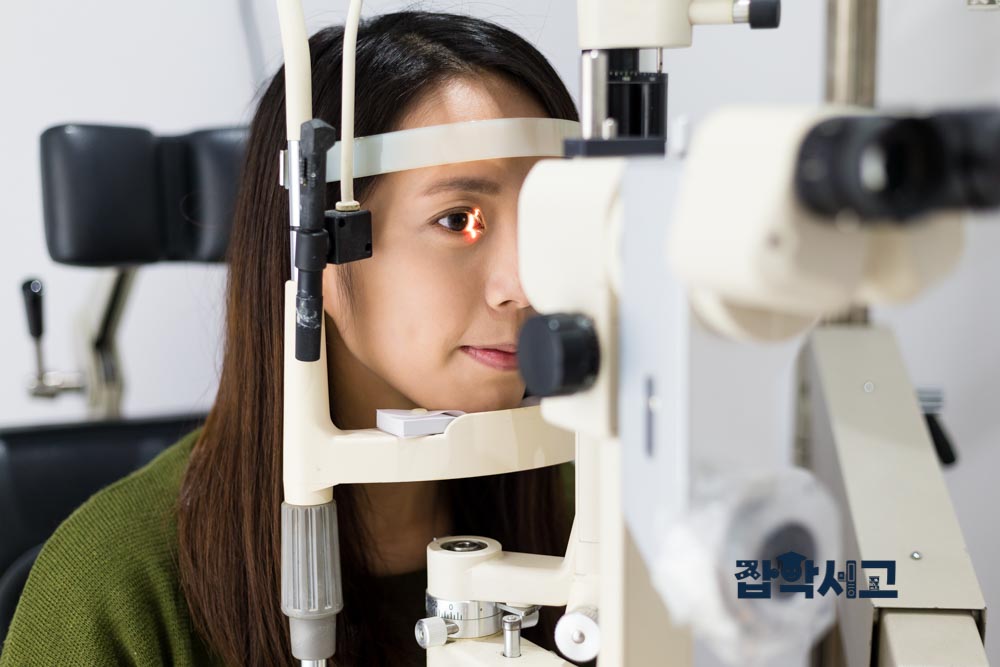
Vision correction is an essential process for people who experience inconvenience in daily life because of impaired vision. The method of vision correction depends on the type and severity of an individual's vision problem, and choosing the right method is important. Typical vision correction methods include glasses, contact lenses, laser surgery, intraocular lens implantation, orthokeratology lenses, and vision training.
Glasses: The Safest Method of Vision Correction
Glasses have long been used as the most basic and safest method of vision correction. They can correct various vision problems, including myopia, hyperopia, and astigmatism, and are especially suitable for children and older adults. Glasses are easy to wear, have almost no side effects, and can easily be prescribed through regular eye exams. They can also be used as a fashion item thanks to their wide variety of designs and styles.
Contact Lenses: Natural Vision and Freedom of Movement
Contact lenses are lenses worn directly on the eye; unlike glasses, they provide natural vision and greater freedom of movement. There are two main types of contact lenses.
- Hard lenses have high oxygen permeability, which is good for eye health, and can be worn for long periods. They are especially effective at correcting astigmatism.
- Soft lenses are comfortable to wear and come in a variety of designs and colors, so many people prefer them. They can be chosen by replacement cycle, such as daily or weekly lenses, and hygiene is essential when using them.
Laser Vision Correction Surgery: LASIK and LASEK
Laser vision correction surgeries such as LASIK and LASEK are popular for their quick recovery and high success rates.
- LASIK is a method in which a corneal flap is created and the cornea beneath it is then reshaped by removing tissue with a laser. Recovery after surgery is quick, but it may not be suitable for people with thin corneas.
- LASEK is a method in which no corneal flap is created; instead, the corneal epithelium is removed and the cornea is then reshaped with a laser. Because healing depends on the epithelium growing back, the recovery period is somewhat longer, but it is suitable for people with thin corneas. These surgeries have the advantages of fast visual recovery and long-lasting effects.
Intraocular Lens Implantation: Long-Term Vision Correction
Intraocular lens implantation is a vision correction method performed after cataract surgery or for patients with high myopia or hyperopia. Cataract surgery replaces the clouded natural lens with an artificial lens, whereas phakic intraocular lens implantation (ICL), performed for high myopia, leaves the natural lens in place and inserts a lens in front of it; both approaches provide a long-term vision correction effect. This surgery is especially effective for people with vision impairment that is difficult to correct with glasses or contact lenses.
Orthokeratology Lenses: Temporarily Reshaping the Cornea
Orthokeratology lenses, or ortho-k lenses, are a method of correcting myopia by wearing lenses at night to temporarily change the shape of the cornea. Sleeping with the lenses in reshapes the cornea, so clear vision can be maintained during the day without wearing lenses. However, continuous use and care are required, and because the corrective effect is temporary, the lenses must be worn every night.
Non-Surgical Vision Correction: Vision Training and Lifestyle Improvements
Non-surgical methods include vision training and lifestyle improvements.
- Vision training helps strengthen the eye muscles and improve visual processing. It is especially effective for people who use computers or smartphones for long periods.
- Improving lifestyle habits is essential for maintaining eye health. This includes working under proper lighting, taking breaks during long periods of close work, and eating a diet rich in nutrients that are good for the eyes. Good lifestyle habits play an important role in preventing vision impairment and keeping the eyes healthy.
Vision correction methods vary with each person's vision condition, and there are many options, including glasses, contact lenses, laser surgery, intraocular lens implantation, orthokeratology lenses, and vision training. Each method has its strengths and weaknesses, so it is important to consult a specialist and choose the vision correction method that suits you best. Since vision has a major impact on daily life, regular checkups and proper care are essential.
Types of Glasses by Use
Prescription Glasses
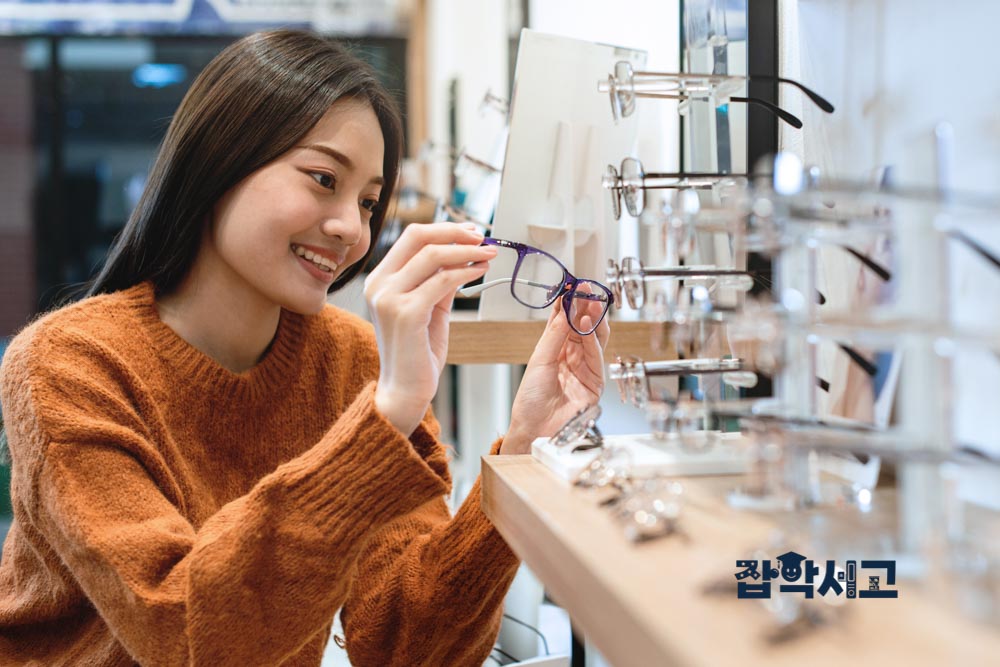
Prescription glasses are the most common type of glasses, used to compensate for vision impairments such as myopia, hyperopia, astigmatism, and presbyopia. They are easy and safe to wear, and accurate correction is possible based on regular eye exams. Correction tailored to each person's vision is achieved through various refractive lenses, and they are especially suitable for people who do long hours of close work or studying. Glasses are functional and are also made in a variety of designs that can reflect personal style.
Blue Light–Blocking Glasses
Blue light–blocking glasses are used to reduce eye strain caused by the blue light emitted by digital devices such as computers and smartphones. Useful for modern people who use digital devices frequently, these glasses ease eye strain and discomfort when looking at screens for long periods. Because blue light can disrupt sleep quality or affect eye health in the long term, glasses that block it play an important role in everyday digital work.
Sports Glasses
Sports glasses are glasses designed to protect the eyes and provide clear vision during exercise. In particular, they are made of impact-resistant materials, providing safety in high-risk sports or activities that require quick reactions. They are used in many sports, including soccer, basketball, cycling, and skiing, and provide optimal protection through shatter-resistant lenses and highly durable frames. Sports glasses play an important role in keeping the eyes safe while also being comfortable to wear.
Sunglasses
Sunglasses are essential glasses that protect the eyes from ultraviolet (UV) rays. Because UV rays can damage the retina and cornea, sunglasses with UV protection are very important for maintaining eye health. They also reduce glare during outdoor activities in strong sunlight, easing eye strain, and they are popular as a fashion item thanks to their variety of designs and styles. Sunglasses are essential for eye protection not only in summer but also in winter, when snow reflects sunlight, as they provide UV protection.
Windproof Glasses
Windproof glasses are used to protect the eyes from wind, dust, and foreign objects. They are especially useful for motorcycle riders and outdoor workers, and because they are made in the form of goggles that fully enclose the eyes, they effectively protect the eyes from strong wind and flying material. Windproof glasses offer a higher level of protection than ordinary glasses and are essential equipment mainly for people who are active in outdoor environments.
Safety Glasses
Safety glasses are special glasses that protect the eyes from hazards that may occur in the workplace. They are designed to protect the eyes from chemicals, dust, flying particles, and the like, and are used in various industries, including construction sites, manufacturing, and laboratories. They are highly durable and are often used together with protective goggles or face shields to ensure worker safety. Because safety glasses are made with the hazards of the work environment in mind, they play an essential role in protecting the eyes on the job.
Fashion Glasses
Fashion glasses are glasses that emphasize style and aesthetics rather than vision correction. Made in various designs, colors, and materials, they are used as a means of expressing personal individuality and serve as a fashion item. Fashion glasses sometimes have no corrective function, but recently glasses that combine correction and style have become popular. These glasses go well with everyday outfits and become an important accessory that gives wearers confidence.
Glasses are an important tool used for many purposes beyond vision correction. There are various types of glasses depending on the purpose, such as vision correction, eye protection, and fashion, and it is important to choose glasses that suit each characteristic.
Glasses and vision correction have become an essential part of modern people's daily lives. Vision problems appear in many forms, and to correct them it is important to choose the appropriate lenses and vision correction method for each person's vision condition.
Thanks to advances in technology, today we have options for protecting and improving our vision through many kinds of glasses and lenses. Choosing the correction method best suited to your vision through regular eye exams and consultation with a specialist is a great help in keeping your eyes healthy and improving your quality of life.