How are the emotions and immersion we experience when watching films or video content created? They may come from an actor shedding tears on screen or from majestic music. Yet the most fundamental and powerful weapon unique to visual media is something else. It is montage, the technique of joining independent, individual shots to create new meaning.
The word montage derives from the French verb Monter (to assemble, to build up). Originally used as an architectural term, it entered film studies and became established as a distinct concept of creating meaning through editing. It goes beyond simply arranging individual scenes in chronological order: it is the principle by which two completely different images, when brought together, evoke a 3rd, new concept or emotion of a higher order.
Main Discussion: The Core Principles of Montage and Its 5 Types
The Kuleshov Effect: The Starting Point of Montage
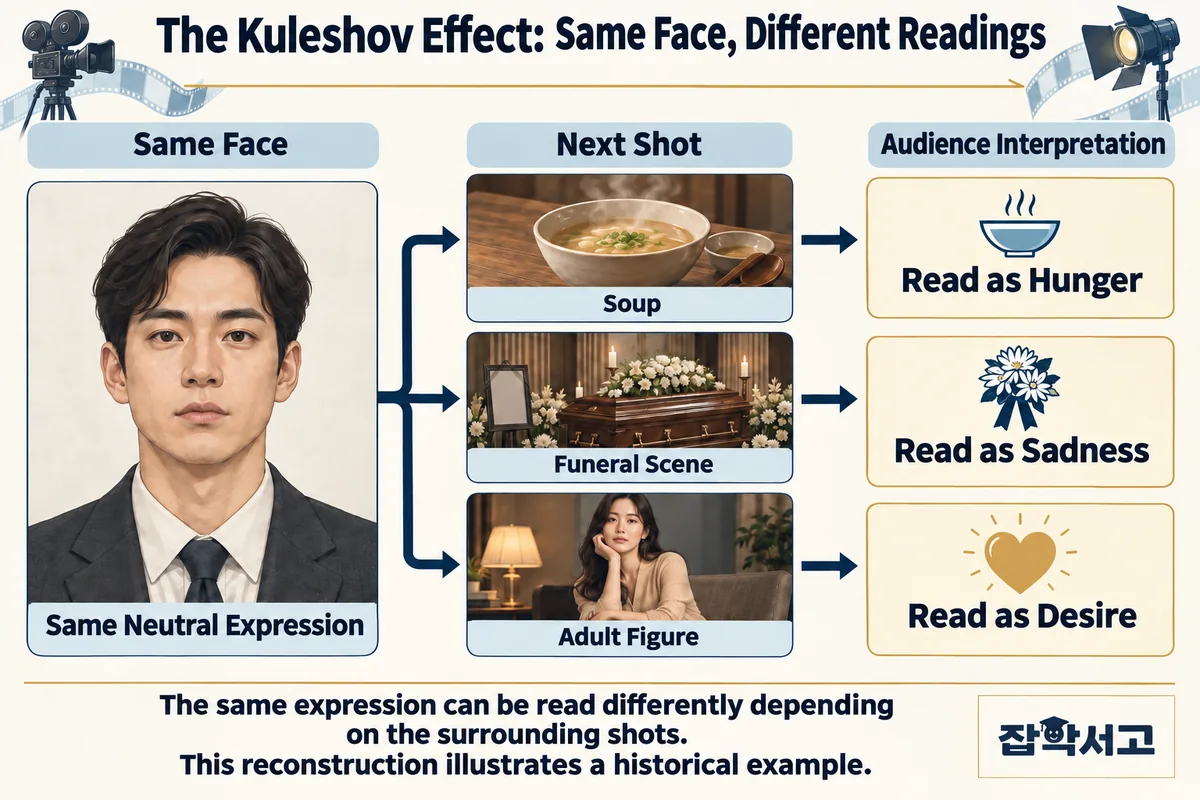
To understand montage theory, there is an experiment we must begin with. It is the famous experiment conducted by Soviet film director Lev Kuleshov in the 1920s.
Kuleshov tried placing three different images after a close-up shot of the actor Ivan Mozzhukhin with an expressionless face.
- An expressionless actor's face + a bowl of warm soup -> The audience thinks the actor feels hungry
- An expressionless actor's face + a young child in a coffin -> The audience thinks the actor feels sad
- An expressionless actor's face + an attractive woman lying on a sofa -> The audience thinks the actor feels desire
Key Point: The actor's expression did not change even once. Yet, through its connection with the images that followed, the audience lavishly praised the actor's performance and interpreted the emotions for themselves. This is the psychological magic created by editing.
Sergei Eisenstein's 5 Major Theories of Montage
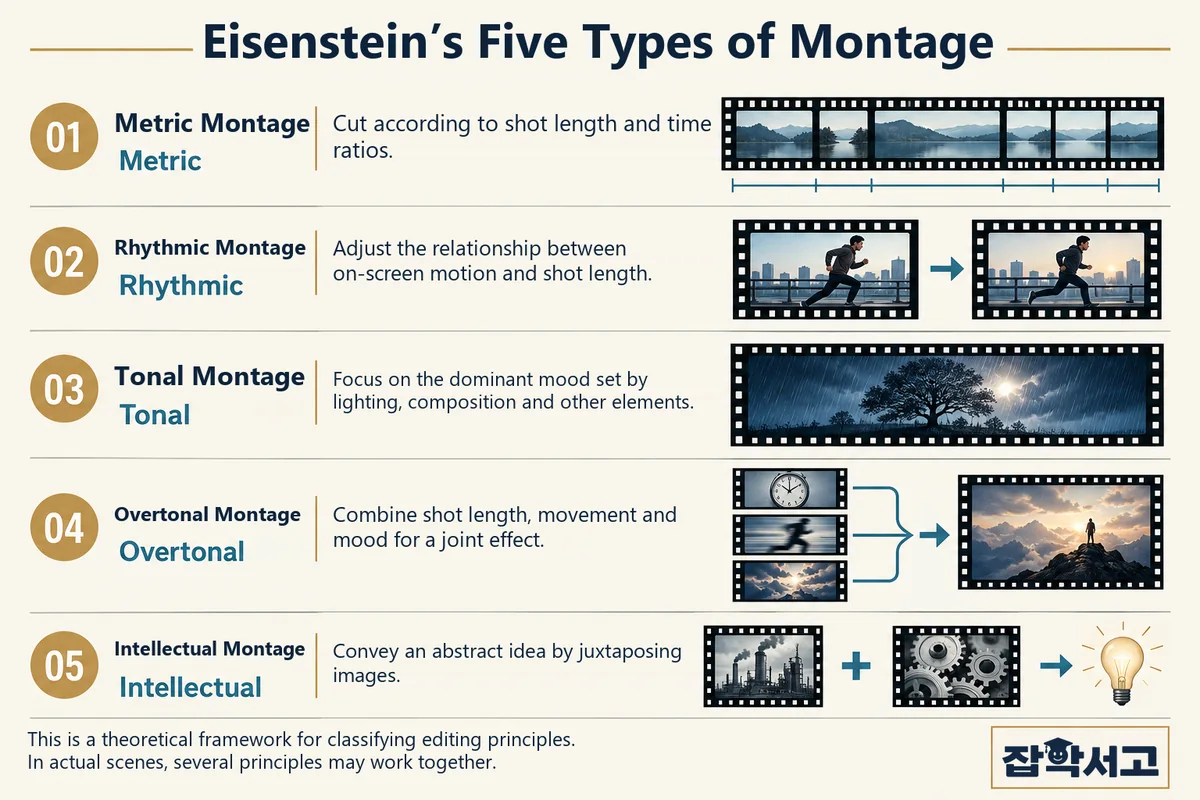
Another Soviet master, Sergei Eisenstein, viewed montage as a collision rather than a simple connection. He introduced into film editing the dialectical perspective in which thesis and antithesis come together to form a synthesis. He classified montage into the following 5 stages.
(1) Metric Montage
- Concept: A method of editing mechanically according to the physical length of the film, regardless of the content within the frame.
- Example: This is an editing technique used in music videos or short-form content, switching images at precise intervals of 1 second and 0.5 seconds in time with the musical beat. It directly conveys a sense of rhythm to the audience.
(2) Rhythmic Montage
- Concept: A method of adjusting the editing speed to match the movement and tempo within the frame.
- Example: This is the famous Odessa Steps sequence in the film Battleship Potemkin. The editing tempo is adjusted to the heavy footsteps of soldiers descending the steps, the frantic movements of civilians fleeing, and the sense of speed of a rolling baby carriage.
(3) Tonal Montage
- Concept: A method of editing based on the lighting, graphic elements, atmosphere, and emotional tone of the images.
- Example: Alternating images of a dark, gloomy sky, wilted flowers, and a person shedding tears maximizes the sense of overwhelming despair or the atmosphere of sorrow.
(4) Overtonal Montage
- Concept: A multidimensional, comprehensive emotional resonance arising from the combined interaction of metric, rhythmic, and tonal montage.
- Example: An intricately staged climax that goes beyond isolated emotions and makes the audience feel profoundly overwhelmed or afraid, registering the sensation in their bodies before their minds.
(5) Intellectual Montage
- Concept: A method of presenting two clashing images with no visual connection to bring an intellectual concept or critical message to the audience's mind.
- Example: Scenes of striking workers being mercilessly slaughtered by the army's guns and bayonets are intercut with images of a cow having its throat cut in a slaughterhouse. Going beyond mere brutality, viewers intellectually grasp the critical perspective that human beings are being butchered like animals.
Applications of Montage in Modern Video Content
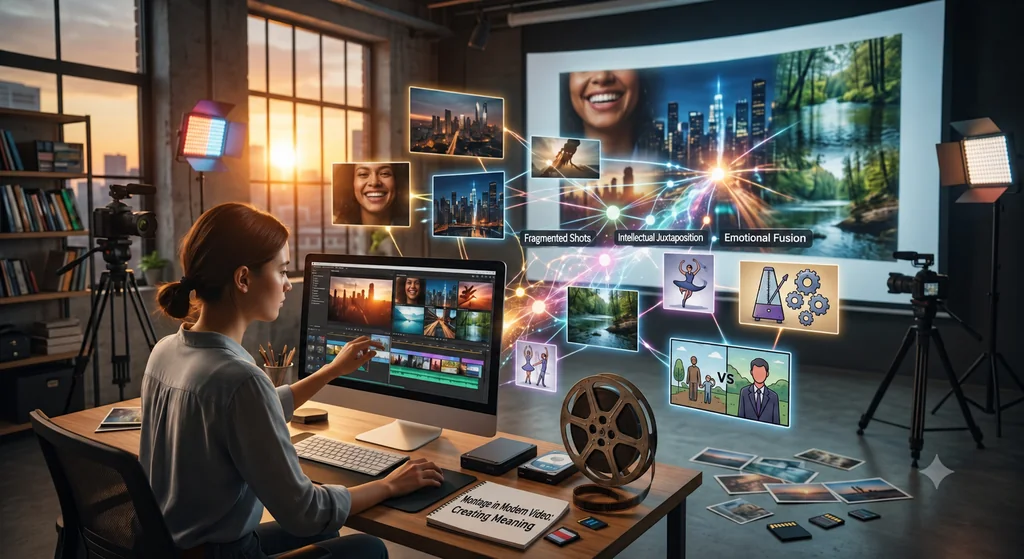
Today, montage extends beyond cinematic techniques and is widely used across all areas, including YouTube, advertising, and social media.
- Compressing Time (Training Montage): In the film Rocky or in sports films, this technique shows the protagonist's growth through training in a series of short cuts accompanied by energetic music. It efficiently condenses a process spanning several months into a video of just over 2 minutes.
- Emphasizing the Theme (Comparative Editing): Intercutting images of wealthy people enjoying a buffet in a lavish penthouse with those of an elderly person collecting waste paper and getting by on makeshift meals conveys the theme of social polarization with powerful visual impact.
Montage: The Evolution of Visual Language
Montage is more than a simple Cut & Paste operation. It is the most fundamental language of film and video studies, yet also a powerful one, orchestrating the audience's subconscious and psychology.
What to include within the camera frame (mise-en-scène) matters, but the message and overall quality of a video change completely depending on the order and tempo in which those frames are arranged and the symbols with which they are made to collide (montage).
Behind every excellent piece of media content we encounter lies an intricate montage mechanism designed to shape the audience's emotions. If we understand these principles of montage when producing or analyzing video content, we will be able to read the deeper visual context beyond the screen.