Documentaries are loved by many as a medium that captures reality as it is while conveying profound insights and emotional impact. Their popularity continues to grow, making a sophisticated and systematic approach to production essential.
This article will examine the key elements of documentary production and discuss in depth the processes of thorough preparation, filming, editing, distribution strategy, and ongoing evaluation and improvement needed to create a successful documentary.
Key Elements and Preparatory Stages of Documentary Production
The Importance of Choosing a Topic
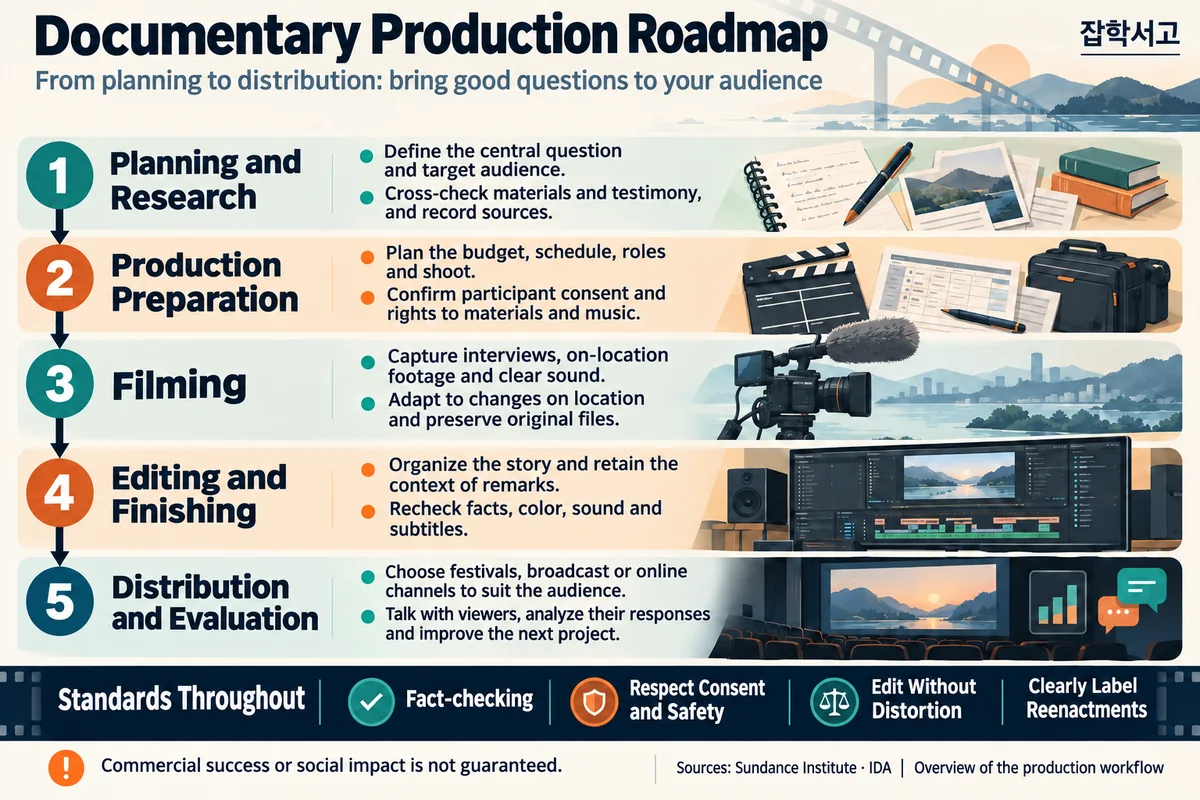
The first step in documentary production is choosing a topic. The topic is an important element that determines the central message and direction the documentary aims to convey. Topics can be discovered in various sources, including personal experiences, social issues, and historical events. When choosing a topic, it should go beyond a simple personal interest or curiosity and be capable of making a deep impression on audiences. The topic must also be chosen carefully, considering the documentary's potential impact on society and its significance. This allows the documentary to resonate with and move more people.
In-Depth Research and Gathering Materials
Once the topic is decided, the next stage is research. Research is a crucial stage that determines the documentary's depth and requires a thorough understanding of the topic. It involves gathering information from various sources and using it to build the documentary's framework. Materials can be obtained through various channels, including books, newspapers, academic resources, and field research, and are essential for developing a deep understanding of actual events and improving the reliability of the information conveyed to audiences.
This stage also requires selecting interview subjects and making contact with them beforehand. Preliminary interviews with experts or people involved strengthen the documentary's persuasiveness, while the interviewees' perspectives enrich its overall flow. Materials gathered through research provide the foundation for the documentary's storyline, allowing a compelling narrative to be built upon them.
Writing a Script and Planning the Shoot
Once research is complete, the process moves on to scriptwriting. Unlike conventional films, documentaries often do not have a complete script written in advance, but a script outlining the basic flow is essential. The script helps prepare for unexpected situations that may arise during filming and keeps the production team moving in the same direction. Establishing guidelines for key scenes, interview topics, and filming locations in advance improves filming efficiency and maintains a consistent story progression.
A detailed shooting plan should also be developed at this stage. It is important to plan carefully which times of day to film key scenes and what equipment and personnel will be needed at each location. Because the shooting plan is directly linked to the budget, it must be realistic and specific.
Setting a Realistic Budget
Budgeting is another important factor that determines the success or failure of documentary production. A realistic budget plan must account for the documentary's scale, filming locations, equipment, labor costs, and other expenses. Because exceeding the budget risks bringing the project to a halt, thorough budget management is essential from the earliest stages.
In particular, it is important to set aside a contingency budget to account for the possibility of unexpected additional costs during filming. An insufficient budget may reduce production quality or prevent all planned scenes from being filmed. The budget plan must therefore be realistic, with appropriate contingency measures to keep the project from being interrupted.
Building the Production Team and Assigning Roles
Making a documentary is not a task that can be done alone. Building the production team is another important stage that determines the documentary's success. Specialists from various fields, including cinematographers, editors, sound specialists, and producers, must collaborate, and their respective roles need to be clearly defined. In particular, specialists in each field must fulfill their own responsibilities while understanding the direction of the overall project.
The cinematographer must create a visual aesthetic appropriate to the topic, while the editor must effectively arrange the collected footage and interview materials into a polished work that can be presented to audiences. The sound specialist must produce sound that establishes the documentary's atmosphere and enhances immersion. Collaboration across these fields thus provides an important foundation for documentary success.
Thorough Preparation Determines the Quality of the Finished Work
Once all these preparatory stages are complete, the team is ready to begin documentary production in earnest. Thorough preparation plays a decisive role in improving the quality of the finished work, while inadequate preparation leads to various difficulties during production. Paying careful attention at every stage and preparing for anticipated problems are the first steps toward successful documentary production.
A documentary is more than simply a video; it is a powerful tool that can convey a message to audiences and bring about change in the world. By giving the preparatory stages proper attention and planning and executing them thoroughly, it is possible to create a work with greater emotional depth and insight.
Filming and Editing: Artistic Techniques of Storytelling

Planned Filming and Story Development
Filming is the core process of documentary production, recording reality vividly. At this stage, thorough advance planning is needed to communicate the documentary's story visually. Careful, specific consideration must be given to how various types of footage, including interviews, footage from the scene, and archival footage, will be arranged.
Before filming begins, the key scenes to be emphasized in the story must be selected in advance, and the message each scene will convey must be clearly established. A shooting plan is a tool for organizing this process systematically, helping the team respond flexibly to unexpected situations that may arise on location.
Capturing natural behavior is also one of the important characteristics of a documentary. Because reality must be captured as it is without distortion or manipulation, the camera operator must respond sensitively to situations unfolding on location and exercise the ability to make spontaneous judgments.
The Importance of Lighting and Composition
Lighting and composition also play crucial roles during filming. Unnatural lighting or awkward composition reduces audience immersion, so techniques are needed to capture people's expressions and backgrounds naturally and effectively. Choosing lighting appropriate to the location and composing people and backgrounds harmoniously can improve the quality of the finished documentary.
Composition is an important means of visually communicating the emotions of a story. For example, placing a person in the center of the frame can emphasize their importance, while filming them against a particular background can explain the situation more effectively. This can make the message the documentary aims to convey clearer and more powerful.
The Role of Sound and How to Use It Effectively
During filming, sound is an essential element in enhancing a documentary's immersion. Just as important as the visuals themselves, sound consists of location sound, narration, background music, and other elements. Location sound adds a sense of realism, while narration helps convey the story or information within the footage more effectively. Background music adds emotional depth and is used in important scenes to heighten the audience's emotions.
Clear voice recording is particularly essential when filming interviews. If the voice lacks clarity, the interview's content may be distorted or communicated less effectively. Sound therefore requires careful management, including using good audio equipment and minimizing external noise.
Editing: Weaving Extensive Materials into a Single Whole
Once filming is complete, the process moves on to editing. Editing is an important process that shapes the documentary's flow, weaving a vast amount of filmed material into a coherent story. This process removes unnecessary scenes, highlights important ones, and clearly organizes the story to be conveyed to viewers.
The editor must restructure the filmed footage while maintaining the emotional arc. This is because the way particular scenes are connected and coordinated with music determines the flow of emotions experienced by the audience. In particular, editing that builds tension toward the climax can heighten audience attention and maximize immersion.
Color Grading and Sound Mixing: Improving the Quality of the Finished Work
Color grading and sound mixing are key elements of postproduction. Color grading adjusts the colors of the footage to determine the documentary's visual atmosphere. This can create visual consistency and convey particular emotions or moods more strongly.
Sound mixing is the process of harmonizing various audio elements. It improves the overall quality of the sound by appropriately arranging location sound, interviews, background music, and other elements. This work plays an important role in determining the documentary's overall quality, and effective sound mixing helps audiences become emotionally immersed.
Filming and Editing: Bringing Artistic Storytelling to Completion
Filming and editing involve more than simply recording footage and joining it together. They constitute the artistic process of storytelling, which is the most important aspect of a documentary. Recording reality through filming and weaving that reality into a story through editing require both creativity and technical skill. Appropriate composition and lighting, sound and music, and editing that maintains the emotional arc can convey a powerful message and move audiences.
All these processes are important elements that allow a documentary to become a form of artistic expression beyond a simple record. Filming and editing each fulfill their respective roles while making decisive contributions to the overall quality of the finished work.
Distribution Strategies and Ways to Encourage Viewer Engagement

The Importance of a Distribution Strategy
Once a documentary is complete, it must reach audiences through a distribution strategy. A distribution strategy plays an important role in successfully bringing the documentary to viewers and requires thorough planning. A clear direction must be established for the channels through which the documentary will be distributed, and this may vary depending on its topic or target audience. Major distribution channels include online platforms, film festival submissions, and television broadcasts.
A distribution strategy is more than simply delivering content; it is an important process of creating points of connection with audiences. A successful distribution strategy enables more people to access the documentary, thereby maximizing its social impact.
The Advantages of Using Online Platforms
Online platforms have become an important channel for documentary distribution today. Through various digital channels, including Netflix, YouTube, and independent documentary platforms, documentaries can reach a broader audience. The advantage of online platforms is that they can be accessed regardless of time or location. This makes it easy to reach viewers at home and abroad, while subtitles in various languages can help secure an international audience.
Successful online distribution also requires consideration of digital marketing strategies. In particular, it is important to expose the documentary to more people through search engine optimization (SEO). Keyword selection, content descriptions, and thumbnail design are essential for increasing the documentary's click-through rate and encouraging viewer engagement.
Opportunities Offered by Film Festival Submissions
Submitting a documentary to film festivals is an important way to enhance its credibility and showcase the filmmaker's capabilities internationally. International film festivals give independent documentary filmmakers opportunities to introduce their work, allowing the documentary to be presented to more audiences. There are various festivals, including the Cannes Film Festival, the Sundance Film Festival, and IDFA, and each seeks documentaries suited to particular topics or formats.
Winning an award at a film festival increases a documentary's credibility and value and can create opportunities to secure additional distribution channels. Festival screenings can also introduce the documentary to critics and film industry professionals, making it easier to expand into television broadcasts or other distribution channels afterward.
Reaching the Public Through Television Broadcasts
Television broadcasts remain an effective way to introduce documentaries to many people. Broadcasting on television is an important means of exposing audiences of various ages to a documentary, and collaboration with terrestrial or cable television, in particular, offers an opportunity to greatly expand its social impact.
Through television broadcasts, documentaries can gain popular appeal and convey their messages to a wide range of viewers. In particular, watching television remains an everyday activity in many households, making it easy for documentaries to reach more people through this channel. Television broadcasts can also be expected to spread a documentary's influence more quickly and widely.
Ways to Encourage Viewer Engagement
Encouraging viewer engagement is another important aspect of documentary distribution. A strategy is needed that goes beyond simply conveying information and encourages viewers to connect with the documentary's topic and message and participate actively. Various engagement programs using social media can be planned for this purpose. For example, Q&A sessions can provide time for viewers to ask questions directly and for the director or producer to answer them, or campaigns related to the documentary can be organized to encourage viewers to take part in practice.
Workshops or seminars related to the documentary's topic can also be held to give audiences a deeper understanding. These programs help establish the documentary as an important tool that calls for social change and encourages people to put it into practice, beyond simply being a video. In particular, workshops or educational materials can communicate the documentary's message more powerfully, thereby increasing its social value.
Strengthening the Message Through Educational Materials and Workshops
Providing educational materials or workshops alongside a documentary is also an important way to expand its social impact. Educational programs based on topics covered in the documentary help audiences develop a deeper understanding of the issues. This allows the documentary's message to reach more people and enables it to be used as a tool for promoting social change.
Workshops provide a forum for substantive discussion of the documentary's topic. Experts, activists, and members of the general public can gather to discuss the issues covered in the documentary in depth and seek solutions. This is an important means of going beyond simply conveying information and helping audiences translate it into action that can bring about real change.
The Importance of Successful Distribution and Viewer Engagement
Successful documentary distribution requires a thorough strategy, through which the documentary can reach more people. Making appropriate use of various distribution channels, including online platforms, film festivals, and television broadcasts, is a key element of successful documentary distribution. By also considering ways to encourage active viewer participation, the documentary can go beyond viewing alone and serve as a tool for social change.
The core of a successful distribution strategy is to keep communicating the documentary's message through various methods, including workshops, educational materials, and social media campaigns, while encouraging viewers to develop a deeper understanding and participate.
Ongoing Evaluation and Improvement for a Successful Documentary

Improvement Through Analysis of Audience Responses
Documentary production requires ongoing evaluation and improvement even after production is complete. The first step in doing so is to thoroughly analyze audience responses. It is essential to understand how audiences received the documentary and whether its intended message was properly conveyed. Audience responses are an important indicator of the documentary's success and can clearly reveal which areas need improvement.
Methods of gathering audience feedback include surveys and analysis of social media comments. Surveys can provide a detailed analysis of the emotions viewers experienced, the scenes that interested them, their level of understanding, and other aspects. Social media provides more diverse forms of feedback in real time and is useful for understanding how audiences feel about the work. In particular, for documentaries distributed through online platforms, real-time responses can be gathered by analyzing comments, view counts, the number of shares, and other data.
Careful analysis of audience responses makes it clear what should be strengthened and what needs to be improved in future projects, helping create better documentaries.
The Importance of Internal Evaluation by the Production Team
Alongside audience responses, internal evaluation by the production team is an important process for creating a successful documentary. It is essential to analyze and address problems that arose during production, difficulties encountered in collaboration, and other issues. During internal evaluation, it is important for each team member to provide honest feedback, helping ensure that the same mistakes are not repeated in the next project.
Internal evaluation should take place at every stage of filming, editing, and distribution. It is essential to review each department's expertise and efficiency and discuss ways to address inadequate communication or unexpected problems. These internal evaluations should be conducted regularly, allowing the entire production team to continue growing and developing.
Evaluating the Effectiveness of Communicating a Social Message
A documentary is more than simply a video; it is an important tool for communicating a social message. It is therefore important to continually evaluate the documentary's impact on society. It is necessary to analyze how effectively the documentary communicated its topic and whether audiences accepted its message and changed their behavior.
For example, if a documentary addressed environmental issues, it is possible to analyze how audiences changed their awareness of environmental protection after watching it. This becomes an important indicator for assessing the documentary's social impact. If necessary, it is also advisable to plan follow-up activities or campaigns to ensure that the documentary's message continues to spread. This process enables the documentary to function as a tool for social change.
Maintaining an Ongoing Interest in Technological Developments
The technical aspects of documentary production must also continue to develop. Because filming techniques, editing technologies, distribution channels, and other aspects are changing and advancing rapidly, the production team must continually learn about and apply the latest technologies and trends.
New camera equipment or technologies such as drone filming can improve a documentary's visual quality, while the latest editing software enables more sophisticated editing. Distribution strategies must also be revised and developed in response to changes in online platforms. This allows the documentary to achieve higher technical quality and reach more audiences.
Development Through Continuous Learning and Growth
Documentary filmmaking does not end with a single project; it is work that requires continuous learning and growth. The process of creating better works based on the experience gained from each project is important. Through research into new topics, learning about new technologies, and understanding new audience groups, documentaries can continue to develop.
These ongoing efforts can contribute to the development of the entire documentary industry beyond individual growth alone. As more people recognize and connect with social issues through documentaries, documentaries will be able to exert even greater social influence.
Continuous Improvement and Evaluation Are the Keys to Success
Documentaries require continuous evaluation and improvement even after production is complete. Better documentaries can be created by analyzing audience responses and incorporating findings from internal production team evaluations into the next project. Continually evaluating a documentary's social impact and the effectiveness of its message also plays an important role in enabling it to bring about social change.
By continuously incorporating technological advances and maintaining an attitude of ongoing learning and growth, documentary filmmakers will be able to achieve greater accomplishments. Beyond simple documentation, documentaries must continue to strengthen their role as important tools for communicating social messages and calling for change.
Documentaries are powerful tools that illuminate various aspects of our society and present possibilities for change. Successful documentary production requires not only thorough preparation and artistic filming and editing, but also effective distribution strategies and ongoing evaluation and improvement. Although this process may be challenging, its results will offer audiences profound emotional experiences and insights.
We hope that these strategies will continue to develop in documentary production and help bring about positive changes in our society.