The smartphones we use contain thousands, even tens of thousands, of files and apps. What would happen if photos, documents, and music files were all mixed together on a single screen without separate folders? Finding just one photo you wanted would take hours.
Libraries are no different. If the millions of books humanity has accumulated were shelved without any rules, even the most accomplished scholar would be unable to find the information they wanted. In library and information science, a system that gives such vast amounts of information a 'location' and an 'order' is called classification (Classification).
Among these systems, the atlas of knowledge used as a standard by tens of thousands of libraries in at least 135 countries around the world is the Dewey Decimal Classification (DDC). Devised by Melvil Dewey in the 19th century, this system goes beyond a simple method of organizing books: it is the culmination of infographic thinking that systematically structures all of humanity's knowledge.
Dividing Knowledge into 10 Large Boxes (Main Classes)
The core principle of the Dewey Decimal Classification begins with dividing the vast world of knowledge into 10 major branches (Main Classes). These are assigned numbers from 000 to 900 according to the academic currents through which humanity has understood and studied the world.
We can compare this to dividing a large center filled with information into different zones.
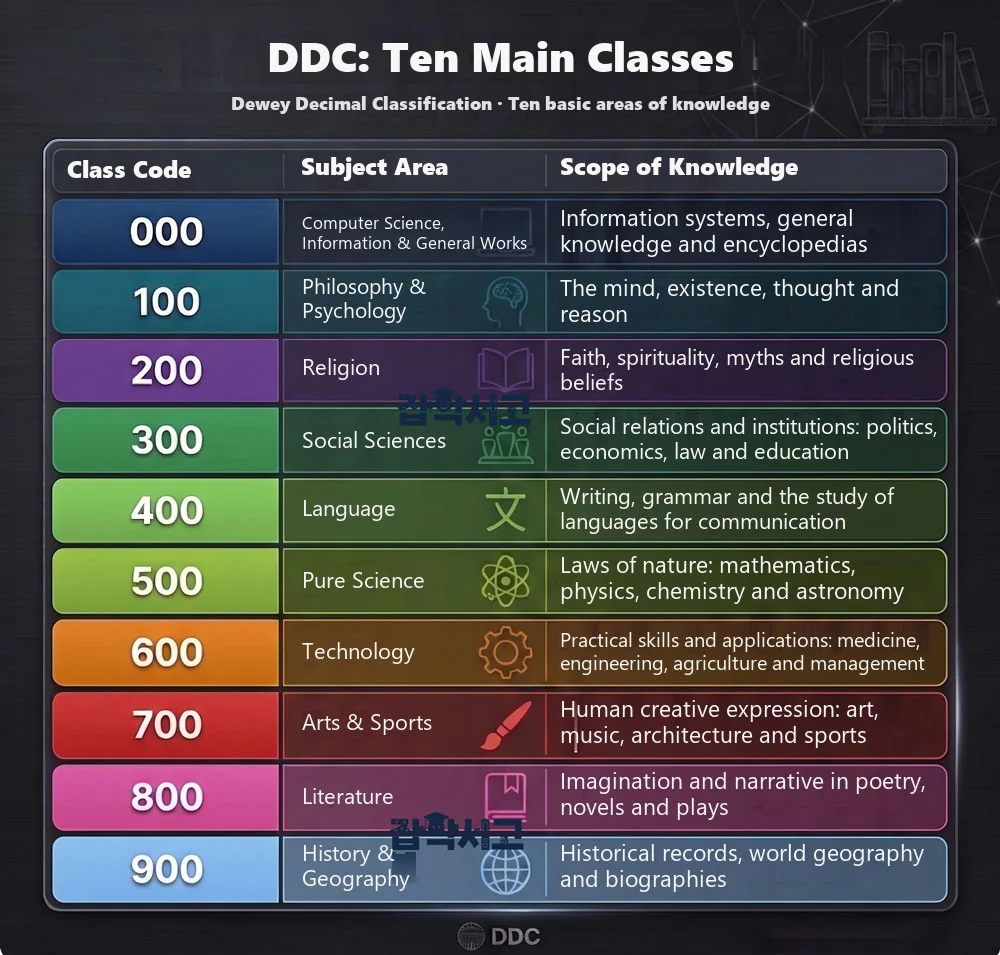
The numbers from 000 to 900 are more than a simple sequence: they serve as unique addresses that determine 'what kind of knowledge this is.'
The Magic of the Decimal System – Infinitely Expanding Subdivisions
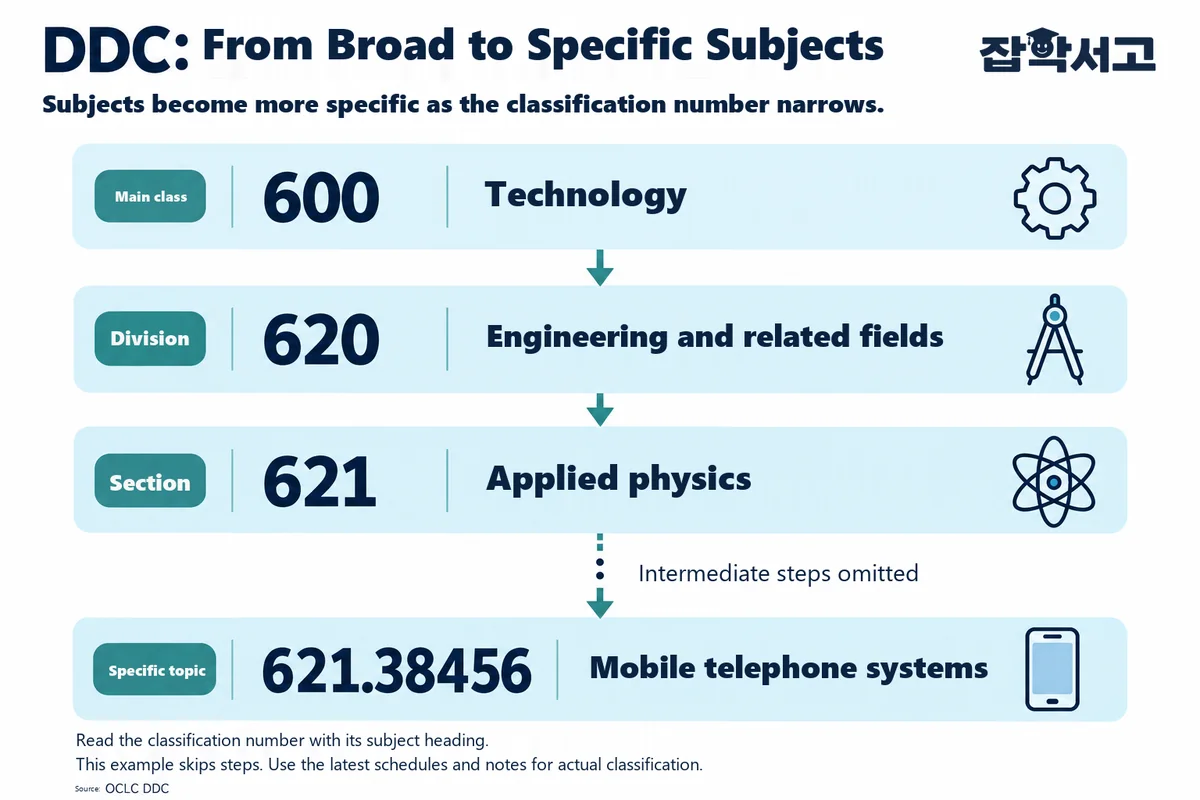
The real power of DDC lies in the decimal system (Decimal System). The 10 large boxes (main classes) are each divided into 10 smaller boxes (divisions), and those boxes are further divided into 10 detailed boxes (sections), continuing this subdivision indefinitely.
Let us examine, step by step, how a topic becomes more specific.
- Overall broad classification (main classes — in units of 100): 600 Technology
- Intermediate classification (divisions — in units of 10): 620 Engineering and related technologies
- Narrow classification (sections — in units of 1): 621 Applied physics
- Detailed subjects (after the decimal point): A decimal point (.) is inserted, and digits are continually appended to represent detailed technological topics precisely.
- 621.3 Electrical engineering and electronics
- 621.38 Communications engineering
- 621.384 Wireless communications
- 621.38456 Mobile telephone systems
Simply by looking at the number 621.38456, an expert can intuitively grasp the information's structure: "Within engineering (620) under technology (600), this goes through applied physics (621) and communications (621.38) to cover mobile telephone systems (621.38456)!"
Because digits can continue to be added after the decimal point, even when new technologies and disciplines such as artificial intelligence or quantum computing emerge in the future, they can be integrated by adding numbers after the decimal point without dismantling the existing system.
The Value of Structuring Information through Infographic Thinking with DDC
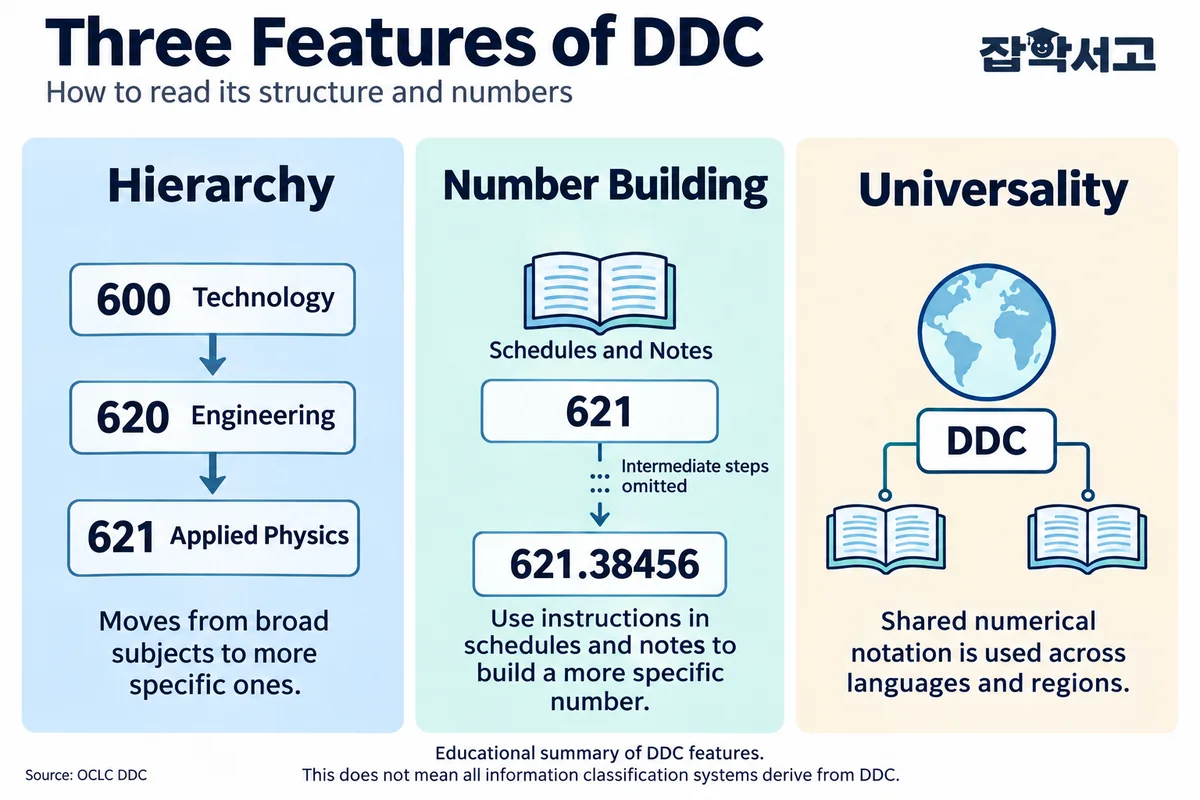
Today, most of the digital information classification systems we encounter, from website category design and file system structures to database indexing, are rooted in the logic of the Dewey Decimal Classification.
DDC presents three core principles of information design.
- Hierarchical organization (Hierarchy): It forms a branching structure that leads naturally from broader concepts to narrower concepts.
- Capacity for expansion (Scalability): It has the flexibility to expand indefinitely after the decimal point as new information arrives.
- Universal applicability (Universality): Even when languages differ, the shared symbols of 'numbers' allow people anywhere in the world to understand the same classification criteria.
DDC is a standard framework that maximizes information accessibility and search efficiency by arranging explosively growing data in an orderly way.
The True Value of Library and Information Science in Establishing Order in Knowledge
The Dewey Decimal Classification is more than a classification symbol attached to a book cover. It is a 'map of knowledge spanning the digital and offline worlds,' established to keep human intellect from losing its way in the ocean of data.
Library and information science is a discipline that extracts meaningful value from vast amounts of information and organizes it systematically so that anyone can access it easily. Understanding the clear structural framework of the Dewey Decimal Classification will enable us to examine and use the structures of the information systems and websites we encounter in everyday life with much greater depth.