A student walks up to the library help desk and asks, “Where are the dinosaur books?” If the librarian points to the shelf with the dinosaur encyclopedias, the conversation ends quickly, but the student may turn away puzzled. What the student actually needed may not have been an encyclopedia at all, but material for a presentation on why the dinosaurs went extinct. There is a bigger gap than you might expect between the question first asked and what the person really wants to know.
Put simply, a reference interview is “the process in which a librarian talks with a user, refines the question first received, and connects the person to the information they truly need.” It is a conversational skill at the heart of library reference service, that is, the work of answering users’ questions and helping them find materials.
In this article, we will look in turn at why reference interviews are needed, the four levels through which a question takes shape, the flow of the interview and its questioning techniques, and finally the criteria for judging a good interview.
A Conversation That Looks Beyond the Question to the Need
Why Reference Interviews Are Needed

People rarely say exactly what they want when they first come to a library.
(1) Questions that are too broad or too narrow
Some ask vaguely, like “Do you have any history books?”, while others single out one particular book. Yet users themselves often don’t know whether that book really contains the information they need.
(2) The reluctance to explain one’s circumstances
The more personal the matter, such as an illness, a legal problem, or money trouble, the more people hide their real purpose and ask in a roundabout way. Not a few are even embarrassed to ask at all.
(3) Users who don’t know how the library is organized
Because users don’t know what materials the library holds or how they are arranged, they tend to rephrase their question as the name of a resource that seems likely to exist. So answering only the question as it appears on the surface can easily hand them the wrong material.
For these reasons, rather than simply taking down the first question as given, a librarian exchanges a few more words to understand the background it came from. A few short remarks can greatly cut down on wasted trips.
Taylor’s Four Levels of Questions

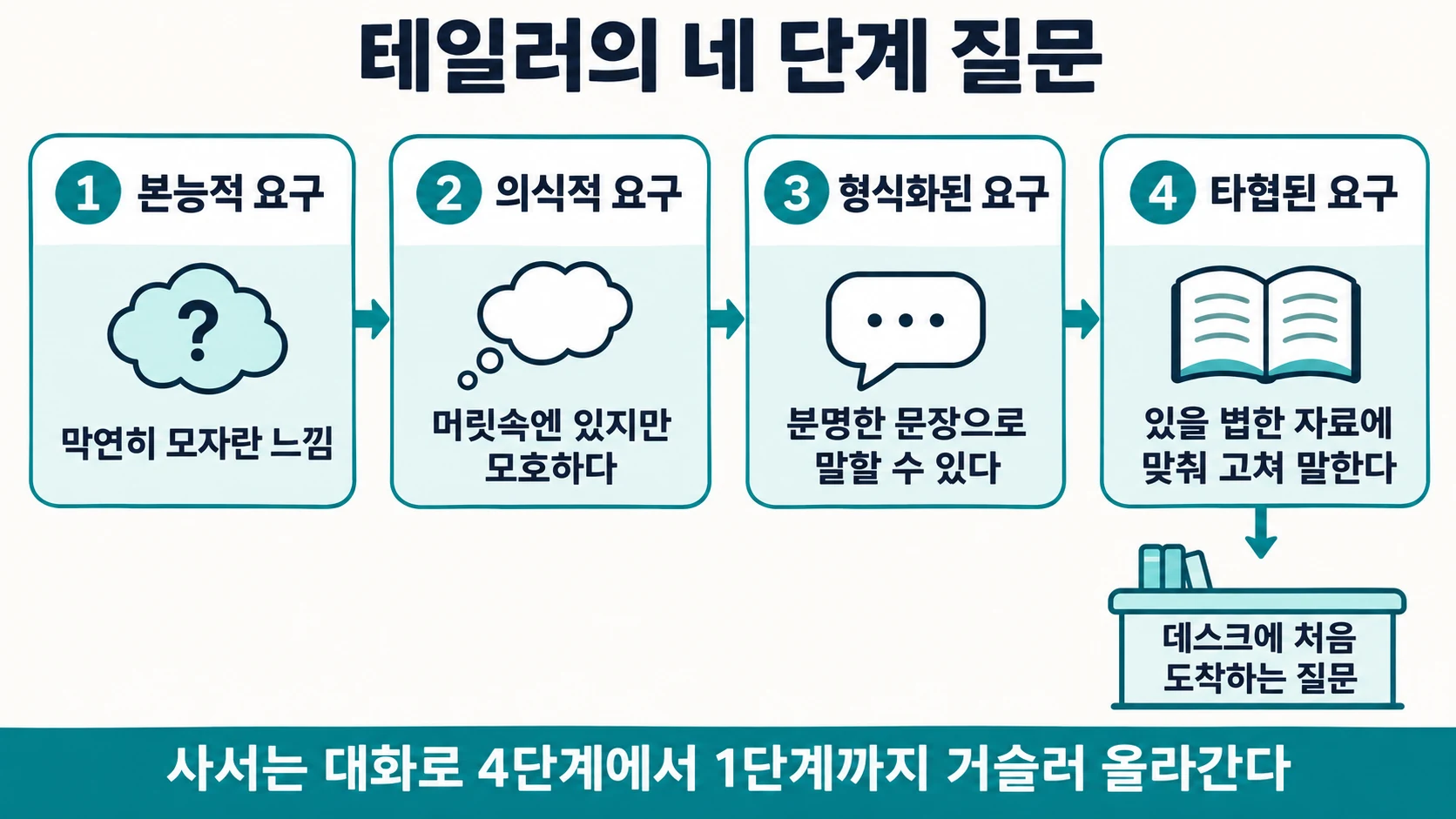
The American information scientist Robert S. Taylor explained in a 1968 paper that a question passes through four levels before it comes out in words.
- Visceral Need: a vague feeling that something is missing, still hard to put into words.
- Conscious Need: a state in which the person knows it in their head but can describe it only in a rambling, ambiguous way.
- Formalized Need: a state in which the person can state in a clear sentence what they want to know.
- Compromised Need: a state in which the question has been reworded to fit the materials the library is likely to have.
The question that first arrives at the library desk is usually the last level, the compromised need. That is why the librarian has to work back, through conversation, to the needs hidden beneath it. When the student above said “dinosaur books,” that may have been the result of rewording a formalized need, preparing a presentation, into the name of a resource likely to be in the library. For this purpose Taylor proposed five filters: the subject, the objective and motivation, the characteristics of the user, the relationship of the inquiry to how materials are organized, and the form of answer the user expects.
The Flow of the Interview and Questioning Techniques

A reference interview generally follows a set flow, but when necessary the librarian goes back to an earlier step and asks again.
Welcoming and Listening
First, greet the user warmly, make eye contact, and listen all the way through. Restating what the user said lets you check together whether the librarian has understood correctly.
Open and Neutral Questions
Open questions with no fixed answer, such as “What would you like to know?”, let users unfold their situation in their own words. In 1986, Brenda Dervin and Patricia Dewdney went a step further and proposed neutral questioning, which asks about the situation, where the user is stuck, and what the information will be used for. For example, you might ask, “What are you hoping to do with that material?”
Checking and Closing
Once the question is clear, you find the material and hand it over, and at the end you ask again, “Is this what you were looking for?” Skipping this check is considered the most common mistake in reference interviews.
Criteria for a Good Interview

Whether a reference interview went well is not judged only by whether the right answer was given.
(1) The 55 percent rule
When results of unobtrusive testing, in which researchers pose as ordinary users and ask questions, were gathered, only a little more than half of the cases received a correct answer. In 1986, Peter Hernon and Charles McClure called this the “55 percent rule,” and the finding helped draw attention to the importance of interviewing skills. Critics, however, also argue that the figure has been overgeneralized.
(2) Would the user want to come back?
Some take the view that whether users want to ask the same librarian again is a more important yardstick than whether the answer was correct. A friendly manner and the habit of checking to the end greatly shape this feeling.
(3) Interviews beyond the screen
Today, digital reference service, where questions arrive by chat, email, or video call, is also common. Because facial expressions and gestures can’t be seen, skills for asking follow-up questions and confirming more carefully in writing are needed.
A reference interview is not about telling someone where a book is; it is about working through, together with the user, a curiosity that the user hasn’t yet sorted out even for themselves. Even in an age when a search box answers just about anything, the value of a conversation that helps refine the question itself remains.
Not stopping at the question first heard, but asking all the way through to what the person really wants to know: that is the first step of good information service.