When we order something from an online store, it arrives at our doorstep with a shipping label attached. This label contains all the information needed for delivery, including the sender, recipient, and type of goods. What about air cargo that crosses borders and flies thousands of kilometers? The many shipments loaded onto a huge airplane also need their own "name tags." In the world of logistics in the sky, AWB (Air Waybill, or air cargo waybill) plays the same role as a parcel shipping label.
An AWB is more than just a sticker attached to cargo. It is the access pass that cargo needs to board an aircraft, a transportation contract, and the most important document certifying the cargo's current status. As global business becomes more active, the importance of air transportation continues to grow, and AWB is always at its center. This article explores what an AWB is, what roles it plays, and how it is structured as an essential part of the logistics industry, in a way that even beginners can easily understand.
AWB, What Exactly Are You?
The Definition and Core Functions of AWB
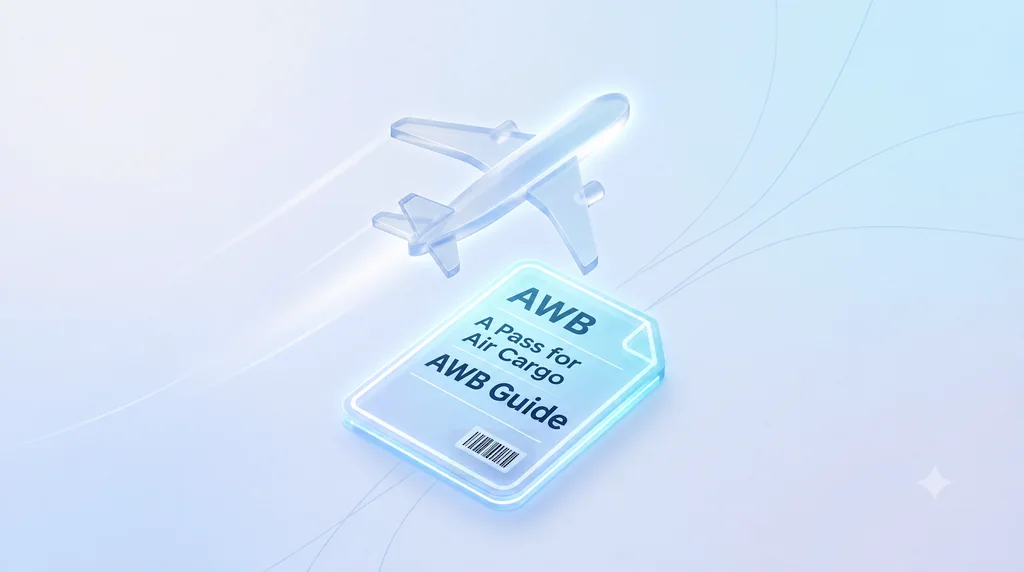
AWB (Air Waybill), translated as "air transport waybill," is a non-negotiable document certifying that an airline has received cargo and indicating that a contract to transport the goods has been concluded between the shipper (sender) and the carrier (airline). Simply put, it is a certificate showing the airline's promise: "We have received these goods and agreed to transport them safely to their destination."
Unlike the B/L (bill of lading) used in sea transportation, its most distinctive feature is that it is non-negotiable. In other words, because an AWB is not a document of title to the goods, holding an AWB does not allow you to sell or transfer the goods as you please. Instead, the person designated as the recipient of the goods (consignee) verifies their identity and collects the goods.
An AWB performs the following 5 core functions.
- Cargo Receipt (Receipt of Goods): It proves that the airline received the cargo without any problems.
- Proof of a Transportation Contract (Evidence of Contract of Carriage): It serves as a contract specifying transportation conditions, charges, the scope of liability, and other details.
- Freight Charges Statement and Invoice (Invoice): It provides the basis for calculating the total freight charges and other costs involved in transporting the cargo.
- Customs Declaration Materials (Customs Declaration Document): It is used as basic documentation certifying information about the goods during import and export customs clearance.
- Cargo Delivery Instructions (Delivery Instruction): It specifies to whom the cargo must be delivered after it arrives at its destination.
Types of AWB: Master vs. House
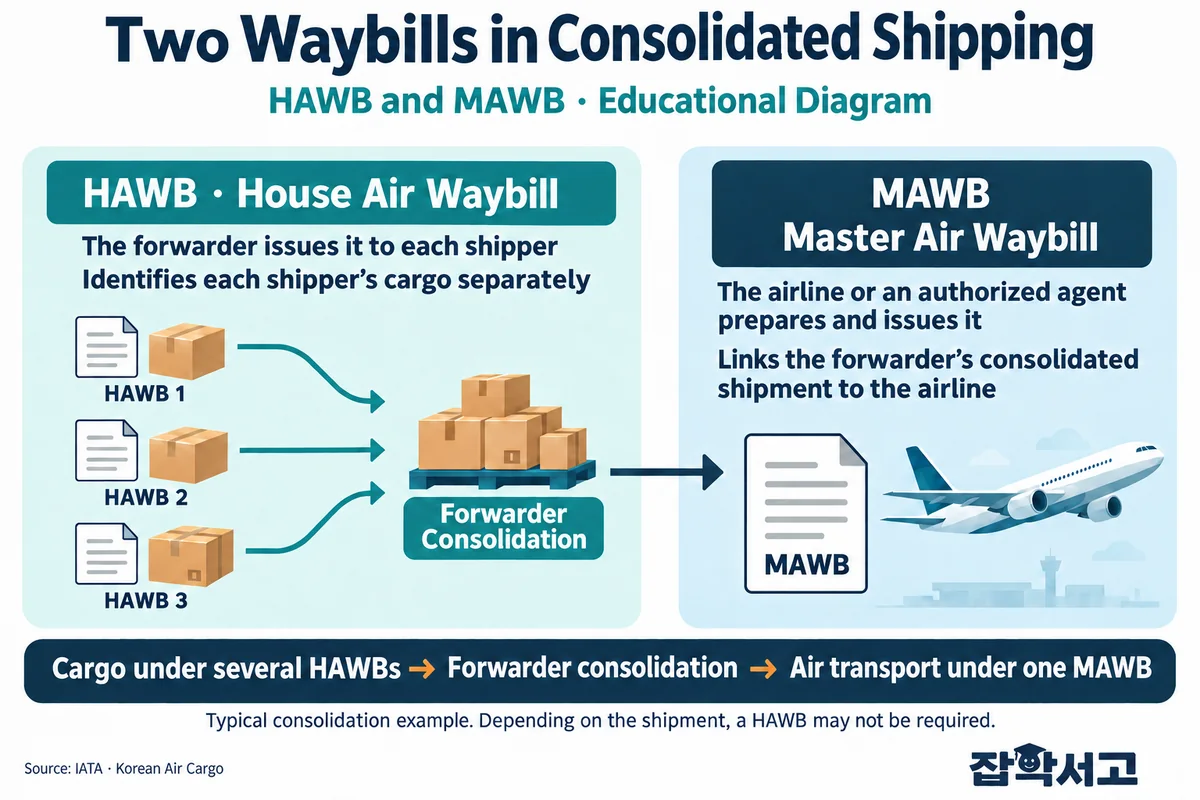
AWBs are broadly divided into two types according to who issues them and how the cargo is organized.
Master AWB (MAWB)
This is a waybill issued by an airline to a forwarder (freight forwarder). When shipments from multiple shippers are combined into one large consignment for transportation, the airline treats the forwarder as the shipper and issues this MAWB. In other words, the actual owner of the goods does not appear on this MAWB.
House AWB (HAWB)
This is a waybill issued by a forwarder to the actual shipper (exporting company). While combining shipments received from multiple shippers under a single MAWB, the forwarder also issues a separate HAWB to each actual shipper. The consignee uses this HAWB to collect the goods from the forwarder at the destination.
This arrangement can be compared to "courier delivery" and "delivery outsourcing." An MAWB is a document used by the courier company's headquarters (the airline) to hand over a batch of shipments to a large delivery company (the forwarder), while an HAWB is like a delivery slip issued by that delivery company to the customer who actually ordered the goods (the actual shipper/consignee).
What Information Does an AWB Contain? (Key Entries)
An AWB has a standard format used worldwide. Although it may look complicated, you only need to understand the key information. The following are the most important details recorded on an AWB.
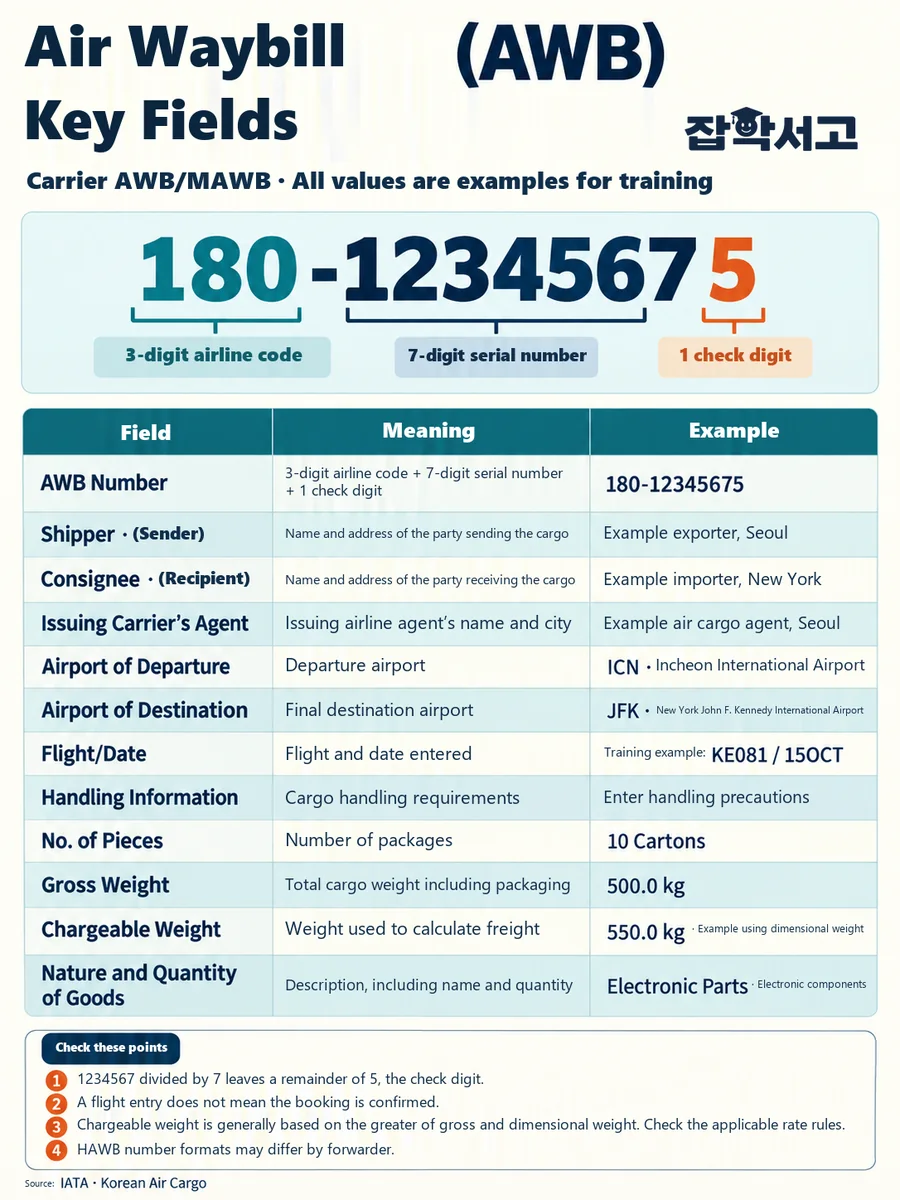
Hold on a moment! The most difficult part to understand is Chargeable Weight (the weight used to calculate freight charges). Because space is limited in air transportation, "volume" matters as well as weight. For example, even at the same weight of 1 tonne, cotton may occupy more space than steel, so freight charges may differ. Airlines therefore consider both weight and volume and charge freight based on the larger value. This chargeable weight is specified on the AWB.
The AWB Issuance Process: The Cargo's Journey
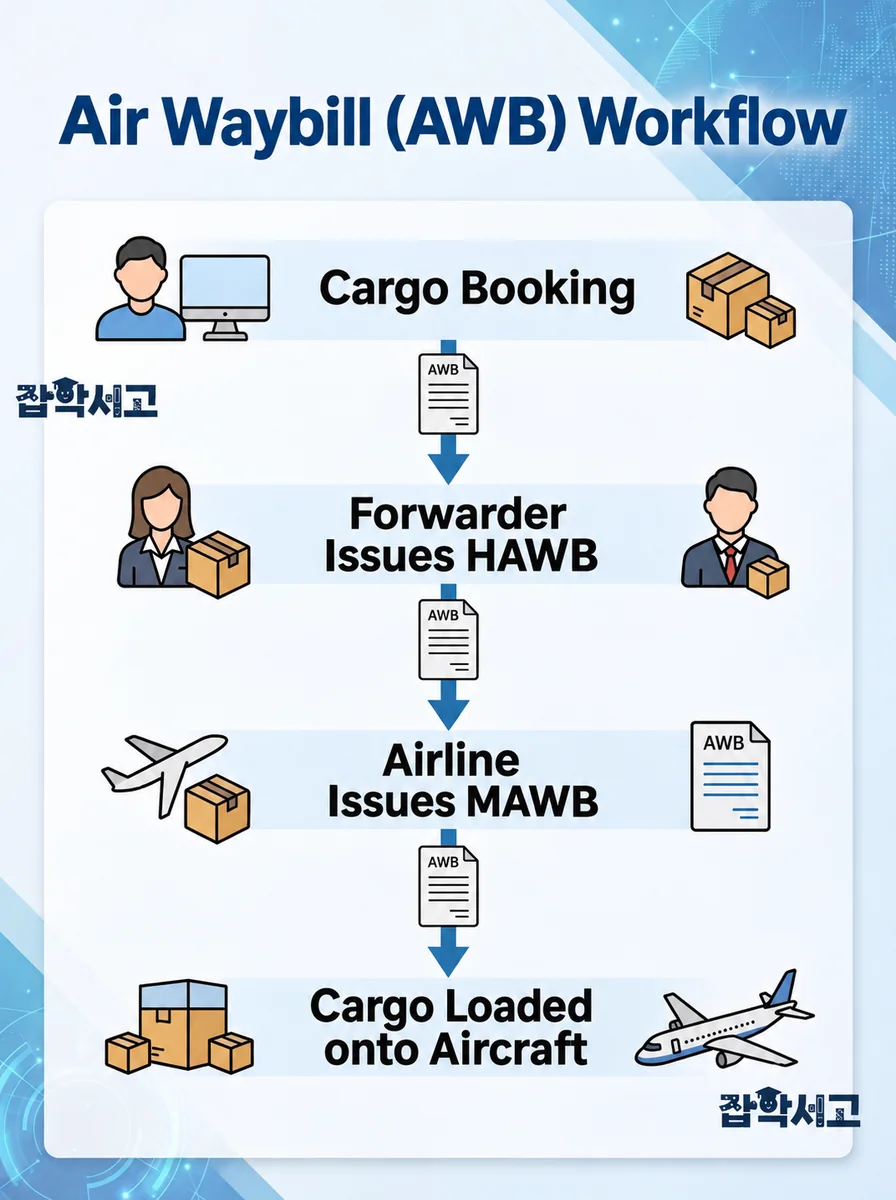
An AWB is issued during the process after cargo leaves the exporter's hands and before it is loaded onto an aircraft.
- Transport Reservation (Booking): The exporter asks the forwarder to arrange transportation of the cargo.
- Cargo Arrival and Inspection: The cargo arrives at a warehouse or terminal near the airport. The forwarder checks the cargo's weight, volume, and condition.
- HAWB Issuance: The forwarder issues an HAWB to the actual shipper based on the verified information.
- Shipment Consolidation (Consolidation): The forwarder combines multiple HAWB shipments into one large cargo unit.
- MAWB Issuance: The forwarder asks the airline to issue an MAWB for the entire shipment, and the airline issues the MAWB with the forwarder as the shipper.
- Customs Declaration and Loading: The export customs declaration is completed based on the AWB information, and the cargo is loaded onto the aircraft.
AWB: Opening the Future of Logistics in the Sky

So far, we have explored AWB as a whole, including its definition, functions, types, components, and issuance process. An AWB is more than a sheet of paper: it is a key legal and administrative certificate that ensures cargo can be transported safely and quickly within the global supply chain. Without AWBs, air cargo transportation would fall into immense confusion.
But the logistics industry does not stand still. One of the biggest topics in the logistics industry recently has been "digital transformation (Digital Transformation)." AWB is also at the center of this change. Traditional paper AWBs carried the risk of loss or damage and were cumbersome to revise or share. To address these problems, the International Air Transport Association (IATA) is strongly promoting the adoption of e-AWB (Electronic Air Waybill, or electronic air transport waybill).
e-AWB is a system that completely replaces paper AWBs, digitizing all data so it can be transmitted and managed in real time. This can eliminate the risk of loss, improve accuracy, and contribute to environmental protection by reducing paper consumption. Above all, it becomes much easier to track the cargo's current location and condition in real time.
AWB is now moving beyond a simple access pass to become the starting point for smart logistics through which data flows. Understanding AWB, the first step toward understanding logistics in the sky, will provide a solid foundation for welcoming the faster and more transparent era of global logistics that lies ahead.