In the world of global business, moving goods across borders involves much more than simply loading and transporting them. Beneath this process lies a complex web of rights and responsibilities, with countless documents circulating to substantiate them. If we had to choose just one document as the most important among them, a key document that determines the success or failure of a trade transaction, it would undoubtedly be the bill of lading (Bill of Lading, hereafter B/L).
For those encountering trade for the first time or new employees who have just joined a logistics department, a B/L may look like nothing more than a sheet of paper filled with complicated English wording. Yet this document goes beyond simply proving that “the goods have been loaded”: it represents ownership of the cargo and serves as a decisive key to making and receiving trade payments. This article will take an in-depth look at the nature and types of B/L, which is like the blood vessels of trade, and how it is used in actual transactions.
What Is a B/L? Its Three Key Facets
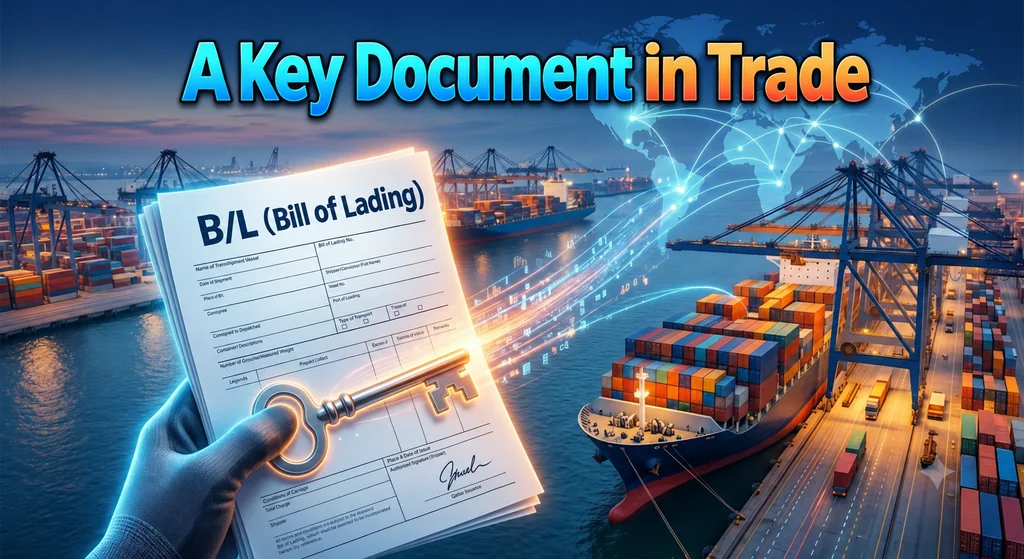
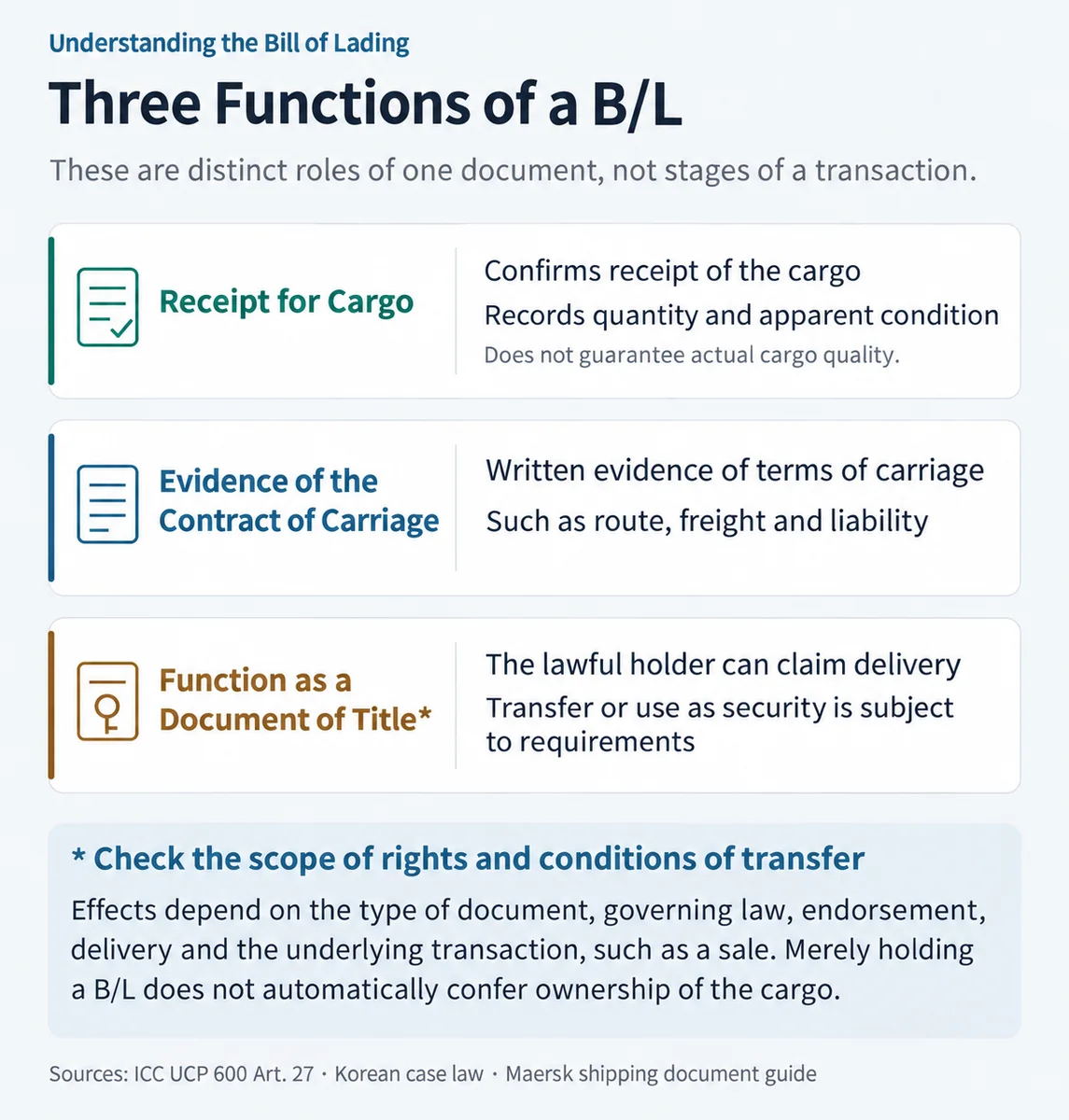
A B/L is a document in which a carrier (usually a shipping company) confirms that it has received cargo from the shipper (exporter) and promises to transport it to its destination and deliver it to the rightful owner (importer). This brief definition encompasses three decisive characteristics of a B/L. Understanding these characteristics is the first step toward understanding a B/L.
First, it functions as a receipt for goods (Receipt for Goods).
It is a receipt through which the carrier officially acknowledges, “I have received your cargo in good condition.” If the cargo was damaged before being loaded onto the ship, the carrier will record that fact on the B/L, and this will serve as important evidence for determining responsibility later.
Second, it is evidence of the contract of carriage (Evidence of Contract of Carriage).
The shipper and the carrier have a contract specifying where the cargo is to be transported from and to, and at what freight rate. The B/L is written evidence containing the specific terms of this contract, such as the transport route, freight terms, and limits of liability.
Third is its most important characteristic: its status as a document of title (Document of Title).
This is the most fundamental feature that distinguishes a B/L from other trade documents, such as a commercial invoice or packing list. Possessing a B/L is equivalent to owning the cargo listed on that B/L. Therefore, when this B/L is handed over to someone else through endorsement, ownership of the cargo is transferred along with it. Because of this characteristic, a B/L can circulate like cash and is used by banks as a means of securing payment.
The Movement of a B/L and Settlement of Trade Payments: A Focus on Letter of Credit Transactions

The importance of a B/L becomes clear when we examine the actual process of settling trade payments, particularly transactions involving a letter of credit (Letter of Credit, L/C). When the importer is uneasy about paying before receiving the goods and the exporter is uneasy about shipping the goods before receiving payment, a letter of credit transaction brings a bank in as an intermediary.
- Cargo shipment: The exporter loads the contracted cargo onto a ship and receives a B/L (original) from the shipping company.
- Negotiation (Nego): The exporter takes various shipping documents (Commercial Invoice, Packing List, etc.), including the issued B/L, to its bank (the negotiating bank) to request payment. This process is called “Nego.”
- Forwarding documents: After confirming that the documents comply with the terms of the letter of credit, the negotiating bank pays the exporter and sends these documents to the importer's bank (the issuing bank).
- Payment and handover of documents: The importer's bank receives the documents and pays the exporter's bank. It then notifies the importer, “The documents have arrived, so deposit the payment and collect the B/L.” Once the importer makes payment, the bank hands the B/L over to the importer.
- Taking delivery of the cargo: The importer takes the original B/L received from the bank to the shipping company (or its agent) at the port, exchanges it for a delivery order (D/O), and finally collects its cargo.
The key point in this process is that “the importer can obtain the B/L (ownership of the cargo) only after paying the bank.” The exporter can secure payment through the B/L, while the importer can safely secure the cargo through the B/L. This is why a B/L serves as more than a transport document: it acts as a mechanism that underpins trust in trade.
Types of B/L for Different Situations
The form of a B/L varies according to the terms of the trade transaction, the type of cargo, and the mode of transport. Although you do not need to know every type of B/L, you must be able to distinguish the key types commonly encountered in practice.
Clean B/L vs. Dirty (Foul) B/L
Clean B/L (clean bill of lading): This is a B/L indicating that, when loaded onto the ship, the cargo shows no apparent defects such as damaged packaging or a shortage in quantity. Letter of credit transactions require a Clean B/L almost without exception.
Dirty B/L (foul bill of lading): This is a document on which the shipping company has recorded details of cargo damage or a discrepancy in quantity on the B/L. For example, if it contains wording such as “Carton broken (damaged box),” it becomes a Dirty B/L, and the bank may refuse negotiation.
Shipped B/L vs. Received B/L
Shipped B/L (shipped bill of lading): This is a B/L proving that the cargo has actually been loaded onto the vessel (ship). In most trade transactions, a Shipped B/L is the standard, and the wording “Shipped on board (loaded onto the vessel)” and the date are recorded on the B/L.
Received B/L (received for shipment bill of lading): This is a B/L proving that the carrier has received the cargo at a wharf or warehouse for shipment. Since the cargo has not yet been loaded onto the ship, in letter of credit transactions it is often recognized as a valid document only if it includes an additional “On Board Notation (a notation confirming loading on board).”
Straight B/L vs. Order B/L
Straight B/L (straight bill of lading): This is a B/L that names a specific individual or company in the Consignee (recipient) field. In this case, only the named consignee can collect the cargo, and it is difficult to transfer the document to someone else. It is mainly used in remittance (T/T) transactions or transactions between a head office and its branches.
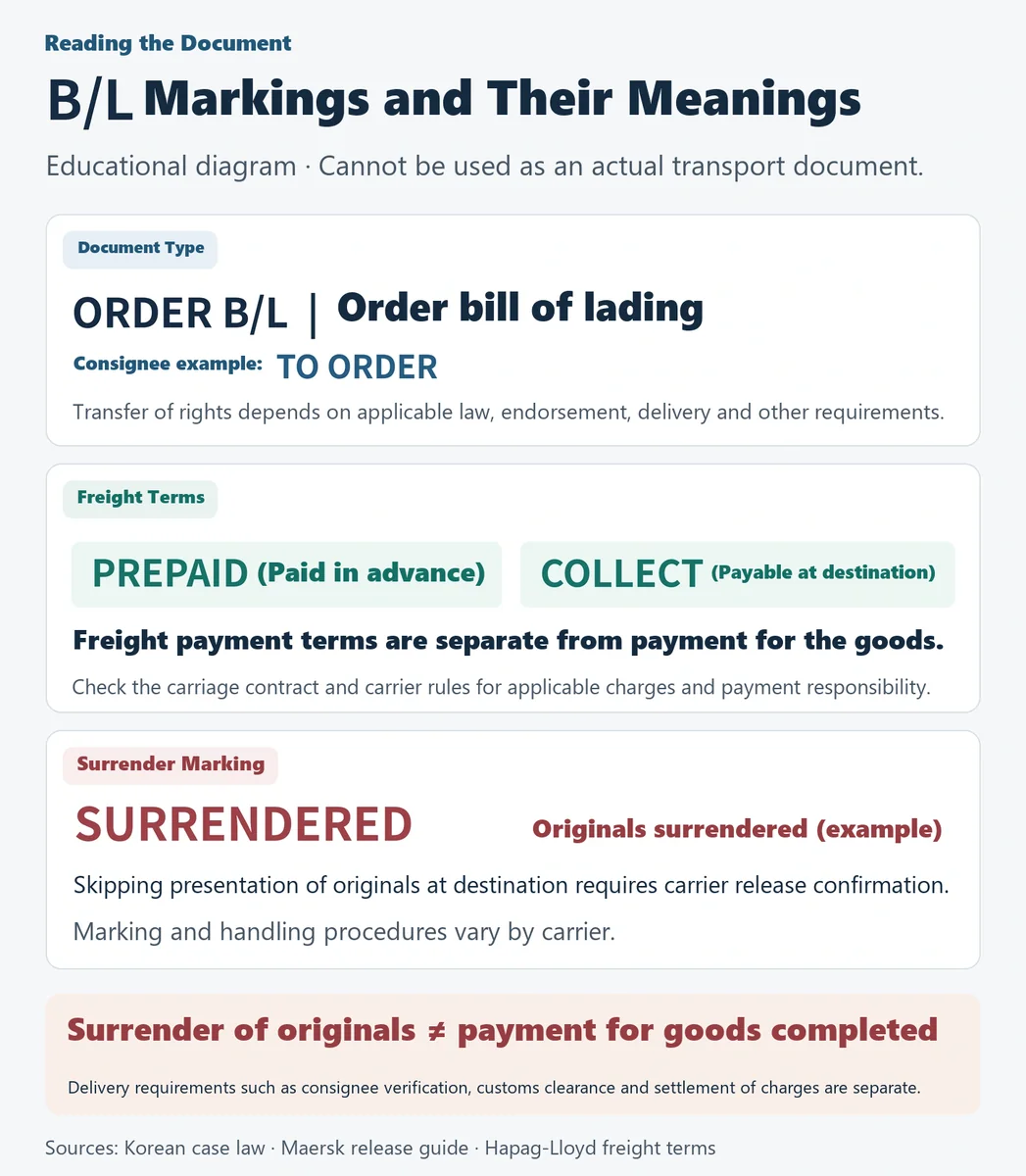
Order B/L (order bill of lading): This is a B/L with wording such as “To Order (to the order of the instructing party)” or “To Order of Applicant (to the order of the credit applicant)” in the consignee field, rather than the name of a specific person. This means that the holder of the B/L can transfer ownership to a 3rd party through endorsement (signing on the back). This is the method most commonly used by banks to secure a collateral interest in letter of credit transactions.
The Era of Paperless Trade: Surrendered B/L and Sea Waybill
Speed is vital in modern logistics. However, because traditional original B/L documents are sent by mail, the documents often arrive later than the ship. (This is especially common on short-distance routes such as Korea–China and Korea–Japan.) In such cases, even though the ship has arrived, the importer cannot collect the cargo without the original B/L and ends up paying storage charges. Two methods are used to resolve this problem.
The first is a Surrendered B/L.
After receiving the original B/L, the exporter returns it to the shipping company (Surrender) and asks, “Release the goods to the importer even without the original.” The shipping company stamps this B/L with “SURRENDERED” or “TELEX RELEASE” and sends a copy by fax or email. The importer can collect the cargo with just this copy and identification. This is fast, but the B/L loses its function as a document of title. Therefore, it should be used only when payment has already been settled or when there is firm trust between the exporter and importer.
The second is a Sea Waybill (sea freight waybill).
This involves issuing a Sea Waybill from the outset instead of a B/L. Unlike a B/L, a Sea Waybill is not a document of title. It is simply a receipt for goods and evidence of the contract of carriage. The importer can collect the cargo merely by proving that it is the consignee named on the Sea Waybill. Since there is no need for the B/L to circulate, this is very fast, but as with a Surrendered B/L, payment cannot be secured through a bank.
Understanding a B/L Is the Starting Point for Managing Trade Risk
A B/L is more than a sheet of paper containing details of cargo transport. It is ownership of the cargo itself, the key to settling payments, and the legal basis for determining responsibility for damage during transport. Clearly understanding the three functions of a B/L (receipt, evidence of a contract, and document of title) and choosing the type of B/L and issuance method appropriate to the transaction are the first steps toward minimizing trade risk.
Although methods that prioritize speed, such as Surrendered B/L and Sea Waybill, are becoming more common, an original B/L still holds an indispensable place in letter of credit transactions and the transportation of high-value cargo. Never forget that each seemingly complex clause and phrase in a B/L ultimately serves as the last line of defense protecting your cargo and money. We hope this article has helped you gain a clear understanding of the B/L, the most fundamental yet most important document in trade and logistics.