Baby diapers are a product that sells at an almost constant rate regardless of the weather or trends. Yet when the American consumer goods company P&G looked at the order records for its Pampers diapers, it found that while store sales were steady, the orders wholesalers placed with the factory were swinging wildly. This phenomenon, in which small fluctuations on the consumer side grow larger and larger as they travel up the supply chain, is known as the “bullwhip effect.”
Put simply, the bullwhip effect refers to “the phenomenon in which changes in end-consumer demand become increasingly amplified as they pass from retailers to wholesalers, manufacturers, and raw material suppliers.” It got its name because it resembles the way the tip of a whip snaps in a large arc even when the handle is flicked only slightly. The phenomenon became widely known after a research team led by Professor Hau L. Lee of Stanford University systematically laid out its causes in 1997.
This article walks step by step through the structure that gives rise to the bullwhip effect, its four main causes, an easy example from the Beer Game, and supply chain management methods that reduce the fluctuations.
The Structure of the Bullwhip Effect and Strategies to Counter It
Small Ripples That Grow Along the Supply Chain
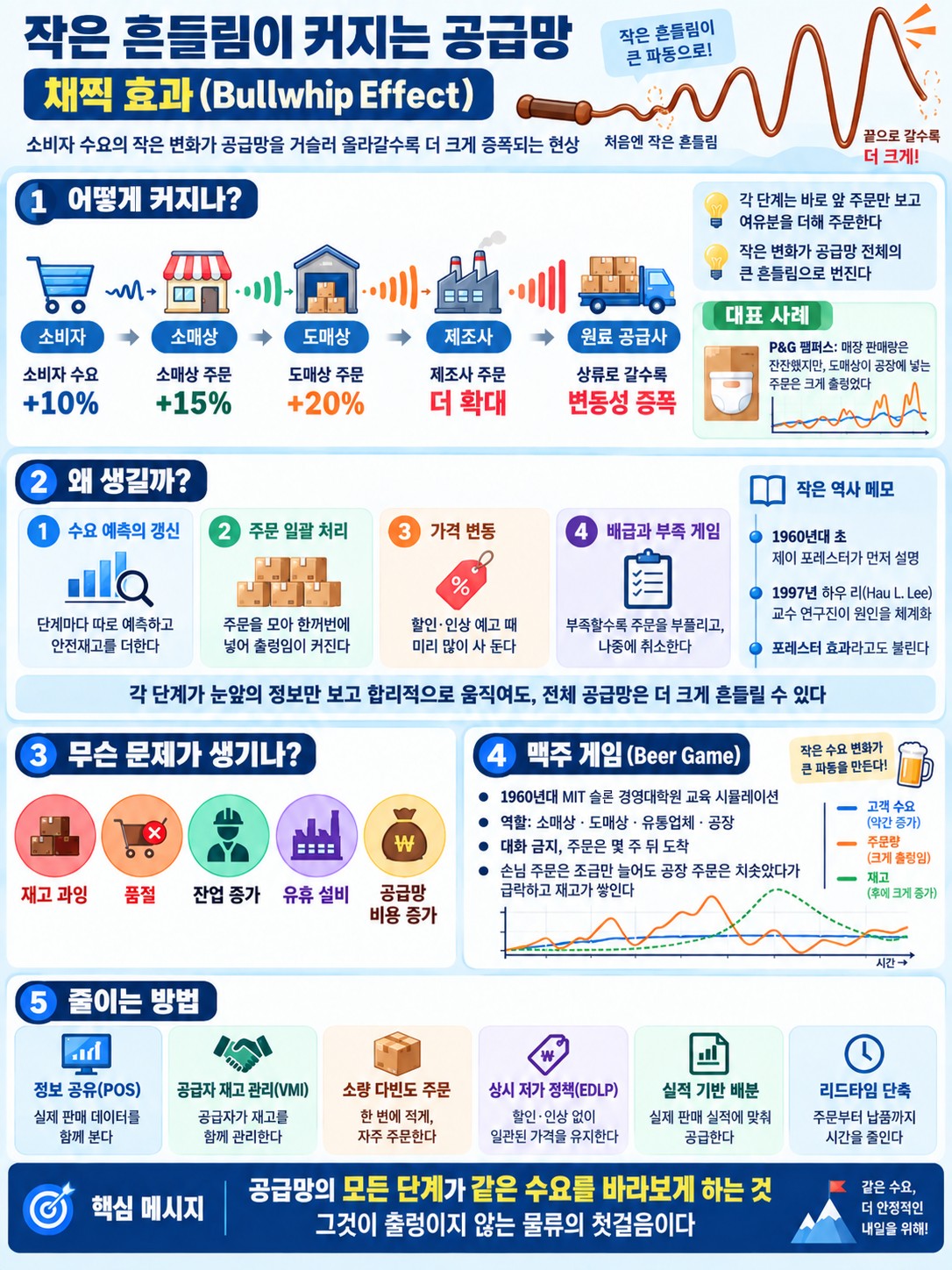

A supply chain is a chain of many stages linked one after another. Each stage looks only at the orders coming in from the stage just before it and places orders with the next stage. In effect, the retailer treats consumer purchases as demand, the wholesaler treats the retailer’s orders as demand, and the manufacturer treats the wholesaler’s orders as demand.
The problem is that each stage adds a little extra and that time lags arise. If consumer demand rises by 10%, the retailer orders 15% more to guard against possible stockouts, and the wholesaler, seeing that order, orders 20% more. Distortion builds up each time the signal is passed along, so the raw material supplier at the very end experiences a far larger change in demand than actually occurred. Because Jay Forrester, the founder of system dynamics, first described this amplification in the early 1960s, it is also called the “Forrester effect.”
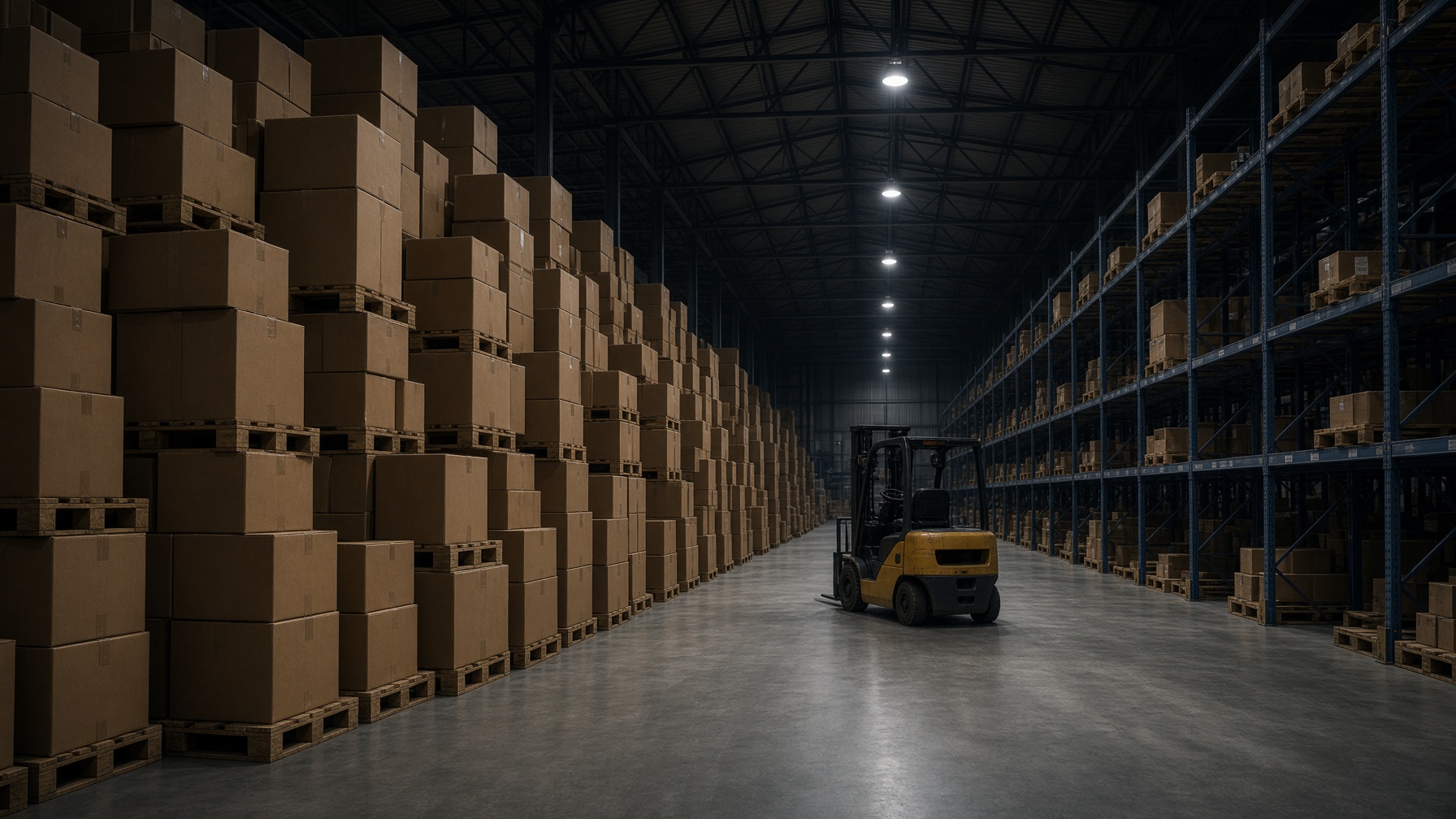
These inflated orders turn directly into costs. When demand rises, factories run overtime and rush to buy raw materials, but when orders fall again, leftover inventory in warehouses and idle equipment become a burden. Sometimes one stage is overflowing with inventory while another stage is running out of stock at the same time. In the end, what consumers buy stays the same, yet the cost of the entire supply chain grows.
Four Causes That Crack the Whip
Professor Hau Lee’s research team identified four causes of the bullwhip effect.
(1) Demand Signal Processing
Each stage forecasts demand separately based on the order quantities of the stage before it and adds safety stock when it orders. As forecasts pile up layer upon layer, small changes are inflated into what look like trends.
(2) Order Batching
When orders are collected and placed all at once to save on shipping and ordering costs, the supplier sees a quiet period and then suddenly receives a large order.
(3) Price Fluctuation
When there is a discount promotion or an announced price increase, buyers stock up in advance, buying more than they need. Actual consumption stays the same, but orders are pulled forward, so the swings grow larger.
(4) Rationing and Shortage Gaming
When goods are scarce and the supplier allocates them in proportion to order quantities, buyers place inflated orders to get at least a bit more. Once the shortage eases, these phantom orders are canceled all at once.
What the four causes have in common is that each stage acts rationally based only on the information right in front of it. Decisions that are correct for each individual add up to create a large fluctuation across the whole system.
An Easy Example: The Beer Game

There is a well-known educational simulation that lets people experience the bullwhip effect firsthand: the “Beer Game,” created in the 1960s at the MIT Sloan School of Management in the United States.
Rules of the Game
- Retailer: Receives beer orders from customers and places orders with the wholesaler.
- Wholesaler: Receives orders from the retailer and places orders with the distributor.
- Distributor: Receives orders from the wholesaler and places orders with the factory.
- Factory: Brews beer to fill the orders.
Participants cannot talk to one another, and the beer they order arrives only several weeks later. Leftover inventory costs money, and running short costs money too.
Results of the Game
Customer orders rise only slightly, once, partway through the game, yet in most teams the factory’s order quantities shoot up and then crash to the bottom. In the end, unsold beer piles up in the warehouses. The game shows that no one set out to make bad decisions; rather, the structure itself, in which information is passed along late and only partially, creates the chaos.
Supply Chain Management That Reduces the Swings

The bullwhip effect cannot be eliminated entirely, but it can be greatly reduced by tackling its causes one by one.
- Information Sharing: When the entire supply chain shares stores’ point-of-sale (POS) data, each stage can plan based on actual demand rather than inflated orders.
- Vendor-Managed Inventory (VMI): The supplier looks directly at the customer’s inventory and replenishes it on its own, eliminating one ordering step.
- Small Lot Ordering: Placing small orders frequently and consolidating shipments calms the big waves caused by batch ordering.
- Everyday Low Pricing (EDLP): Keeping prices consistently similar instead of offering frequent discounts reduces demand from stocking up in advance.
- Allocation Based on Past Sales: When supply is short, allocating goods according to past sales performance rather than order quantities reduces phantom orders.
Reducing lead time (the time from placing an order to its arrival) is also important. The shorter the wait, the shorter the period that must be forecast and the less safety stock needs to be held.
Getting every stage of the supply chain to look at the same demand is the first step toward logistics that do not swing wildly.