Every day, we consume goods that have traveled from all over the world. The coffee beans we brew in the morning, the smartphone in our hand, even the clothes we wear. How have all these goods been able to reach us on time and at relatively low prices? At the heart of the answer is the 'container (Container).'
Logistics in the past was like assembling an enormous puzzle. Workers loaded and unloaded boxes, sacks, and drums of various sizes onto and off ships one by one. It took a long time, and damage and theft were frequent. But in the 1950s, the arrival of the container, born from an idea by an American transport operator, Malcom McLean, transformed this entire landscape.
This standardized steel box became more than a vessel for holding goods: it became the most powerful 'blood vessel' connecting modern civilization.
The Magic of Standardization: The Global Language Created by 'TEU' and 'FEU'
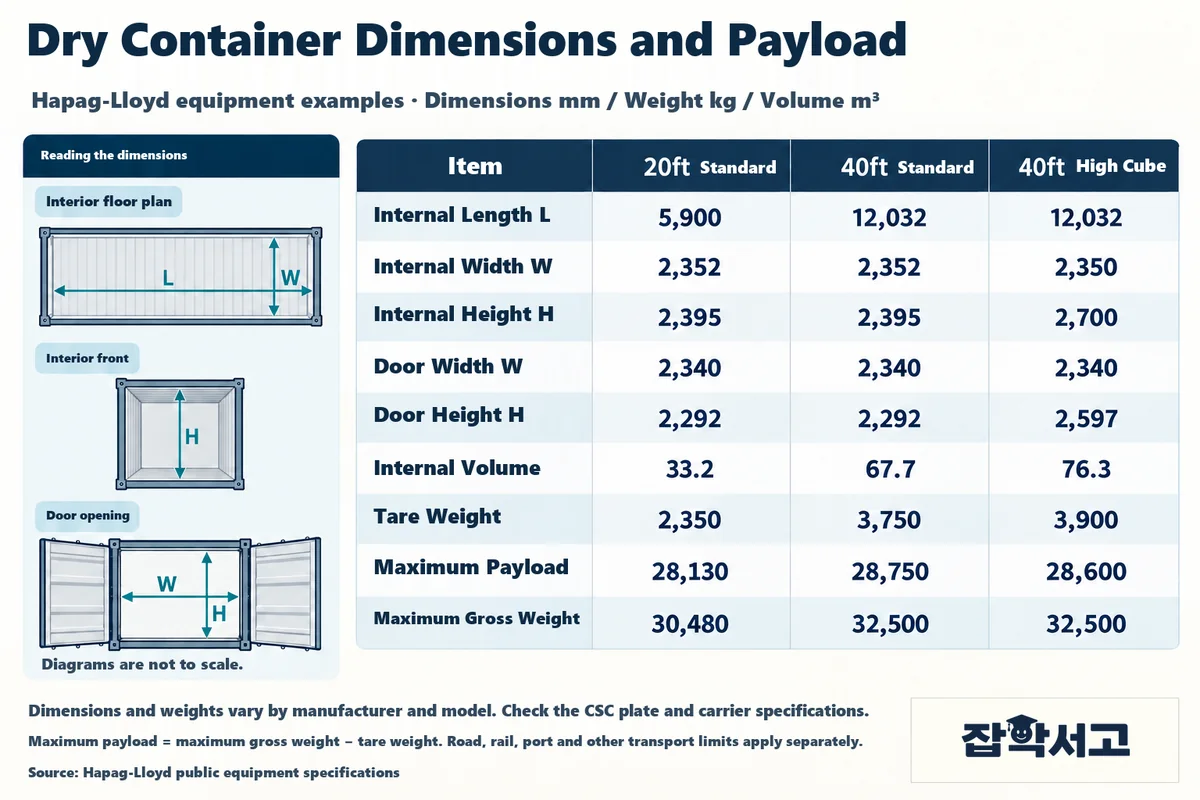
The container's greatest innovation lies in 'standardization (Standardization)' as defined by the International Organization for Standardization (ISO). Wherever you go in the world, container dimensions and the positions of their securing devices match exactly, giving rise to a 'global language' for logistics. The containers most widely used in logistics fall broadly into 20-foot, 40-foot, and high cube (High Cube) types.
20-Foot Dry Container (1 TEU)
The most commonly seen basic unit is called '1 TEU (Twenty-foot Equivalent Unit).'
External dimensions: Approximately 6.1 m (20 feet) long, 2.4 m (8 feet) wide, and 2.6 m (8 feet 6 inches) high
Internal volume and load capacity: Its internal volume is approximately 33 CBM (cubic meters), and it can carry a maximum cargo load of about 21–28 tonnes, excluding its own weight. It offers an overwhelming advantage when transporting heavy, compact cargo such as steel, minerals, grain, and drums of liquid.
40-Foot Dry Container (1 FEU)
Equivalent in size to two 20-foot containers combined, it is called '1 FEU (Forty-foot Equivalent Unit)' in logistics statistics.
External dimensions: Approximately 12.2 m (40 feet) long, 2.4 m (8 feet) wide, and 2.6 m (8 feet 6 inches) high
Internal volume and load capacity: Its internal volume is approximately 67 CBM, twice that of a 20-foot container. Interestingly, being twice the size does not mean it can carry twice the weight. Because of gross weight limits under road traffic laws, its actual cargo capacity is approximately 26–28 tonnes, similar to that of a 20-foot container. It is therefore optimized primarily for volumetric cargo (Volumetric Cargo), which is bulky but relatively light, such as furniture, home appliances, clothing, and shoes.
40-Foot High Cube Container (40ft High Cube)
This is the most preferred specification in recent global logistics trends. It has the same length as a standard 40-foot container, but its height is approximately 2.9 m (9 feet 6 inches), making it exactly 1 foot (about 30 cm) taller than the standard model.
Features and efficiency: Although the difference appears to be just 30 cm, its internal volume increases to approximately 76 CBM, allowing it to carry about 12–14% more cargo than a standard 40-foot container. This allows palletized cargo to be stacked an additional layer higher, or tall precision machinery to be loaded intact without disassembly, dramatically reducing transport costs.
The Key to Uninterrupted Logistics: 'Integrated Multimodal Transport' and Economies of Scale
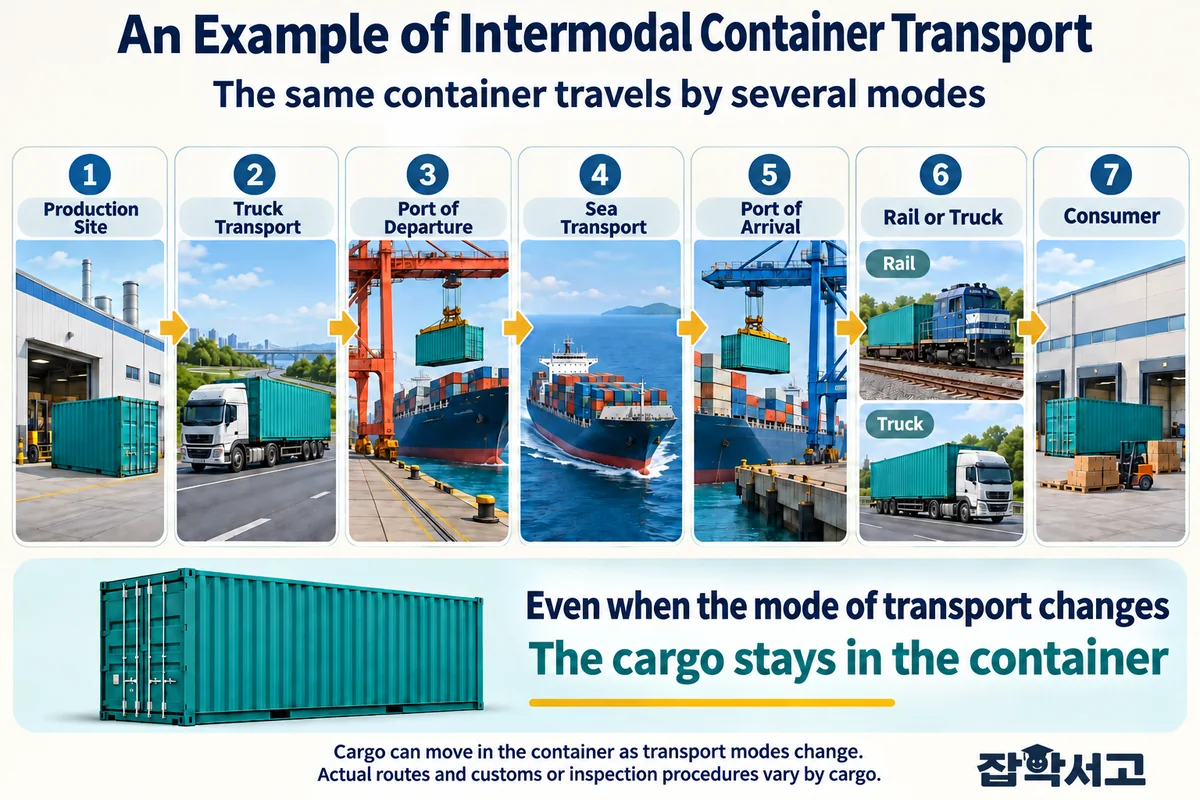
This thorough standardization brought about a seismic shift across the entire logistics system. Because the specifications are identical, cargo can travel uninterrupted to its final destination without needing to be unpacked or reclassified along the way.
Seamless Transfers: 'Integrated Multimodal Transport (Multimodal Transport)'
Goods loaded into containers at the Port of Busan are sealed at the exporting company's factory before traveling by ship to the Port of Los Angeles in the United States. There, the containers are unloaded and transferred directly by crane to inland rail transport (Double Stack Train, freight trains carrying containers stacked 2 tiers high) or large trucks, without any need to remove the goods inside. Reducing cargo rehandling and exposure when switching modes of transport reduces time lost and the risks of theft and damage.
Economies of Scale Beyond Imagination
Standardized containers are stowed securely along cell guides (Cell Guide) inside the ship, fitting together like a checkerboard without the slightest deviation. Recently built ultra-large container ships in the 24,000 TEU class cover an area equivalent to 4 soccer fields and stack containers to the height of a 20-story apartment building. In the past, when general cargo ships docked at ports and workers loaded cargo by hand, transport costs per tonne were astronomical, but containers handle tens of tonnes in just a few minutes, reducing logistics costs to no more than 1/10 of their previous level. This is what enables us to buy wine, fruit, and inexpensive manufactured goods from the other side of the planet at low prices in the convenience store near our home.
Transforming the Port Landscape: Vast Automated Systems

The arrival of containers completely transformed the appearance of ports as well. Docks once crowded with rugged workers have become quiet, tightly coordinated automated spaces dominated by computers and enormous artificial intelligence machines.
Quay Cranes (Gantry Crane / Ship-to-Shore Crane)
These enormous cranes extend toward the sea and are virtually symbols of the port. They lift containers from ships and lower them onto the dock, or perform the reverse operation to load them aboard. A special device called a spreader (Spreader) inserts locking pins into the holes at the container's four upper corners (Corner Casting), securing it firmly; it is powerful enough to lift 4 20-foot containers or 2 40-foot containers simultaneously. Operators control the latest cranes precisely from remote control rooms while watching monitors, much as they would play a game.
Yard Cranes and ASC (Automated Stacking Crane)
The large open area where containers unloaded from ships are temporarily stored is called a 'container yard (CY).' Here, automated yard cranes (ATC) moving along rails efficiently stack containers 5–6 tiers high in the optimal positions designated by a computer. An artificial intelligence system calculates departure times and maximizes stacking efficiency by, for example, placing the containers scheduled to leave first on top.
AGV (Automated Guided Vehicle) and Mobile Equipment
The wheeled transfer equipment that carries containers between quay cranes and the yard is also evolving. In the past, tractor drivers operated it themselves, but at the latest smart ports, AGVs travel autonomously by following magnets embedded in the ground or laser sensors, gliding like ghosts as they carry cargo.
Hidden Technology and the Future: Smart Boxes Equipped with the Internet of Things (IoT)
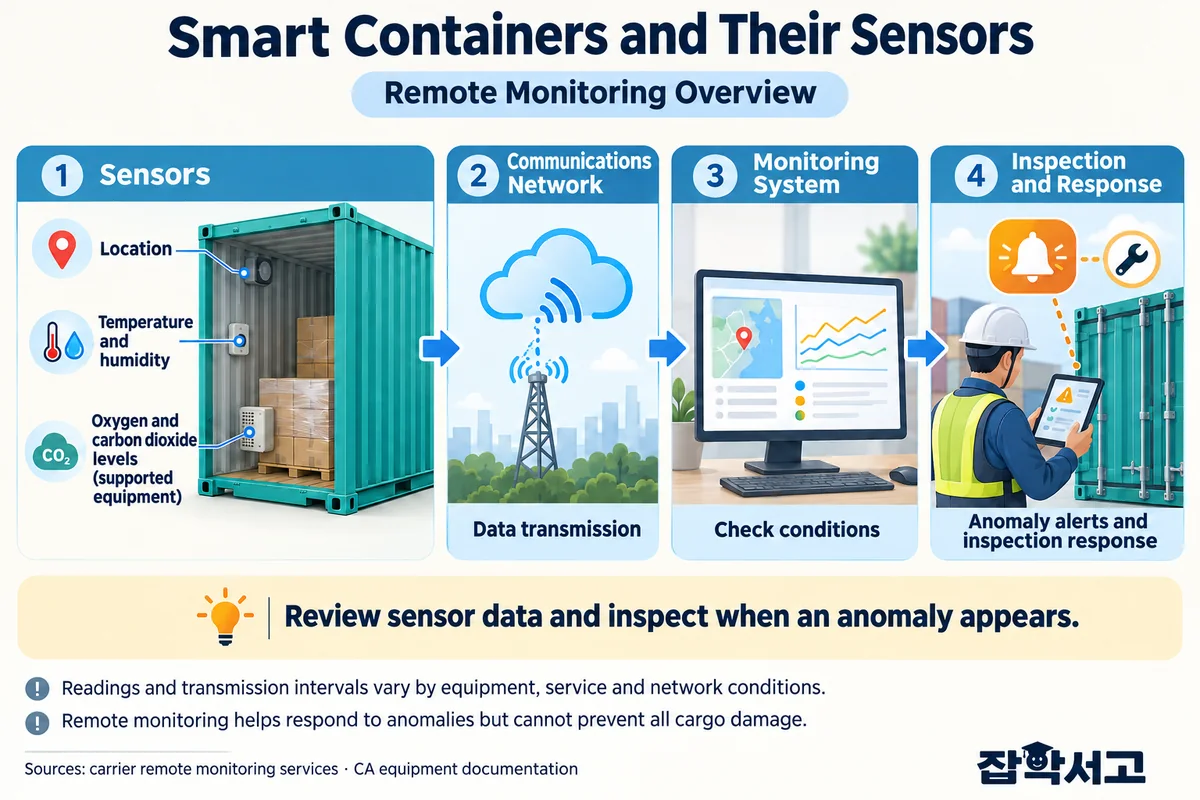
Although they look like simple steel boxes, today's containers are evolving into advanced devices that bring together refrigeration technology and information and communication technology.
Freezer/Refrigerated Containers (Reefer Container)
These are the secret to our ability to eat fresh Chilean grapes even in the depths of winter and safely import temperature-sensitive advanced semiconductor wafers and biopharmaceuticals. A precision electric refrigeration unit is attached to the container's outer wall, controlling the internal temperature in increments of 0.1 degrees across a range from an ultralow 35 degrees below zero to 30 degrees above zero. They are even equipped with CA (Controlled Atmosphere) technology, which adjusts nitrogen and carbon dioxide concentrations to suppress fruit respiration and prevent spoilage.
IoT-Based 'Smart Containers (Smart Container)'
In the past, once a container was loaded onto a ship and taken out to the middle of the ocean, there was no way to know its internal condition until it reached its destination. Recently, however, Internet of Things (IoT) sensors have become standard equipment, transmitting not only internal temperature, humidity, and oxygen concentration but also the magnitude of impacts experienced during transport (G-Force) and location (GPS) in real time through satellite communication. If the refrigeration unit fails during sea transport and the temperature rises, an onshore control center can detect it immediately and remotely instruct the ship's engineer to carry out repairs, helping reduce the risk of cargo damage through early detection of abnormalities, inspection, and response.
The Greatest Shared Commitment Binding the World Together
The container is more than a simple steel box. It is the most successful agreement on 'specifications and dimensions' reached by humanity around the world, and the largest physical network in human history operating on that agreement. Without the worldwide commitment to the standards of 20 feet and 40 feet, today's global division of labor and mass consumption structure, in which components are made in Asia, assembly takes place in Europe, and consumption occurs in the United States, could never have emerged.
Even at this very moment, tens of millions of standard containers are crossing oceans and continents, acting as cells that keep the global economy circulating. Concealing the science of precise dimensions and advanced IT technology within their rugged exteriors, containers fill the capillaries of civilization and will continue to evolve as the most powerful foundation supporting humanity's prosperous life.