Look at the drinks fridge in your neighborhood convenience store, and you’ll often find that the best-selling drinks are reliably restocked just as they’re about to run out, even though the owner never placed a separate order. Something similar happens on the snack shelves of big supermarkets and in parts warehouses next to factories. Before the side buying the goods writes a purchase order, the side supplying them checks the stock first and refills it on its own. In logistics, this approach of leaving restocking decisions to the supplier is called ‘vendor-managed inventory,’ or VMI for short.
Put simply, vendor-managed inventory means ‘an inventory operation in which the supplier looks at the buyer’s sales and stock information together with the buyer, and decides and takes responsibility for when and how much to replenish.’ The key is to move first by looking at the data instead of waiting for an order.
In this piece, we’ll look in turn at the background from which vendor-managed inventory emerged, how it actually works, the benefits buyers and suppliers gain, and what to be careful about when adopting it.
Inventory Filled by Data Instead of Purchase Orders
How did vendor-managed inventory begin?

Vendor-managed inventory became widely known through the 1980s partnership between the American consumer goods company Procter & Gamble and the retailer Walmart.
(1) Sending diapers without an order
Around 1980, Procter & Gamble teamed up with a grocery chain in St. Louis, Missouri, to test Continuous Replenishment, sending diapers to the warehouse on its own even when the store side hadn’t ordered them. This approach was applied to Walmart as well in 1988.
(2) From rivals to partners
From around 1985, the two companies set aside a relationship in which they haggled over prices and held out against each other, and began sharing sales and inventory information through Electronic Data Interchange. As a result, on-time deliveries are said to have increased greatly and inventory turned over faster. Many other food and consumer goods companies, as well as European manufacturers, later followed this approach.
How does vendor-managed inventory work?

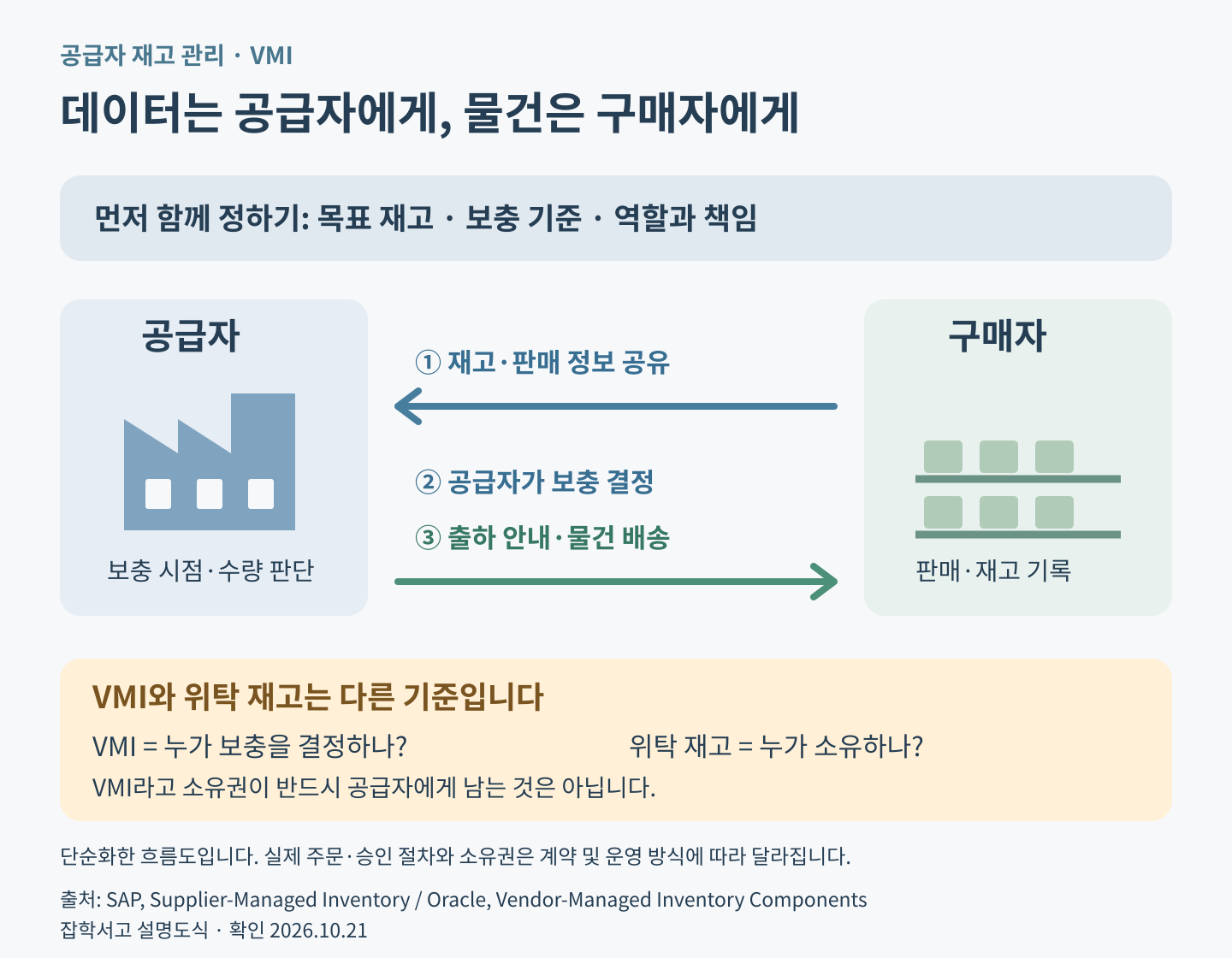
Vendor-managed inventory starts with sharing information and leads to a flow in which the supplier decides on replenishment.
- Information Sharing: The buyer regularly sends the supplier the stock levels at its stores or warehouses and point-of-sale (Point of Sale) data.
- Replenishment Decision: Based on this information, the supplier decides when, how much, and how to ship.
- Advance Shipping Notice: When the supplier ships goods, it notifies the buyer in advance of what is on its way.
- Service Level Target: The two companies agree in advance on targets such as how much stock to keep at minimum and how far to cut stockouts, and the supplier meets those standards.
In practice, a common method is to set a minimum and maximum stock level for each item, and when stock falls close to the minimum line, the supplier fills it back up to the maximum line. It is especially effective for items that are used often but are a hassle to order one by one, such as consumable parts like screws and bolts in a factory storeroom or medical supplies on hospital shelves.
Consignment inventory (Consignment Inventory), which looks similar, is an approach in which the supplier keeps ownership of the goods until they are sold. Vendor-managed inventory differs in that it hands over the decision-making power over replenishment, and does not necessarily hand over ownership as well.
Benefits for buyers and suppliers

The point of vendor-managed inventory is not that only one side benefits, but that it reduces the effort on both sides.
[Benefit 1] Buyers cut stockouts and workload
Buyers are freed from writing and checking purchase orders, and can also reduce stockouts of fast-selling items. Because the supplier knows the products better, there is also less piling up of more stock than needed.
[Benefit 2] Suppliers see demand first
Instead of waiting for large orders to pour in suddenly, suppliers can plan production and delivery while watching the actual flow of sales. Thanks to this, they can soften the bullwhip effect (Bullwhip Effect), in which swings in orders get magnified the further up the supply chain you go, and save on transport costs by, for example, sending fully loaded trucks.
What to watch out for when adopting it

As convenient as vendor-managed inventory is, it can instead sow the seeds of conflict if trust and commitments waver.
(1) Trust and the quality of information
If the sales and inventory information the buyer sends is late or wrong, the supplier’s judgment goes wrong too. Suppliers may also want to push in more of their own goods, so it is important to set targets and responsibilities clearly in the contract. On the buyer’s side, after handing over inventory decisions it may come to lean too heavily on the supplier, so regular sessions to review performance together are needed.
(2) Toward planning together
To make up for these limits, the mid-1990s saw the arrival of Collaborative Planning, Forecasting and Replenishment, in which suppliers and buyers jointly draw up even sales plans and demand forecasts. Starting from a 1995 initiative centered on Walmart, it was codified as industry guidelines in 1998.
Vendor-managed inventory is an approach that asks not so much who holds the inventory as who can best judge it. When data and trust take the place where purchase orders used to go back and forth, shelves are filled more steadily with less effort.
Sharing the numbers in your warehouse honestly with your trading partners is the first step toward a supply chain that cuts stockouts together.