If the price of rice rises sharply, will people buy less rice? Most goods sell less when their price goes up, but in very poor households people may actually end up buying more rice. This strange kind of good that sells more as its price rises is the “Giffen good.”
Put simply, a Giffen good is “a good whose quantity demanded increases when its price rises and decreases when its price falls.” Because it goes against the Law of Demand, which says people buy less when prices rise and more when prices fall, economists also call it the “Giffen Paradox.”
In this article, we will look in turn at the background of how the name Giffen good came about, the mechanism behind it, and real examples and debates.
The Secret of a Good That Defies the Law of Demand
Where Does the Name Giffen Good Come From?

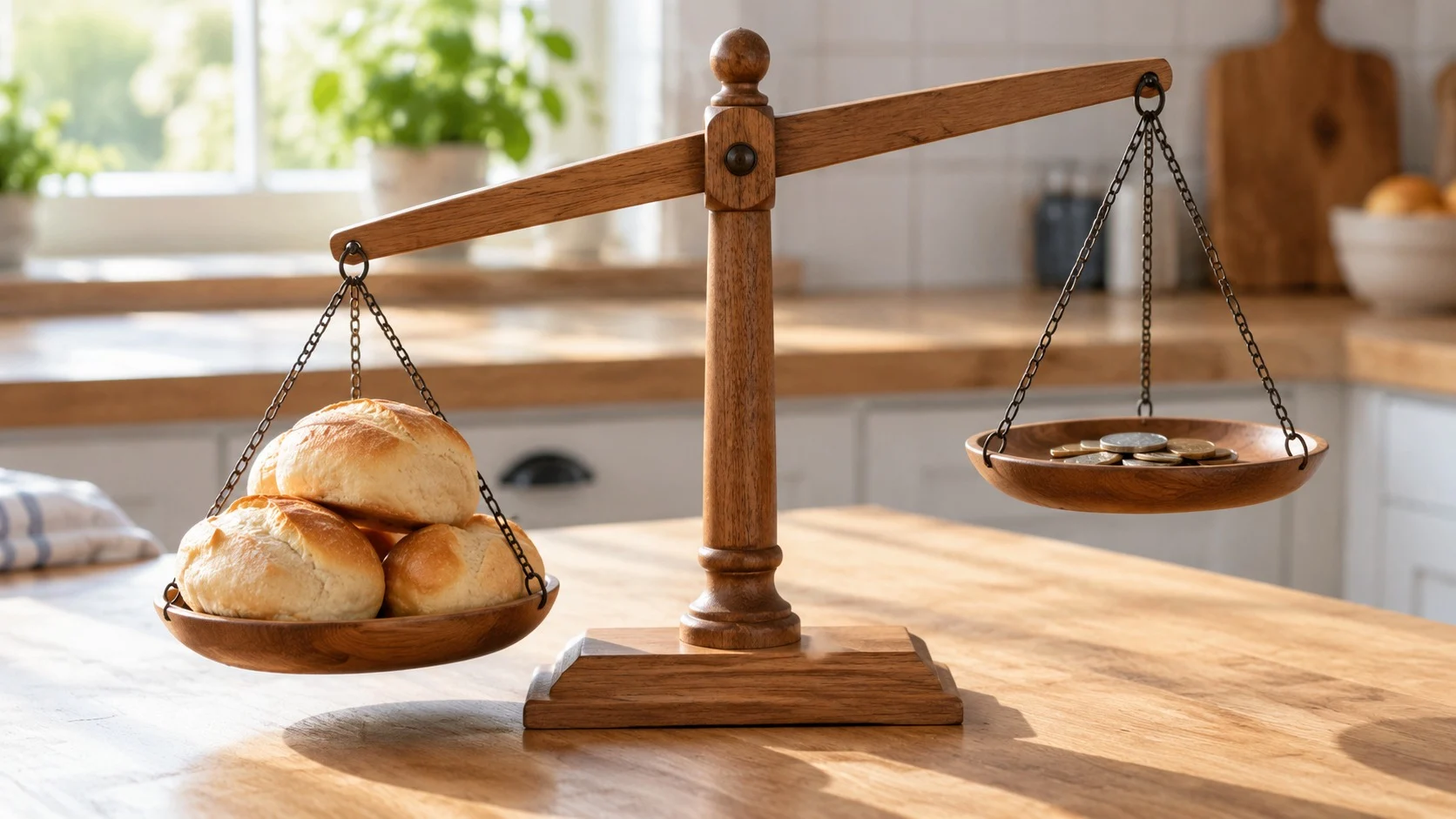
The name Giffen good comes from Robert Giffen, a Scottish-born British economist and statistician. While studying the household budgets of 19th-century British working families, he is said to have noticed that when the price of bread rose, poor households actually bought more bread.
The person who made this idea widely known was the British economist Alfred Marshall. In the 1895 edition of his “Principles of Economics,” Marshall explained that, “as Mr. Giffen has pointed out,” when the price of bread rises, poor laborers’ families have no choice but to cut back on expensive foods such as meat, and since bread is still the cheapest food, they end up eating more bread. However, in 1947 the American economist George Stigler pointed out that it is hard to find such a claim in Giffen’s own writings, and there is also research showing that Simon Gray had already described a similar phenomenon earlier, in 1815.
How People End Up Buying More Even When the Price Rises
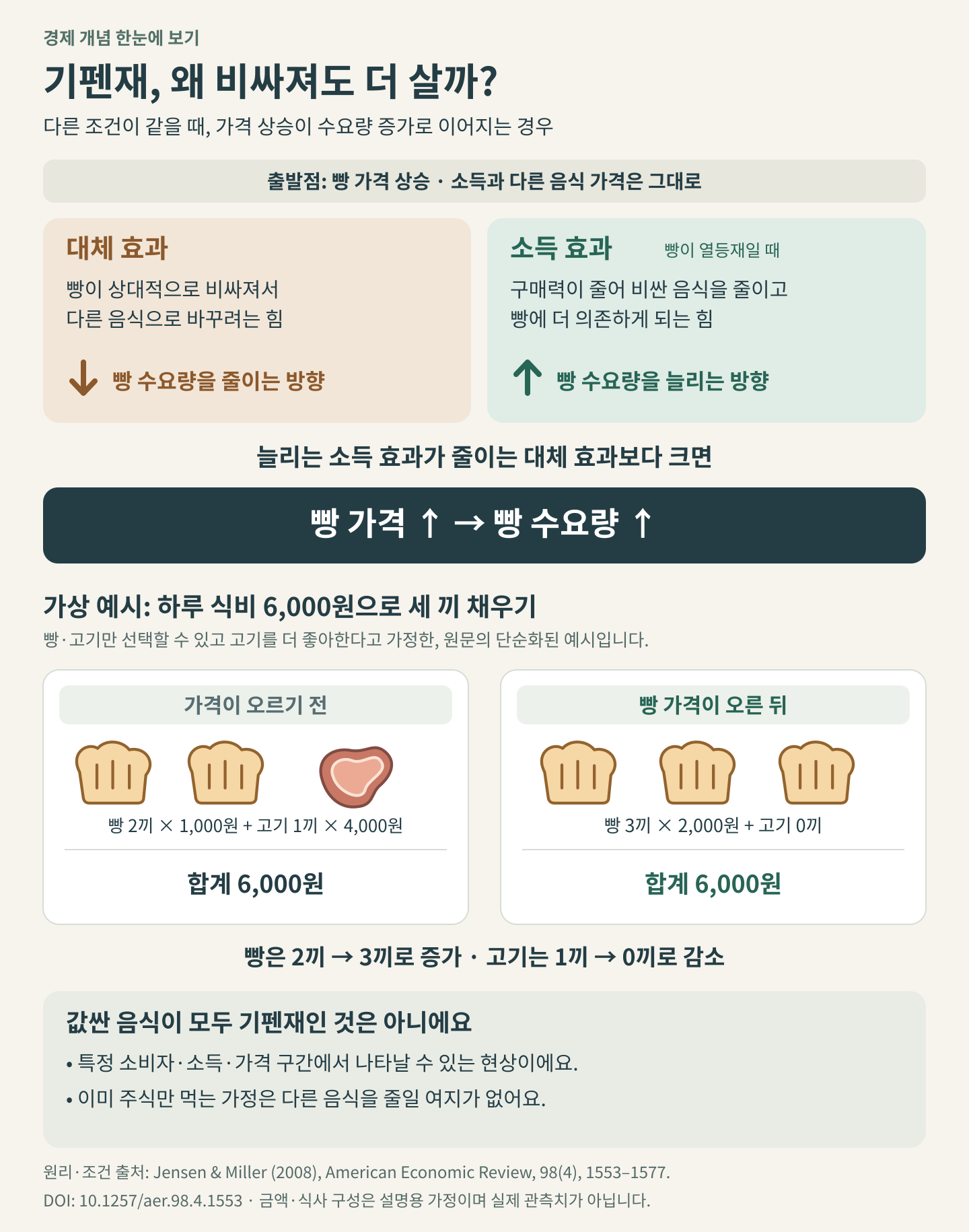
When a price rises, a consumer’s choice is affected by two forces. A Giffen good arises when these two forces move in opposite directions.
(1) Substitution Effect
When something becomes relatively more expensive, people try to switch to something else. This force always makes people buy less of the good that has become more expensive.
(2) Income Effect
When a price rises, the same money buys less, so in effect it is the same as becoming poorer. Cheap goods that people buy more of when their income falls are called Inferior Goods, and for an inferior good the income effect actually makes people buy more of it.
(3) When the Income Effect Wins
If the income effect of an inferior good is strong enough to outweigh the substitution effect, the quantity bought increases even though the price has risen. That is why every Giffen good is an inferior good, but not every inferior good is a Giffen good.
For this to happen, three conditions usually have to be met at the same time.
- Inferior Good: It must be a cheap good that people seek out more as their income falls.
- Lack of Substitutes: There must be no suitable similar good to choose instead.
- Large Budget Share: The good must take up a large share of the household budget, yet there must still be some room left to buy a little of other foods.
Understanding Giffen Goods Through Bread and Rice
Imagine a person who has 6,000 won a day for food and must eat three meals a day. A bread meal costs 1,000 won, and a meat meal, which they prefer, costs 4,000 won. This person spends exactly 6,000 won on two bread meals and one meat meal. But if the price of bread rises to 2,000 won, the money for meat disappears, and to fill three meals they have to buy bread three times. The price of bread went up, yet the amount of bread bought increased from two meals to three.
The Rice Experiment in Hunan, China
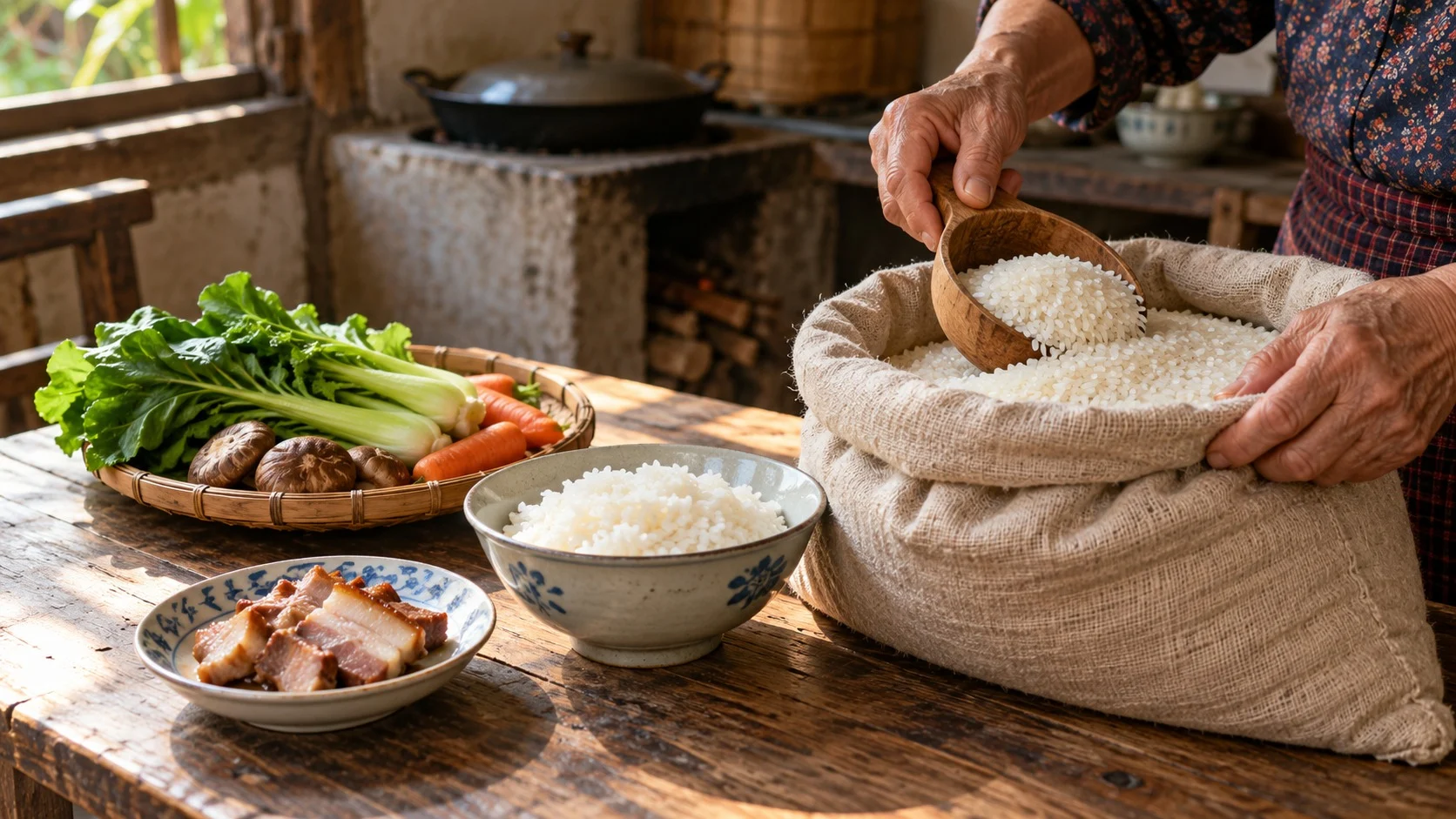
The evidence most often cited is a study published in 2008 by American economists Robert Jensen and Nolan Miller. They selected very poor households in China’s Hunan and Gansu provinces and handed out vouchers that let them buy their staple foods, rice and wheat flour, more cheaply. Households in Hunan then bought less rice even though rice had become cheaper, and bought and ate more of pricier foods such as meat. Seen the other way around, this reveals the Giffen-good pattern of buying more rice when its price rises. For wheat flour in Gansu, the evidence was weaker.
Debates and Limits Surrounding Giffen Goods

Giffen goods always appear in textbooks, but they are very hard to find in reality.
(1) Were Irish Potatoes Really a Giffen Good?
For a long time, potatoes during the Irish Great Famine of the 1840s were cited as the classic example. However, in 1984 American economists Gerald Dwyer and Cotton Lindsay countered that this did not match the historical records, and in 1999 Sherwin Rosen also argued that it could be explained by an ordinary demand model.
(2) Different from Veblen Goods
Luxury goods that people want more because they are expensive are Veblen Goods, which sell more because the price itself signals status. Giffen goods differ in that people’s view of the good stays the same, but they are forced to buy more because their budget is tight.
(3) Hard to See in the Market as a Whole
Giffen goods tend to appear only in the poorest households, so they are easily buried in market-wide data that combines many income groups. That is why the term “Giffen Behavior” is sometimes used, emphasizing people’s circumstances rather than the good itself.
Giffen goods show that the common-sense rule that people buy less when prices rise does not always hold. And because these exceptions mostly arise in the tightest household budgets, they also reveal how heavy a burden staple food prices are for poor families.
Taking into account the circumstances of the people hidden behind a demand curve drawn in numbers is the first step toward truly understanding the economy.