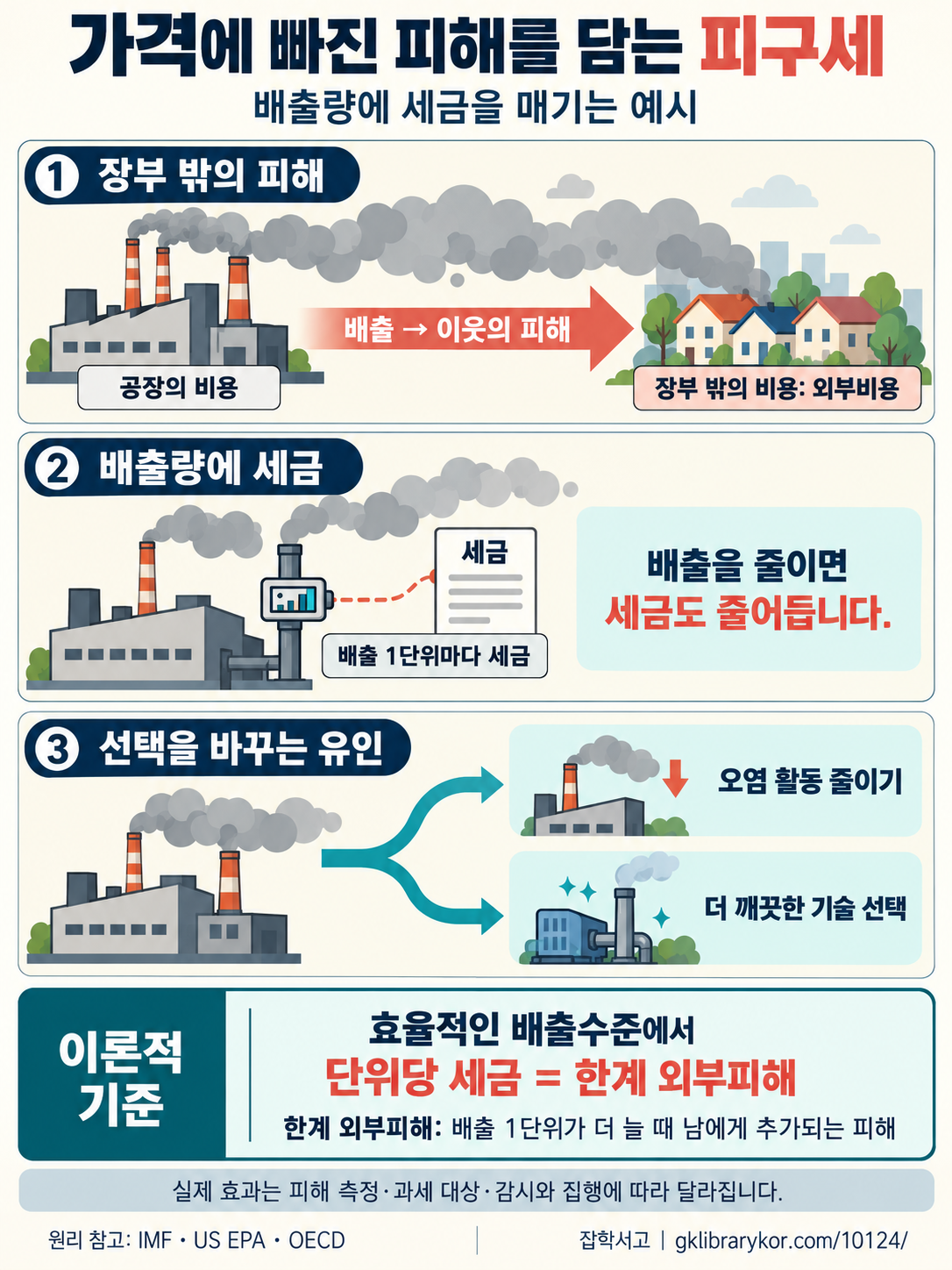
The smoke coming out of a factory chimney is not written down as any cost in the factory owner's books. Yet the neighbors who breathe that smoke pay hospital bills, wash their laundry again, and lose their clear skies. The person who made the goods and the people who pay the cost are not the same. The idea of correcting this harm, which is not captured in prices, through a tax is the “Pigouvian tax.”
Simply put, a Pigouvian tax is “a tax levied on an activity that harms others, equal to the amount of that harm, so that market prices reflect the actual social cost.” It is named after the ideas that British economist Arthur Cecil Pigou set out in his 1920 book The Economics of Welfare.
In this article, we will look in turn at the concept of externalities on which the Pigouvian tax is based, the principle by which the tax corrects the market, representative examples in use today, and finally the difficulties this tax faces and alternative solutions.
Putting a Price on the Harm: How the Pigouvian Tax Works and How It Is Used
The Starting Point of the Pigouvian Tax: Externalities

To understand the Pigouvian tax, you first need to know about costs and benefits that leak outside the market, namely externalities.
(1) People outside the deal pay the cost
When a transaction harms a third party who has nothing to do with it, without any compensation, this is called a negative externality. Factory pollution, cigarette smoke, and roads packed with cars are typical examples.
(2) When prices are too low, too much gets made
Producers count only the costs they pay directly, so goods are priced lower than the cost borne by society as a whole. As a result, more is produced and consumed than is desirable for society. Economics treats this as a market failure, in which the market cannot reach an efficient outcome on its own.
(3) The harm to neighbors that Pigou saw
Pigou gave the example that when a factory is built in the middle of a crowded neighborhood, the neighbors end up bearing traffic congestion, lost sunlight, and worsening health. Such harm is not written in anyone's books, but it is a cost that clearly exists.
How the Tax Corrects the Market

Pigou's solution is simple: put the costs missing from the books back into the books in the form of a tax.
(1) Tax in proportion to the harm
An ideal Pigouvian tax is set equal to the harm added to third parties when the activity increases by one unit, that is, the marginal external cost. Then the cost the producer feels becomes equal to the cost society actually bears.
(2) What you tax matters
If you tax the volume of production, the factory moves toward producing less. If you tax the emissions themselves instead, the factory gains a reason to switch to cleaner processes or technologies without necessarily cutting production. That is why taxing the target closest to the harm is considered effective.
(3) The opposite prescription: the Pigouvian subsidy
There are also positive externalities, where an activity benefits others without being paid for it. In that case too little gets made, so a subsidy is given instead to encourage more of it. Flu vaccinations and support for research and development are examples.
Pigouvian Taxes in Everyday Life

Even when they do not carry Pigou's name, many taxes and charges today stand on the same idea.
- Carbon Tax: Taxing the carbon emitted by fossil fuels puts the cost of climate change into fuel prices. Many European countries, including Sweden, Finland, and Denmark, have one in place.
- Congestion Charge: Since 2003, London in the UK has charged vehicles entering its central zone to reduce traffic and air pollution, spending the money on public transport. It was modeled on Singapore's electronic road pricing system.
- Tobacco and Alcohol Tax: These add to prices the medical and social costs that smoking and drinking increase. Pigou himself explained taxes on alcohol by pointing out that drink increases the costs of crime and policing.
- Sugar Tax: An attempt to reduce obesity and the resulting public healthcare costs by taxing drinks with a lot of added sugar.
Difficulties of the Pigouvian Tax and Alternative Solutions

The idea is neat, but setting a Pigouvian tax correctly in practice is not easy.
(1) Harm is hard to measure precisely
For a Pigouvian tax to work, the government must know the size of the harm precisely. But converting the harm pollution does to health and the climate into money is always controversial. If the tax is too low it has no effect, and if it is too high it cuts back even necessary activities.
(2) The limits of indirect taxation
When emissions are hard to measure directly, a related product such as gasoline is sometimes taxed instead. But actual emissions vary with the condition of the car and driving habits, so some people end up paying more tax than the harm they cause.
(3) Coase's rebuttal: bargaining can also solve it
In a 1960 paper, economist Ronald Coase argued that if property rights are clear and bargaining costs are low enough, the parties can negotiate their way to an efficient outcome without the government imposing a tax. Coase himself, however, acknowledged that real-world bargaining costs are rarely that low.
The Double Dividend Hypothesis
Some argue that if the money raised by environmental taxes is used to cut other taxes that distort the economy, such as income tax, two benefits can be gained together: a better environment and a more efficient tax system. This is called the double dividend hypothesis, and economists still disagree on how large the second benefit actually is.
The Pigouvian tax is an attempt to write the costs the market missed back into prices. Deciding whom to charge and how much is difficult, but because it reveals hidden harm as a price, it still underpins many policies today. Counting up what costs our choices leave for other people is the first step toward a fairer market.