When your paycheck goes up, your shopping basket gets a little fuller too. But open up the household ledger and you notice something odd. The money spent on food has gone up, yet the share of total spending that goes to food has actually gone down. The rule that first put numbers to this hidden relationship between income and food spending is ‘Engel's Law.’
Put simply, Engel's law means the empirical rule that ‘as income rises, the share of total spending that goes to food gradually falls.’ The German statistician Ernst Engel published it in 1857, and it is still used today as a basic yardstick for gauging the living standards of a country or a household.
In this piece, we will look in turn at the basic concept of Engel's law, the Engel coefficient and the Engel curve, cases in real numbers, and how the law is used along with its limits.
Reading Living Standards from the Food Share
What Is Engel's Law?

Engel was born in Dresden in 1821 and in 1850 became head of the statistical bureau of the Kingdom of Saxony. In an 1857 paper on production and consumption in Saxony, he analyzed the budgets of working-class households and showed that the poorer a family was, the larger the share of its total spending that went to food.
(1) It is the share that shrinks, not the amount
Engel's law does not mean that rich people eat less. As income rises, people buy better ingredients and eat out more, so the amount spent on food itself grows. It simply cannot keep pace with the rise in income, so its share of the total becomes smaller.
(2) Food is a necessity
There is a limit to how much a person can eat. So even if income doubles, food spending does not double. In economics, goods like this are called ‘necessities.’
(3) It serves as a yardstick of living standards
Engel held that, other things being equal, the share of spending that goes to food is the best measure of a society's material standard of living. The more money left over after paying to put food on the table, the more breathing room there is in life.
The Engel Coefficient and the Engel Curve
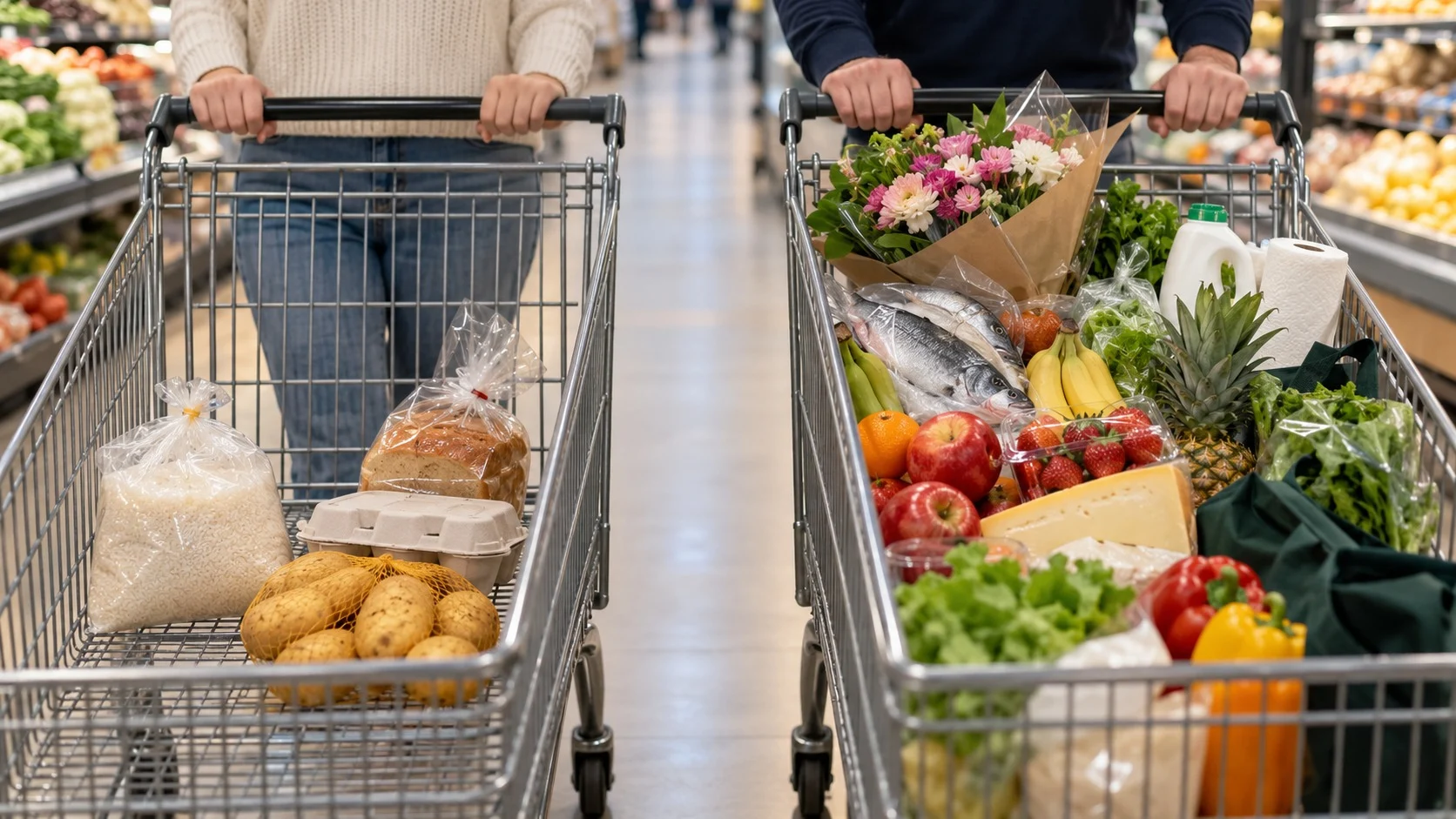
Engel's law has been organized into several tools that are still used in economic analysis today.
- Engel Coefficient: The share of a household's total consumption spending that goes to food. If a household spends 2 million won a month and 500,000 won of that goes to food, its Engel coefficient is 25%.
- Engel Curve: A curve drawn with income on the horizontal axis and spending on a particular good on the vertical axis. The curve for food rises toward the upper right, but its slope grows gentler as it goes.
- Income Elasticity of Demand: A value showing by what percentage demand rises when income rises by 1%. For food it is greater than 0 but less than 1, so it rises more slowly than income.
The Engel coefficient is also often presented as a standard for classifying living standards. According to a widely cited classification, above 59% is poverty, 50–59% is bare subsistence, 40–50% is a moderately comfortable level, 30–40% is an affluent level, and below 30% is a wealthy level.
Engel's Law in Numbers

Engel's observation still shows up clearly in today's statistics, more than 160 years later.
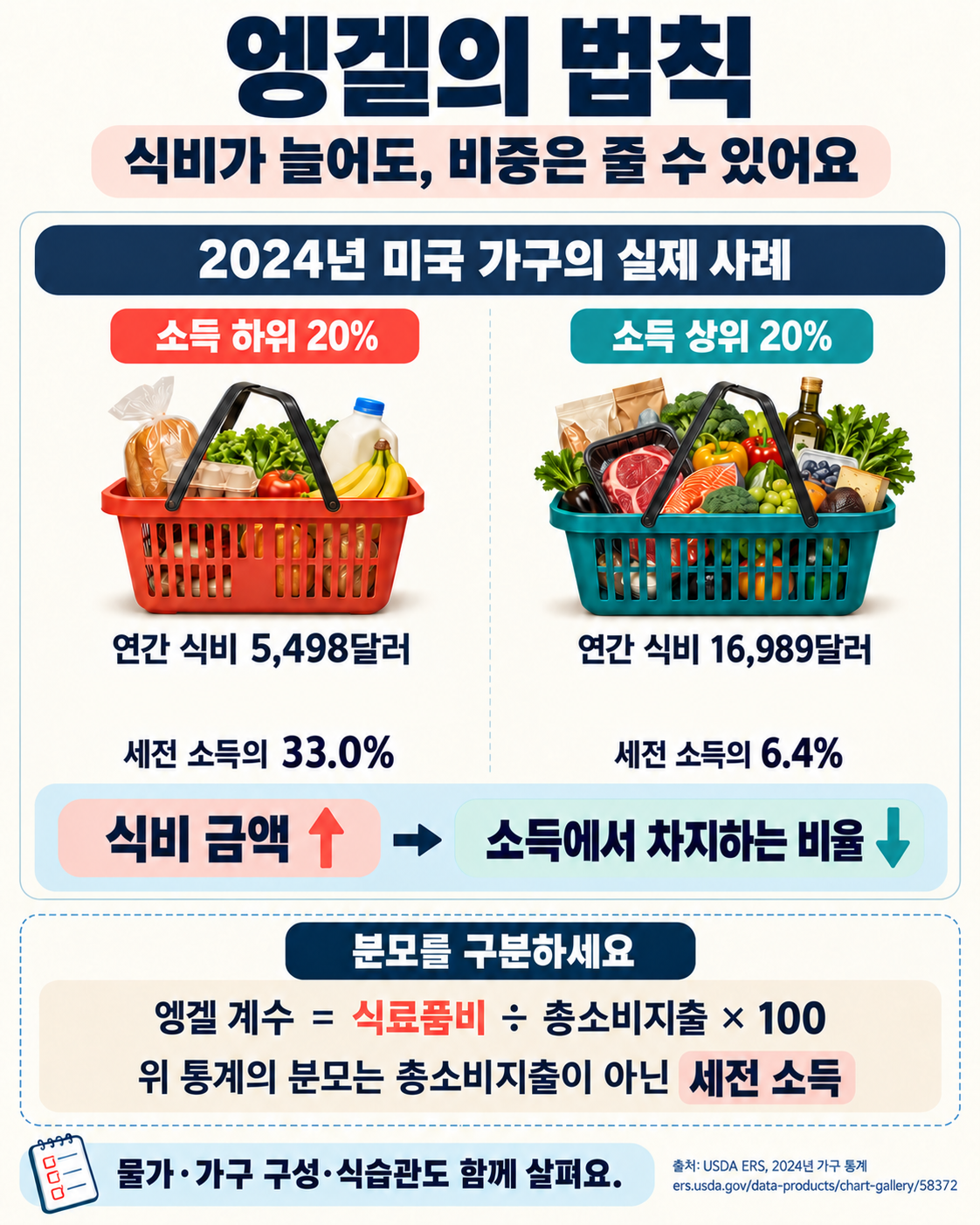
[Case 1] Food Spending by Income in U.S. Households
According to the U.S. Department of Agriculture's (USDA) Economic Research Service, in 2024 households in the lowest 20% by income spent an average of $5,498 on food, which made up 33.0% of their before-tax income. Households in the top 20% spent more than three times as much, $16,989, but that came to only 6.4% of their income.
[Case 2] Differences Between Countries
In the same data, high-income countries such as the United States and the United Kingdom spend less than 10% of household expenditure on food eaten at home. By contrast, in low-income countries such as Nigeria, this share climbs to nearly 60%.
[Case 3] Schwabe's Law, Which Also Holds for Rent
In 1868, Hermann Schwabe, head of the Berlin city statistical office, studied the relationship between rent and income and showed that the poorer a household was, the larger the share of its income that went to rent. This observation, which applies Engel's law to housing costs, is known as ‘Schwabe's Law.’
The Uses and Limits of Engel's Law

Simple as it is, Engel's law has a wide range of uses in policy and economic analysis.
(1) It is used to set poverty lines
Many countries have set poverty lines by dividing the cost of a nutritionally adequate diet by the food share. Knowing the cost of food makes it possible to estimate the entire minimum cost of living. In the United States in the 1960s, Mollie Orshansky of the Social Security Administration, relying on a 1955 survey showing that families of three or more spent about one-third of their after-tax income on food, multiplied a minimum food budget by 3 to lay the groundwork for the official poverty line.
(2) It shows who is hit harder by food prices
For low-income households with a large food share, the same rise in food prices shakes their finances far more. That is why policies that raise farm prices end up cutting the real income of poor households more.
(3) It explains changes in industrial structure
Because food consumption rises only slowly even as income grows, agriculture's share of the economy shrinks as a country becomes richer. In the United States, the share of workers employed in agriculture fell from 41% in 1900 to less than 2% in 2000.
(4) The share alone cannot tell the whole story
The food share also varies with family size, age, food culture, eating-out habits, and prices. In 1932, the American sociologist Carle Zimmerman pointed out that if Engel's law is interpreted too strictly, it does not hold for individual families or particular periods.
Engel's law shows that a single line in a household ledger can reflect the circumstances of an entire society. If more and more households see their food share rise, that may be not merely a matter of prices but a sign that the breathing room in their lives is shrinking.
Reading the weight of everyday living that lies beyond the numbers is the first step in studying the economy at a human scale.