Social welfare policy is an important policy developed to protect socially vulnerable people, reduce social inequality, and improve the quality of life of all citizens. South Korea's social welfare policy has undergone decades of change and growth, reflecting various social demands and changes in the times throughout this process.
This article examines in depth the background to the formation and development of South Korea's social welfare policy, analyzes its main components and current state, and explores the problems encountered in implementing the policy and ways to address them. It will also examine the future direction of social welfare policy and the opportunities associated with it.
The Background to the Formation of South Korea's Social Welfare Policy
South Korea's social welfare policy was quite limited before the 1960s. Traditionally, families performed social welfare functions, and government involvement in welfare was almost nonexistent. As economic development plans were implemented in the 1960s, the government's role gradually began to receive greater emphasis. This was because industrialization and urbanization revealed the limitations of the welfare functions performed by families. These changes highlighted the need for a public social welfare system and prompted the introduction of government-led welfare policies.
The 1970s: Introduction of National Health Insurance and Establishment of an Initial Welfare System
The late 1970s marked the beginning of social welfare policy in earnest in South Korea. With the introduction of the National Health Insurance system, a public social welfare system covering all citizens was established. Policies during this period focused on safeguarding citizens' basic health, and the state's welfare role began to expand in earnest. In particular, as accelerated economic development improved citizens' living standards, demand for welfare also increased.
The 1980s: Introduction of Basic Livelihood Security and Welfare for People with Disabilities
The 1980s were a period when welfare policies for socially vulnerable people were strengthened. Alongside economic growth, the Basic Livelihood Security system was introduced to support people living in poverty, and legislation on welfare for people with disabilities was enacted. With the implementation of the Act on Welfare of Persons with Disabilities, welfare services such as medical care, education, and vocational training began to be provided systematically to people with disabilities. These policies made a significant contribution to protecting socially vulnerable people.
The 1990s: Expansion of the National Pension and Strengthening of Welfare for Older People
The 1990s were a period when South Korea's social welfare policy reached a new turning point. As the gap between rich and poor widened due to the limitations of economic growth, the National Pension system was expanded, and welfare policies for older people were pursued in earnest in preparation for an aging society. Community-based welfare services also became more active, and various systems were introduced to protect socially vulnerable people. This was an important period during which the institutional foundations of social welfare in South Korea were established.
The 2000s: Establishment of a Comprehensive Welfare System
Entering the 2000s, South Korea's social welfare policy developed into a more comprehensive system. The National Basic Livelihood Security Act was enacted, enabling all citizens to be guaranteed a minimum standard of living, and the medical insurance and pension systems were further strengthened. In addition, welfare policies were developed for people from diverse social backgrounds, including multicultural families and foreign workers, expanding welfare services for social minorities. These changes demonstrated how welfare policy was changing as South Korean society became increasingly diverse and complex.
The 2010s: Closing Gaps in Welfare Coverage and Developing a Korean Welfare Model
The 2010s focused on closing gaps in welfare coverage and building a comprehensive social safety net for all citizens. Holistic welfare encompassing psychological and social support as well as financial assistance was emphasized, and a Korean welfare model gradually took more concrete shape. In addition, community-based welfare services became more active through public-private partnership models, and the provision of tailored welfare services was emphasized. These changes played an important role in creating an environment in which all citizens could lead stable lives.
Continued Development and Challenges
South Korea's social welfare policy has developed alongside economic development and has gradually changed in response to citizens' needs. Today, South Korea's social welfare policy plays an important role in various fields in improving citizens' quality of life. However, many challenges remain, including population aging, the gap between rich and poor, and gaps in welfare coverage. Addressing these challenges requires continued policy improvement and innovation.
The Main Components of Social Welfare Policy

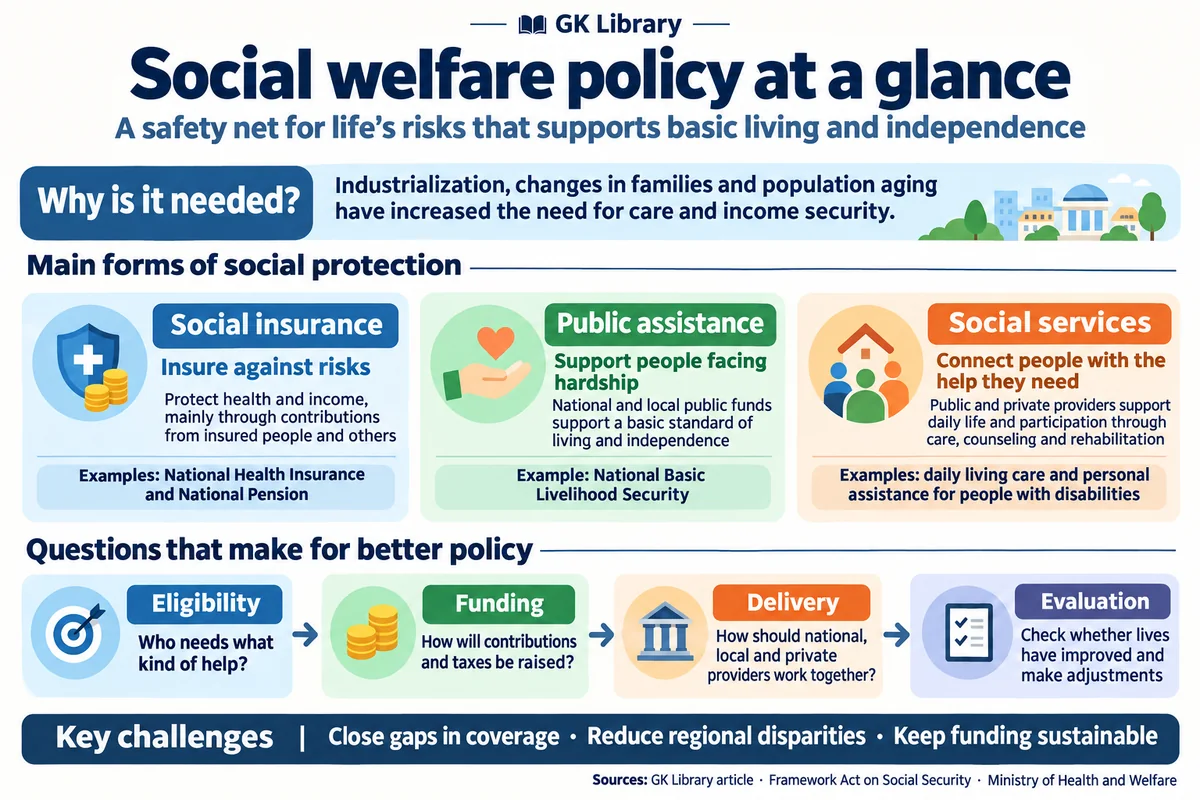
South Korea's social welfare policy operates across various areas to ensure citizens' quality of life. This policy is divided into five main components, each aimed at protecting socially vulnerable people and improving welfare for all citizens.
The National Health Insurance System
National Health Insurance is a core component of South Korea's social welfare policy, ensuring that all citizens can receive appropriate medical services. This system is funded through health insurance premiums paid by citizens and reduces the burden of medical expenses. Most citizens are enrolled in this system, which has greatly improved access to medical services. However, imbalances in medical infrastructure and problems with access to medical care in certain regions remain challenges.
The National Pension System
The National Pension system was established to ensure that citizens can lead stable lives in old age. When workers, self-employed people, and others pay pension insurance premiums for a specified period, they can receive a pension upon reaching a certain age. This plays an important role in ensuring citizens' financial security in an aging society. However, population aging and declining birth rates are increasing concerns about the financial sustainability of the National Pension. Pension reform is needed to address this, and public discussion on the issue is actively underway.
The Basic Livelihood Security System
The Basic Livelihood Security system guarantees a minimum standard of living for people with low incomes. It provides support for essential living expenses, including housing, food, medical care, and education, and serves as a social safety net. This system helps people with low incomes escape the vicious cycle of poverty. However, it has been criticized for leaving gaps in coverage because eligibility criteria are strict. Concerns have also been raised that the amount of assistance is insufficient to cover living expenses adequately.
Welfare Services for People with Disabilities
Welfare services for people with disabilities include various programs that promote their participation in society and independence. Medical assistance, vocational training, educational support, and other services improve the living standards of people with disabilities and help them live independently in society. In particular, policies to expand accessible facilities and promote employment for people with disabilities are being strengthened. However, improvements to the physical environment and social attitudes are still needed, and an environment must be created in which people with disabilities can live alongside others in society without discrimination.
Welfare Services for Older People
Welfare services for older people play a very important role in an aging society. Programs providing housing support, medical assistance, and help with participation in social activities are being operated, contributing to older people's financial security and quality of life. In particular, care services and long-term care facilities for older people are being expanded. However, poverty and social isolation among older people are worsening, making measures to address these problems urgently necessary. In addition, the increasing financial burden of welfare services as the older population grows is another challenge that must be addressed.
Analysis of the Current State of Social Welfare Policy
South Korea's current social welfare policy has brought about positive changes in several fields, but many challenges remain. The National Health Insurance and National Pension systems ensure stable lives for citizens, but disparities in the quality of medical services and the pension system's financial problems require continued discussion. The Basic Livelihood Security system protects people with low incomes, but gaps in coverage must be closed and assistance amounts adjusted to reflect actual needs. Welfare services for people with disabilities and older people are also expanding, but efforts are needed to overcome barriers in social attitudes and institutions.
Challenges and Development
South Korea's current social welfare policy supports citizens' welfare through various components. However, continued policy improvement is needed to respond to social changes such as population aging, low birth rates, and economic inequality. In particular, institutional improvements are needed to secure the financial sustainability of welfare systems and provide more comprehensive protection for socially vulnerable people. South Korea's social welfare policy will continue to expand its role as an important means of improving citizens' quality of life.
Problems in Implementing Social Welfare Policy and Ways to Address Them

Financial Problems and Ways to Address Them
The greatest challenge in implementing social welfare policy is the financial burden. Providing social welfare services requires a substantial budget, funded primarily through national and local taxes. However, slowing economic growth and changes in population structure are increasing fiscal pressure. New ways of securing funding are needed to address this. Specifically, alongside the efficient use of social welfare budgets, long-term fiscal plans are needed to secure stable welfare funding. Ways to minimize the budgetary burden through tax system reform and more efficient methods of providing welfare services should also be considered.
Improving the Efficiency of the Service Delivery System
Social welfare services are provided through cooperation among the central government, local governments, and private organizations. However, problems such as duplicate service provision and inefficient resource allocation can arise in this process. Addressing these problems requires a systematic approach that integrates the welfare service delivery system and improves the efficiency of resource allocation. Alongside a clear division of responsibilities between central and local governments, it is important to redefine cooperation with private organizations to reduce duplicate services and prevent resources from being wasted. Building a digitized service delivery system using information and communications technology to improve efficiency should also be considered.
Closing Gaps in Welfare Coverage
Current social welfare policy is designed mainly around people with low incomes, often excluding the middle class or certain other groups from welfare benefits. This is an important factor in creating gaps in welfare coverage. A more comprehensive and flexible welfare system is needed to close these gaps. In particular, a welfare system should be developed that reflects diverse living circumstances in addition to income criteria, allowing various groups to receive welfare benefits. Through this, it is important to ensure that the middle class can also receive appropriate welfare benefits when facing financial instability.
Improving Perceptions of Social Welfare
Public awareness and participation are essential for the successful implementation of social welfare policy. However, many citizens tend to regard social welfare as simply a benefit. To improve this perception, it is necessary to emphasize that social welfare is an essential element contributing to individuals' lives and national development. This requires publicity campaigns that communicate the importance of social welfare, as well as policies that motivate citizens to participate actively in social welfare systems. It is also important to change negative perceptions of welfare by spreading an understanding of welfare as a public good that benefits all citizens.
Technical Problems Associated with Digitalization
Social welfare services are being digitalized in line with the era of the 4th Industrial Revolution, but the digital divide makes it difficult for some groups to access these services. In particular, older people and people with low incomes often cannot use welfare services smoothly because they have limited access to digital devices or the internet. Policies to improve access to digital social welfare services are needed to address these problems. For example, distributing digital welfare devices, providing free internet access, and expanding digital education programs should reduce the information gap and enable all groups to benefit from digital social welfare.
Establishing a Policy Evaluation and Feedback System
Policy evaluation and feedback are important for ensuring the sustainability of social welfare policy. South Korea's current social welfare policy is often not evaluated systematically, or evaluation results are not sufficiently reflected in policy improvements. Addressing this requires systematizing the policy evaluation system and establishing a policy improvement process based on it. A process is needed to evaluate the effectiveness of welfare policies periodically and revise and supplement them based on the findings. It is also important to disclose policy evaluation results transparently and establish feedback mechanisms that reflect citizens' opinions.
Directions for Sustainable Social Welfare Policy
South Korea's social welfare policy faces various challenges, but ample measures can also be developed to address them. Fiscal pressure, inefficiencies in the service delivery system, gaps in welfare coverage, and technical problems are challenges that can be addressed through a systematic approach and continued improvement. Successfully implementing social welfare policy requires securing its sustainability and creating an environment in which all citizens can enjoy welfare benefits fairly.
Future Directions and Opportunities for Social Welfare Policy

A Transition to Comprehensive and Integrated Welfare
Future social welfare policy will pursue a more comprehensive and integrated approach encompassing diverse groups. It will develop beyond the existing focus on people with low incomes toward reflecting social diversity, including the middle class, foreign workers, and multicultural families. By providing a wide range of welfare services for all citizens in addition to protecting socially vulnerable people, this will help reduce social inequality and ensure fairer welfare benefits.
Emphasis on Holistic Welfare
Holistic welfare encompassing psychological and social support as well as financial assistance will be emphasized. In future society, issues such as mental health and social isolation will emerge as important welfare concerns alongside economic poverty. Accordingly, policies addressing mental health problems are expected to be strengthened, and multifaceted support will be provided to improve citizens' overall quality of life. The focus will be on providing welfare in a balanced way across citizens' physical, mental, and social well-being.
Strengthening Tailored, Community-Based Welfare
Moving away from a centralized welfare model, tailored welfare services that meet communities' characteristics and needs will become more important. A shift toward designing and implementing welfare policies according to each region's characteristics will ensure that community residents receive practical assistance. Strengthening public-private cooperation to distribute welfare resources effectively within communities and providing tailored solutions to problems that differ by region will be central to this approach.
Expansion of Digital Welfare Services
Digital welfare services using technological advances will expand further in line with the era of the 4th Industrial Revolution. Smart welfare systems will be built using technologies such as artificial intelligence, big data, and IoT to maximize the accessibility and efficiency of welfare services. For example, big data will make it possible to predict demand for welfare, while artificial intelligence will enable the provision of tailored services. This digital transformation will contribute particularly to reducing gaps in welfare coverage and enabling more citizens to receive prompt and accurate welfare services.
Securing Sustainable Funding and Economic Strategies
Securing funding is essential for the sustainability of social welfare policy. Various financial measures will be developed for this purpose, including tax system reform and the establishment of social welfare funds. There is also a strong possibility that self-sustaining welfare models will be developed through links with the social economy. Ways will be explored to build models that combine the welfare system with the social economy, including social enterprises and cooperatives, to supplement funding and provide sustainable welfare services.
International Cooperation and Compliance with Global Standards
Future social welfare policy will develop toward meeting global standards through cooperation with the international community. Through cooperation with international organizations and the introduction of advanced welfare models from abroad, South Korea's social welfare policy will develop into a more advanced and integrated model. Through this, South Korea will participate in global trends in welfare policy and implement policies that meet international welfare standards. These international exchanges will improve the quality of South Korea's social welfare policy and contribute to establishing it as a global welfare model.
The Evolution of Welfare Toward Innovation and Sustainability
Future social welfare policy will move in a more integrated and comprehensive direction. The development of welfare policies that reflect diverse groups and social demands will make it possible to realize welfare that benefits all citizens. In addition, various innovative elements, including digitalization, community-based welfare services, and compliance with global standards through international cooperation, will combine to establish a foundation for sustainable welfare policy.
South Korea's social welfare policy has undergone various changes and developments over decades, significantly affecting citizens' lives. Current social welfare policy plays an important role in improving citizens' quality of life, and several challenges remain for the successful implementation of these policies. Continued policy improvement and innovation are essential to address them.
Future social welfare policy should develop through a more comprehensive and integrated approach so that all citizens can enjoy tangible benefits. This will help reduce social inequality and contribute to building a fairer and more stable society.